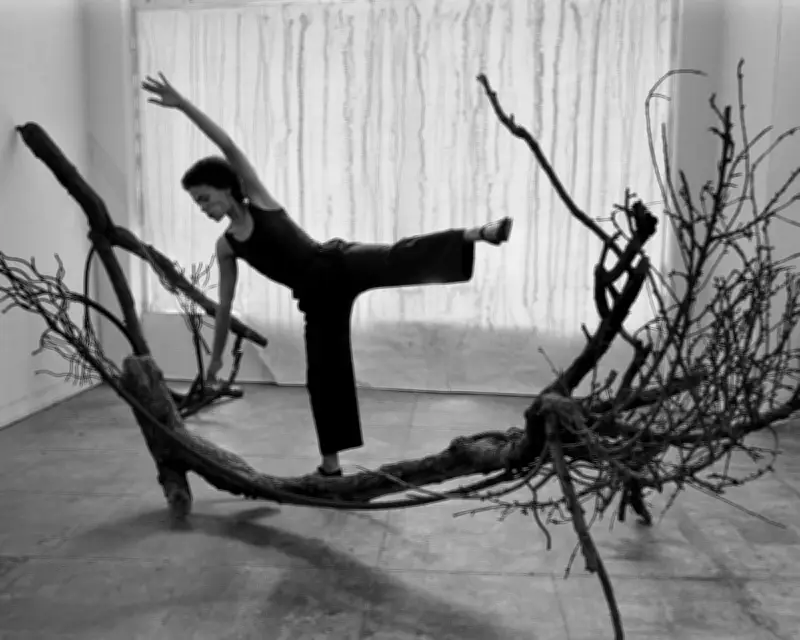
For five decades, American artist Maren Hassinger has crafted captivating site-specific sculptures through simple actions: tying square knots, twisting metal into organic forms, blowing breath into plastic bags, or walking through a room. The exhibition Maren Hassinger: Living Moving Growing at the Berkeley Art Museum and Pacific Film Archive (BAMPFA) presents her most significant retrospective to date, recreating celebrated works, documenting performances, and inviting audience participation.
The Magic of Simple Gestures
“There’s a kind of magic to her work,” said BAMPFA senior curator Anthony Graham. “The way she’s able to transform materials and really change the space that those things inhabit, to make us see them in a new way.” Hassinger’s art encourages viewers to perceive everyday objects differently. For instance, Untitled Rope features four thick industrial ropes arranged in loose macrame knots, seemingly ready to be pulled taut. “I always approach the sculpture thinking that it’s this latent performance,” Graham explained, suggesting that if viewers walked to either end and pulled, they would both separate and connect.
Knots as a Unifying Theme
Knots recur throughout Living Moving Growing. In Sign of the Times, strips of The New York Times are twisted and tied into massive ropes hanging from a gallery wall. Other works include enormous wire rope on the verge of being knotted, pink plastic bags tied off to hold breath, and Hassinger’s hands tying knots in her 2005 video Birthright. Graham noted that knots are both everyday and versatile: “Tying knots is a skill that is at once everyday, like tying one’s shoes, but could also be decorative, like macrame, or could be industrial, like the kinds of knots that are needed on ships.”

Breath and Community
Hassinger’s routine practices become tools for connection. In Love (Pyramid), she fills neon pink plastic shopping bags with her breath and a tiny love note, pinning them to the wall in a large sculpture. This piece requires ongoing care, as staff must refill deflated bags. “It’s really simple, just to take a deflated bag, fill it back up with air, and pin it right back on the wall,” said Graham, highlighting the ability to care for things and give them new lives.
Sign of the Times involves community workshops where participants create knotted newsprint ropes. When I toured the exhibit, long cords hung like jungle vines. Over time, as Hassinger leads monthly workshops, the sculpture will fill the entire gallery. These workshops break down hierarchies, allowing curators, experts, and audiences to interact as people. “On opening day, the theater was full of everyone just talking, everyone was kind of in the world together,” Graham recalled. “For Hassinger, that becomes the radical act, to create a caring world.”
Exploring Identity and Politics
Video pieces like Birthright and Daily Mask address race and identity. Birthright documents a first meeting with her uncle, tracing family history. Daily Mask shows Hassinger applying grease oil stick to her face, eventually covering herself in blackface. As a Black female artist emerging in the 1970s, she found community with other avant-garde artists like David Hammons, Franklin Parker, and Ulysses Jenkins.
A Milestone Retrospective
After moving to New York in 1984, Hassinger became director of the Reinhardt School of Sculpture at the Maryland Institute College of Art. Her reputation grew with the 2011 Hammer Museum show Now Dig This!, which highlighted Black artists in Los Angeles. This BAMPFA retrospective marks a major moment. “I hope that the show helps people slow down and pay closer attention to the world around them,” said Graham, “to see all of the small gestures and movements and materials that we’re constantly surrounded by that are full of meaning.”
Maren Hassinger: Living Moving Growing is on display at the Berkeley Art Museum until 29 November.