Inside a Neo-Nazi Gig: Leo Regan's Risky Two-Year Photo Project
In 1990, Leo Regan was balancing photojournalism with music photography to earn a living. At the time, he observed a disturbing rise in neo-Nazi music, driven by bands like Skrewdriver and the Blood and Honour movement. What began as a magazine feature quickly evolved into a much larger, two-year project, following these individuals across the country. This intensive work culminated in a book and a documentary, though it posed significant moral, ethical, and physical dangers.
Regan faced suspicion from the subjects but maintained honesty about his intentions. He made it clear he disagreed with their politics but had no hidden agenda. Collaborating with a Jewish publisher and editor on his book, Public Enemies, he encountered criticism from those who questioned his approach. However, Regan believes that as an artist, it is essential to explore and challenge uncomfortable realities. The camera, he notes, offers a unique privilege to enter other people's lives, and he aimed to move beyond the symbolic representation of skinheads to achieve genuine closeness.
The Chaos of a Milton Keynes Gig
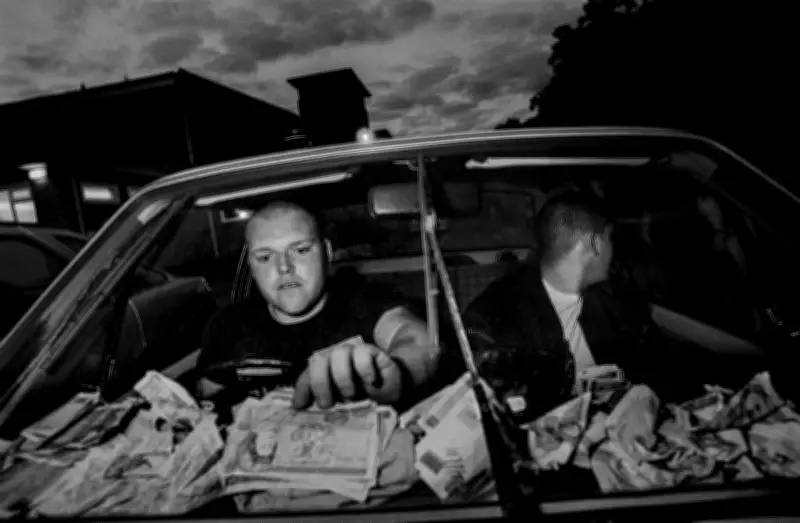
One particularly vivid moment from this project occurred in a posh area of Milton Keynes, where a group of skinheads rented a school hall under the guise of a 21st birthday party. In reality, it was a venue for a neo-Nazi gig, causing horror among the hall's renters. Police surrounded the building but allowed the event to proceed to prevent attendees from spilling onto the streets, which would have created more chaos.

Inside, the scene was mayhem, with frequent fights breaking out between factions or simply for amusement. In the midst of this, two skinheads approached Regan, wanting to escape the room to count the door takings. They told him, "Right, Leo, we're using your car to count up." Regan agreed, on the condition he could take a photograph. This image captures them counting cash, with the gig still ongoing in the background. Afterward, all attendees received a police escort to the nearest train station to ensure they left the neighbourhood swiftly.
Reflections on Danger and Legacy
After two years immersed in the neo-Nazi scene, Regan knew it was time to step away. He was becoming increasingly visible, with police and leftwing groups monitoring him due to his associations. His timing proved prudent, as the environment grew more paranoid and volatile with the emergence of the Combat 18 movement, a highly dangerous group. Some individuals he had documented ended up in Combat 18, receiving life sentences, while others took divergent paths, including renouncing their past beliefs.
Looking back, Regan acknowledges the incredible risks involved, often wondering, "Jesus Leo, what were you doing?" Yet, he stands by his work, driven by a belief in the need for communication and human connection, even in extreme contexts. He emphasizes that he does not seek to forgive or downplay the extremities he witnessed, which were deeply shocking and hateful. Despite occasional physical altercations, he managed to avoid serious harm by keeping a low profile during riots and violent outbreaks.
Regan's career highlights include the camera's ability to access hidden worlds in all their messy glory, embracing ambiguity and the unexpected. His advice to others is to keep pushing boundaries, as being in the right place often means going too far. His latest documentary, My Friend Lanre, is available on Channel 4 on demand, continuing his exploration of challenging subjects through visual storytelling.