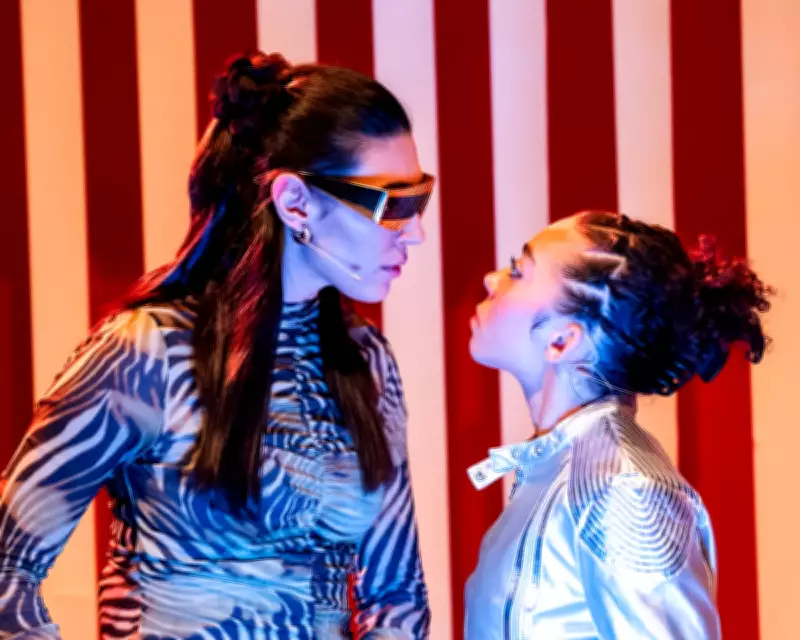
My Uncle Is Not Pablo Escobar Review: Colourful Latinx Bank Drama Loses Its Sting
Brixton House, London – A new production titled My Uncle Is Not Pablo Escobar bursts onto the stage with vibrant energy and a bold exploration of Latinx identity in contemporary Britain. However, this ambitious play, created by five writers, ultimately struggles to maintain its focus, as a fictional bank heist narrative overshadows its more compelling themes.
Striking Visuals and Identity Exploration
The play opens with a powerful visual sequence that immediately grabs the audience's attention. Four shadowy figures move to the pulse of techno beats, while options from the UK census flash around them. The list includes "White, Black, Asian, Mixed," but notably omits Latinx, highlighting the community's often overlooked presence in British society.
This is followed by a clever scene where actors stretch a giant hairband in different directions, symbolising the constant push and pull of belonging to two cultures at once. Questions arise: Notting Hill carnival or Rio carnival? Brazilian bikini or swimming costume? These moments effectively capture the nuanced experiences of Latinx immigrants navigating dual identities.

Later, the audience is engaged directly, asked to answer questions from the British citizenship test. The inevitable confusion and lack of correct responses underscore the complexities of assimilation and belonging, adding a layer of interactive commentary to the production.
A Convoluted Bank Heist Plot
Despite these strong opening sequences, the play shifts gears into a fictional narrative loosely inspired by the 2012 HSBC scandal. The story centres on Ale, played by Yanexi Enriquez, a young woman juggling A-level studies with early-morning shifts as a bank cleaner. Her sister Cata, portrayed by Lorena Andrea, visits from Chile and recruits Lucia, played by Cecilia Alfonso-Eaton, to go undercover and investigate the bank's exploitative practices.
Joined by fellow cleaner Honey, played by Nathaly Sabino, the trio embarks on a Scooby-Doo-esque bank heist, racing to complete a data breach during a lavish party. While there are moments of tension and inventive uses of props, such as a toy chihuahua and a plastic mask, the plot feels like a mesh of disjointed ideas rather than a fluid narrative.
Creative Ambition and Lack of Focus
The play is credited to five writers: Valentina Andrade, Elizabeth Alvarado, Lucy Wray, Tommy Ross-Williams, and Joana Nastari. Occasionally, their voices are heard in voiceover, adding to the production's layered but sometimes chaotic feel. Directed by Wray and Ross-Williams, the show attempts to weave together sibling tension, feelings of not fitting in, and an immigration subplot introduced at the last minute.
However, these elements fail to coalesce into a unified message. The play's ambition is clear—it seeks to shed light on the experiences of Latinx people, the fastest-growing population in the UK—but it lacks a central focus that ties its various threads together.
Final Verdict
My Uncle Is Not Pablo Escobar is a production with undeniable creative spark and important themes. Its visual metaphors and interactive moments offer poignant insights into Latinx identity in Britain. Yet, the convoluted bank heist plot detracts from these strengths, resulting in a play that feels fragmented and unfocused.
While the need for more Latinx stories on British stages is urgent and undeniable, this particular effort, despite its colourful energy, ultimately loses its sting. The play runs at Brixton House, London, until 3 May, offering audiences a glimpse into a community's struggles, even if it falls short of delivering a cohesive narrative.