Hurvin Anderson's Retrospective: A Journey Through Memory and Identity
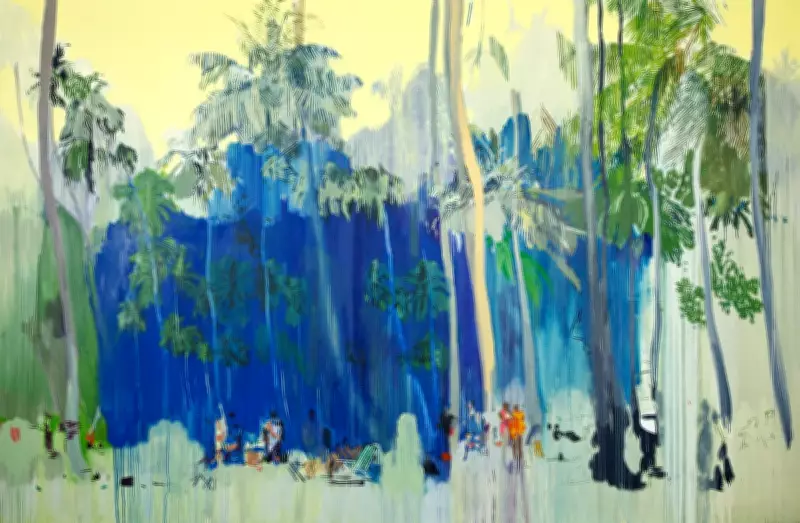
Lush, humid, tropical beauty defines Hurvin Anderson's Maracas III from 2004, setting the tone for a deeply introspective exhibition at Tate Britain in London. This show, which runs from 26 March to 23 August, presents a haunting and hazy collection of figurative paintings that explore the artist's Black British and Jamaican heritage with a fragile and unresolved intensity.
Clashing Contrasts and Unresolved Conflicts
Anderson's world is marked by stark contrasts: us and them, then and now, concrete and jungle, acceptance and rejection. Growing up in 1990s Birmingham, he began painting from family snapshots and found photographs, creating images where figures seem to melt into backgrounds or turn into ghosts. For instance, in Hollywood Boulevard (1997), a woman in a patterned dress blends into the wallpaper, while his adult sister sits beside her childhood self, blurring the lines between past and present.
These works challenge the notion of nostalgic truth, as geographic distance and temporal shifts become intangible through Anderson's brushstrokes. A large painting of his sister and niece on a frozen lake in Canada leaves their faces featureless, symbolising a sense of not belonging. Similarly, his depiction of Wyndley swimming pool in Birmingham transforms it into a modernist fever dream, viewed from a distance as if inaccessible.

Sanctified Spaces and Political Undertones
The barbershop emerges as a sanctified place in Anderson's oeuvre, where Black individuals can belong without rejection. He paints it both empty and serene, like a church, and occupied, with clients' faces reflected in mirrors and walls adorned with photos of Martin Luther King Jr and Malcolm X. One poignant portrait shows a man alone in a barber's chair, head bowed as if in prayer, highlighting themes of community and solitude.
In the early 2000s, Anderson shifted focus to Trinidad and Tobago, capturing iron security grilles and chain link fences that frame views while excluding outsiders. Paintings like Country Club: Chicken Wire (2008) depict country clubs behind fences and hotels being reclaimed by jungle, reinforcing physical divisions. Unlike Peter Doig, whose work also deals with memory and the Caribbean, Anderson's approach is deeply political, addressing slavery, colonialism, and post-colonial realities. He paints Black spaces with Black figures and white spaces consumed by nature, reflecting on Jamaica's history of exploitation.
Reprocessing Memories Through Art
Anderson repeatedly reworks the same scenes—such as barbershops, security grilles, and a woman against wallpaper—creating a sense of stumbling through someone else's memories. This repetition mirrors how memories evolve as we age, with the artist reprocessing his past experiences. In one room, five paintings of the same concrete staircase in a mutating jungle showcase his mastery of colour, with bright blues, throbbing purples, and deep greens drawing viewers into a mesmerising visual experience.
His technique combines geometric, modernist elements with washes of dripping, gestural colour, blending free-hand figuration with minimalist grids. The result is beautiful yet anchored by an unresolved sense of conflict, questioning the need for resolution when the painting itself is so compelling.
Conclusion: A Beautiful and Haunting Exhibition
Hurvin Anderson's retrospective at Tate Britain is a powerful exploration of identity, memory, and history. Through his hazy, heat-drenched paintings, he invites viewers to grapple with clashing contrasts and political legacies, leaving them with more questions than answers. The exhibition's beauty lies in its ability to convey the fragility of belonging and the haunting presence of the past, making it a must-see for art enthusiasts and cultural historians alike.