Understanding Holi: The Hindu Festival of Colors
Holi, widely recognized as the Hindu festival of colors, stands as a joyous annual celebration marking the arrival of spring, imbued with deep cultural and religious significance. Typically observed in March across India, Nepal, other South Asian nations, and diaspora communities worldwide, this festival honors love and symbolizes a period of rebirth and rejuvenation. It serves as a time to embrace positivity and release negative energy, fostering unity and happiness among participants.
The Origins and Mythology of Holi
Holi traces its roots to Hindu mythology, with various tales explaining its traditions. In many regions of India, large bonfires are lit on the eve of Holi, known as Holika Dahan, to signify the destruction of evil and the triumph of good. One prominent story involves King Hiranyakashipu, who demanded worship from all, including his son Prahlad, a devotee of Lord Vishnu. When Prahlad disobeyed, the king ordered his sister Holika, immune to fire, to carry the child into a bonfire. However, Prahlad's devotion protected him, leaving him unharmed while Holika perished, illustrating the victory of faith over malice.
In southern India, the event is called Kama Dahanam, commemorating Lord Shiva burning Kamadeva, the god of love, with his third eye. This act symbolizes the destruction of lust and earthly attachments for spiritual elevation, preceding the colorful festivities. Additionally, Holi is linked to Lord Krishna and his love for Radha, as well as his playful interactions with devotees known as gopikas, celebrated for their unconditional devotion.

How Holi Is Celebrated
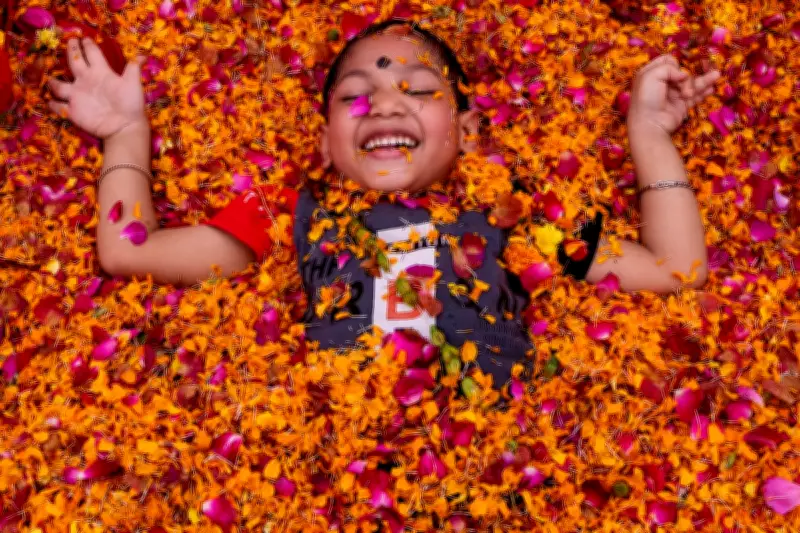
On the day of Holi, streets and towns transform into vibrant spectacles as people gather to throw colored powders into the air. Celebrants, often dressed in white, engage in playful battles using colored water balloons, squirt guns, and powders, creating a kaleidoscope of pigments. The air echoes with cries of "Holi hai!" meaning "It's Holi!" as music, dancing, and feasting ensue. Bollywood films have romanticized and popularized these traditions over decades, enhancing its global appeal.
The colors used during Holi carry symbolic meanings:
- Blue represents Lord Krishna's skin.
- Green symbolizes spring and rebirth.
- Red denotes marriage or fertility.
- Red and yellow together signify auspiciousness in rituals.
Special foods are integral to the celebration, with gujia, a flaky, deep-fried sweet pastry filled with milk curd, nuts, and dried fruits, being a popular treat. Thandai, a cold drink made from almonds, fennel seeds, rose petals, poppy seeds, saffron, milk, and sugar, is also commonly enjoyed at Holi parties.
Holi in the Global Diaspora
In North America and other countries with Hindu populations, Holi is celebrated through Bollywood parties, parades, and various public and private gatherings. Many U.S. temples observe Holika Dahan on dates aligning with the full moon, such as February 2 or 3 in 2026, coinciding with rare events like total lunar eclipses. Hindu temples and community centers often organize cultural programs, friendly cricket matches, and other festivities to mark the holiday, fostering community spirit and cultural preservation.
Holi's timing is based on the Hindu luni-solar calendar, falling on the last full moon day of the month of Falgun, typically in March. In 2026, it will be celebrated on March 4, highlighting its connection to lunar cycles and seasonal change.