Frank Bowling's Artistic Journey from Social Commentary to Abstract Freedom
Frank Bowling's Journey from Social Art to Abstract Freedom

Frank Bowling: Seeking the Sublime Review – A Path from Constraint to Liberation

In 1961, when Frank Bowling created his earliest works featured in this compact yet profoundly illuminating exhibition, the art world imposed rigid dichotomies upon painters. Artists were expected to align with either political activism, using their craft to advocate for societal improvement, or formalist principles, where art was judged solely on aesthetic merit. They had to choose between European or American traditions, and perhaps most confiningly, they were categorized as either a Black artist with a presumed duty to represent specific communities or simply an artist—a label typically reserved for white, often male, creators who could address universal themes. From the outset, this young British-Guyanese painter demonstrated a clear aversion to these limiting binaries.

Early Struggles and Attempts to Conform

The exhibition's initial pieces reveal Bowling's tentative efforts to navigate these expectations. 4 Horsemen of the Apocalypse, produced during his time at the Royal Academy in London, appears tailored to meet academic standards. Featuring a screaming black face amidst a chaotic scene of tormented figures, the work is contextualized by wall text linking it to the 1961 assassination of Patrice Lumumba, the former prime minister of the Democratic Republic of the Congo. This positions Bowling as both a postwar existentialist confronting historical horrors and a Black artist engaging with postcolonial narratives. Similarly, Beggar No 5 (1962–63) heavily echoes Francis Bacon's style, risking dismissal as derivative were it not for its thematic focus on Caribbean themes of labor and hardship, which Bowling once described as "cane-cutting and suffering."

However, these early paintings ultimately fall short. The Bacon-inspired aesthetic proves ill-suited for socially conscious art; just as one would not hire Bacon for a wedding portrait, Bowling's adoption of this mannered approach lacks the macabre allure that defines the master's work. Instead, they highlight a gifted artist grappling to find his authentic voice amidst external pressures.

Wide Pickt banner — collaborative shopping lists app for Telegram, phone mockup with grocery list

Breaking Through with Swan and the Shift to Abstraction

A pivotal moment arrives with Swan (1964), a small painting depicting a flailing white form trapped within an iridescent grid. This piece can be interpreted in two ways, reflecting the either/or logic of the era. Viewed as pure abstraction, its discordant forms, brittle colors, and claustrophobic composition evoke a palpable sense of panic and confinement. Alternatively, the wall text reveals it was inspired by a swan caught in an oil slick on the Thames, inviting a narrative reading as a symbol of transformation and dual identity—perhaps echoing Swan Lake—where imposed "blackness" hinders flight.

The interdependence of these readings underscores that no perspective is exclusive. Regardless of interpretation, Swan signals an impasse demanding radical change. By 1966, Bowling left London for New York, reinventing himself under the influence of critic Clement Greenberg, who championed art as a purely aesthetic domain, free from political or identity-based constraints. This marked a dramatic shift from Bowling's earlier statement to critic John Berger in 1958, where he expressed a desire to "paint my people: that is black people."

Liberation and Mastery in Abstract Works

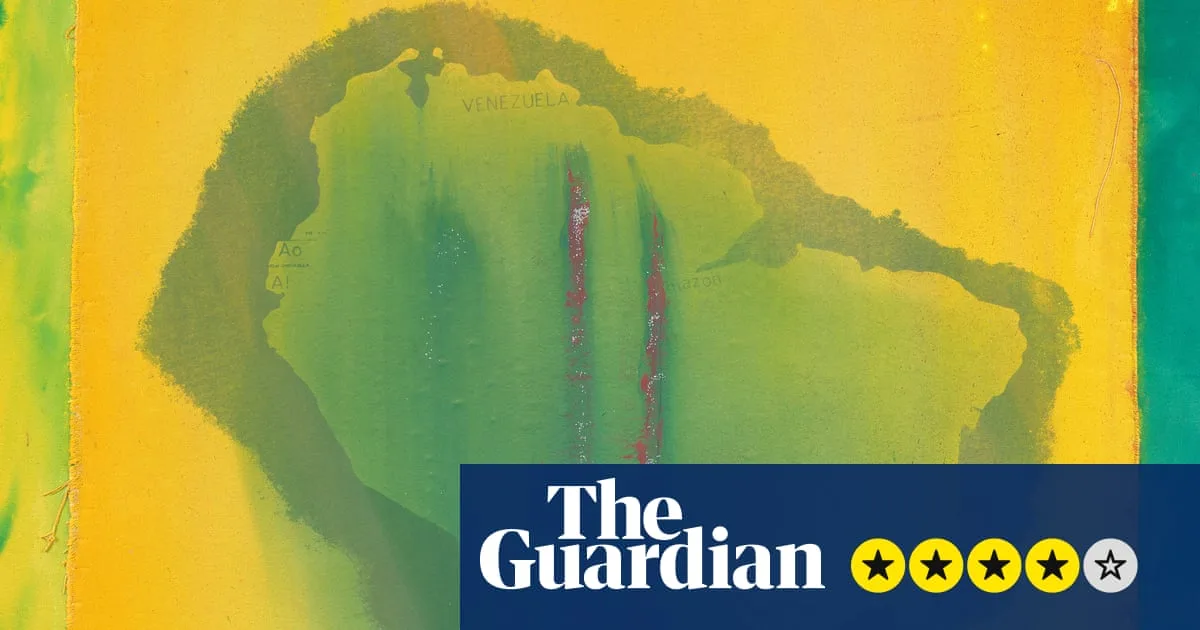
Bowling's newfound freedom is vividly displayed in Lenoraseas (1976), a vertical stripe of poured paints in pinks, yellows, whites, and purples. Created by manipulating a canvas on a movable board, it showcases his exceptional skill as a colorist, producing mesmerizing optical effects. Yet, this abstraction holds deeper layers: its textured surface resembles a mountainous landscape, and its title references Lenora in Guyana, where the Essequibo River meets the Atlantic Ocean.

Thus, Lenoraseas operates simultaneously as an abstract painting and a depiction of a river, bridging the sublime landscapes of Constable and Turner with the Platonic abstractions of Barnett Newman and Helen Frankenthaler. It serves as a document of personal and historical journeys, with the river symbolizing ancestral crossings. Bowling's work affirms that art can embody multiple meanings at once, defying simplistic categorization.

Pickt after-article banner — collaborative shopping lists app with family illustration

Transforming Tradition in Pondlife (After Millais)

The exhibition's most remarkable piece, Pondlife (After Millais), reimagines John Everett Millais's narratively dense Ophelia into a hazy, impressionistic atmosphere. Through fluid brushwork that blends greens into blues and reds into golds, Bowling creates a technically sophisticated composition that draws the viewer's eye inward. However, this serene scene is subtly disrupted by found objects—fabric patches and metallic fragments—painted onto the canvas, evoking shipwreck debris stirred by a storm.

Like the bodies of water he frequently references, Bowling's finest paintings resist fixed identities, connecting disparate places and cultures while suspending history in their depths. They cannot be easily pinned down, reflecting his lifelong pursuit of artistic freedom beyond societal constraints.

Frank Bowling: Seeking the Sublime is on display at the Fitzwilliam Museum in Cambridge from 27 March to 17 January 2027, offering a comprehensive exploration of his evolution from socially conscious beginnings to abstract liberation.