Sage Ni'Ja Whitson's Exhibition Memorialises Black Trans Deaths Across the US
Between 2021 and 2025, Black nonbinary artist Sage Ni'Ja Whitson embarked on a profound journey across the United States, visiting 91 locations in 15 states where trans, gender nonconforming, or intersex individuals had died, either by murder or suicide. At each site, Whitson conducted a personal ceremony to bear witness to the tragedies that occurred there. "It was very challenging in ways that I'm continuing to mend from and rest with," they said. "It is not 'inexpensive' on my body and spirit. That cost I knew would be there."
These Waking Glories: A Powerful Solo Show
Currently on display at the California African American Museum (CAAM) in Los Angeles is These Waking Glories, Whitson's solo exhibition featuring a variety of photographs and other artworks created in conjunction with these ceremonies. This moving and important exhibition serves as a powerful bearing of witness to the violence that continues to ravage racial and gender minority communities, offering an experience that demands attention and reflection.
Central Pieces: 90 Pedestals of Remembrance
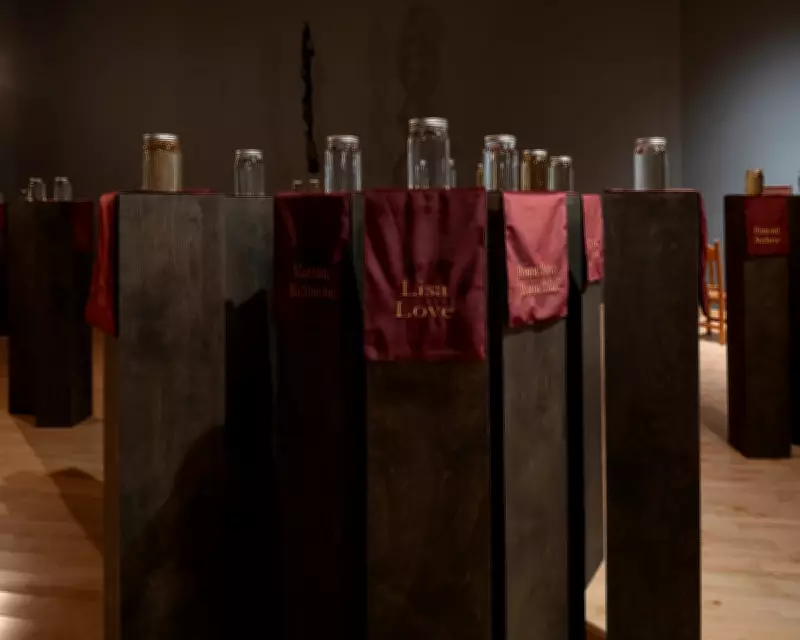
One of the central pieces in These Waking Glories is a series of 90 pedestals commemorating the individuals Whitson is remembering. Each pedestal stands exactly 61 inches tall, a deliberate choice to encourage audiences to slow down and interact with them respectfully. Atop each pedestal is a jar containing essences developed from materials gathered at the corresponding site, along with a velvet stole bearing the name of the deceased. Two pedestals bear no name, representing unknown individuals who have passed.

Whitson explained, "It was an important decision so that there would be a reverential distance. I was thinking about the way that shrines in the Yoruba tradition are created, some of which are not accessible to the public or uninitiated members of community."
Ceremonial Practices and Site Visits
For each ceremony, Whitson collected various materials from the sites, using their training in herbalism to transform these gleanings into liquid essences. The sites visited included Los Angeles, Chicago, Cleveland, the Bronx, Harlem, Jacksonville, San Francisco, Montgomery, Phoenix, Atlanta, and Baton Rouge. During these visits, Whitson performed rites such as checking in with the land for permission, making offerings of herbs, sage, tobacco, and other materials, and praying through words, songs, or meditations.
"I developed protocol that was mostly repeated at each site, with variations based on what the spirit called at each space," they shared. "There was praying in those locations, which sometimes looked like words out loud, sometimes songs, sometimes quieter meditations, to be invoking the names of a transcestor outlaw out loud."
Challenges and Community Engagement
Whitson's practice sometimes brought them into potentially dangerous situations. For instance, while honoring Bonaire 'Bonnie' Black, a trans woman who died under uncertain circumstances in an Atlanta parking garage, Whitson attracted unwanted attention and had to leave prematurely. "That site, like many others, was active with folks in their day-to-day," they said. "I had to move quickly because I was afraid to be noticed by folks who were there to do their business. It was just less safe for me to be there."
An essential part of Whitson's work involved dialoguing with local transgender communities. Whenever possible, they facilitated story-sharing circles where Black trans, gender nonconforming, and intersex people could share their histories of survival. These gatherings often intersected with forms of trans resilience, such as DJ parties, fundraisers for unhoused individuals, and advocacy work. "It really became important that the work needed to celebrate the lives and stories of the living, while also honoring the losses," they said. "It became a beautiful network of people, and it was just heartwarming to me."

Timeliness Amidst Political and Social Context
When Whitson began these ceremonies in 2021, they did not anticipate how timely These Waking Glories would become. The exhibition emerges at a moment when federal and state governments are waging oppression against trans people, amid what the Human Rights Campaign labels an "epidemic" of violence, disproportionately affecting Black trans women. "Now when trans people are experiencing a government attempt to erase our identities, it's another kind of death, in addition to the epidemic of murders," said Whitson. "It's the systemic erasure by this federal government. It feels more than important to be doing this now, and I hope it's done in a way that it's not about the spectacle or glorifying the violence of their losses but to really center the spirit of memory, and to bring people together."
Artistic Growth and Institutional Support
For Whitson, These Waking Glories has been a transformative project, helping them grow as an artist. As part of a residency at CAAM since 2022, Whitson has advanced in this and other artistic endeavors. "This project for sure gifted me the courage to stand and commit to the vision of a work. It called me to value the capital-C ceremony of the work," they said. "I've learned the value and beauty of what can happen when that vision is respected and honored."
Cameron Shaw, CAAM's executive director and chief curator, emphasized the importance of supporting such work. "Supporting this work through CAAM's residency program reflects the Museum's ongoing commitment to Black artistic practices that hold complexity, expand boundaries, and create frameworks for healing," Shaw said.
Continuing the Work for Community Survival
Despite the emotional and financial toll of crisscrossing America over several years, Whitson remains deeply committed to their mission. They view building spiritual traditions as indispensable work for the survival of their community. "Building the spiritual vitality of trans communities – of Black trans communities – is worthy work that's important to our survival," they said. "It's work that I want to continue." These Waking Glories is on display at the California African American Museum until 5 April.