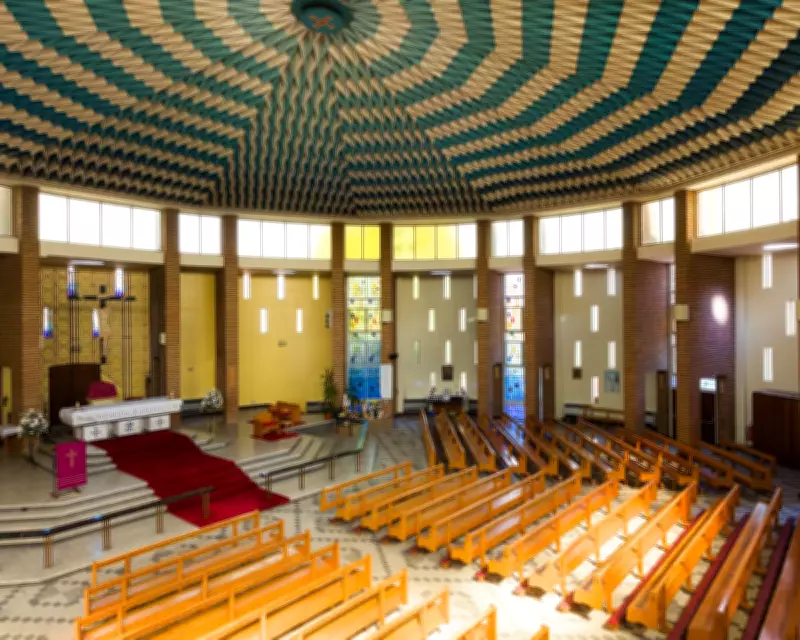
The architectural world mourns the loss of Desmond Williams, a visionary architect who passed away at the age of 93. Williams was celebrated for his innovative designs of modernist Catholic churches, which uniquely combined liturgical functionality with bold architectural ambition and artistic partnerships. His legacy includes four listed churches, a testament to his significant impact on postwar British architecture.
Innovative Designs for a Changing Church
In the mid-20th century, growing Catholic congregations and the liturgical reforms of the Second Vatican Council created a demand for new church buildings. These changes emphasised communality and intimacy, leading architects like Williams to move away from traditional axial plans. Instead, he embraced more inclusive and spatially dynamic forms that actively engaged worshippers in the liturgical experience.
St Mary's Church in Dunstable
Completed in 1964, St Mary's church in Dunstable, Bedfordshire, stands as a prime example of Williams's work. The building features a circular plan that envelops the congregation, drawing them closer to the altar. Its most striking element is a tetrahedral ceiling, composed of 600 aluminium pyramids bolted together in alternating bands of blue and white. This intricate design, reminiscent of origami, was inspired by Williams's visits to King's College Chapel in Cambridge, echoing its medieval fan vaulting in a modern context.

Historic England has listed St Mary's, noting it as an important early work in Williams's career, highlighting his innovation during a period of great change in ecclesiastical architecture. His other grade two-listed Catholic churches include St Dunstan in Birmingham, St Michael in Wolverhampton, and St Augustine in Manchester, all completed in 1968.
Collaboration and Artistic Integration
Williams's practice was deeply rooted in collaboration with artists. At St Augustine's in Manchester, he worked closely with ceramic artist Robert Brumby, whose sculptural reredos, along with Pierre Fourmaintraux's abstract stained glass, enriched the architectural space. This interdisciplinary approach created unified and powerful liturgical environments that embodied the progressive spirit of 1960s British modernism.
Early Life and Influences
Born in Whalley Range, Manchester, in 1932, Williams was the son of Sydney Williams, a draughtsman for submarine electrical systems, and Eleanor, a devout Catholic. Educated at St Bede's College in Manchester, his interest in architecture blossomed early. A teenage visit to Quarr Abbey on the Isle of Wight left a lasting impression, with its simple brick interior and harmonious proportions inspiring his fascination with the relationship between space, sound, and spiritual experience.
Further inspiration came from a cycling trip through East Anglia, where he explored Norwich Cathedral and other historic buildings. Williams studied architecture at the University of Manchester School of Architecture, alongside contemporaries like Donald Buttress, who later became the surveyor of the fabric of Westminster Abbey.
Career and Professional Contributions
After qualifying, Williams briefly partnered with Arthur Farebrother in Altrincham, securing early commissions for churches and schools. His first major project as project architect was St Catherine of Siena in Didsbury in 1957, designed in a Romanesque basilica style. At just 28, he established his own practice in Manchester, building strong ties with the Department of Education and Science, which led to numerous educational projects.
Williams designed many schools and colleges, including a major extension to Ampleforth College, a Catholic boarding school founded by Benedictine monks. His educational work was noted for its rigorous planning, adaptability, and efficiency, balancing pedagogical goals with practical constraints.
In 1968, he formed a partnership with the Liverpool-based firm W & JB Ellis, which evolved into Ellis Williams Architects, now with studios in London, Berlin, and across northern England. Later in his career, Williams focused on consultancy work, particularly in educational buildings, continuing until the mid-1990s.

Influence Beyond Practice
Williams played a significant role in the wider architectural profession. He served as chair of RIBA's north-west region, president of the Manchester Society of Architects, and acted as an adviser to the OECD on educational development. He was also RIBA's design co-ordinator for forums on education and higher education, known as a generous mentor who supported young architects.
In 1988, he was appointed OBE for his contributions. Despite his professional achievements, Williams remained modest, enjoying retirement with interests in aviation and orchestral organ music.
Personal Life and Legacy
Williams is survived by his second wife, Susan (née Richardson), whom he married in 1988, and four children from his first marriage to Felicity (née McDonnell) in 1964, which ended in divorce. His children are Dominic, Sarah, and twin sons Andy and Jez. Desmond Williams's work continues to inspire, leaving a lasting mark on modernist architecture and Catholic church design.