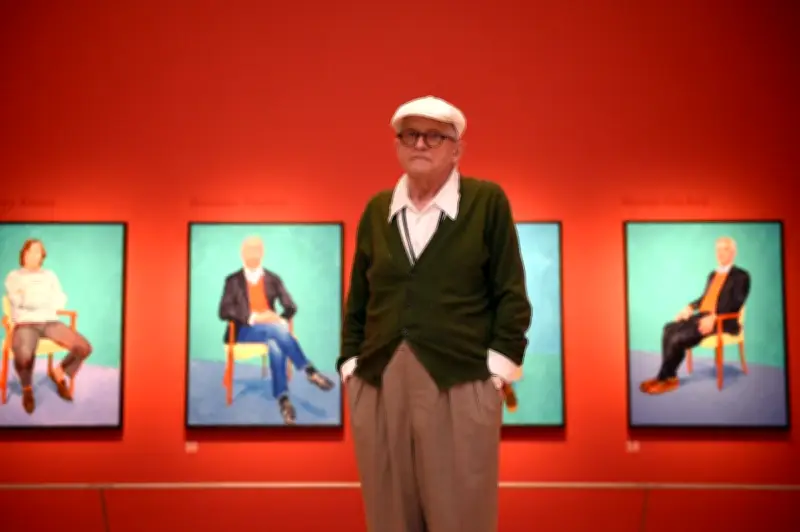
From the azure blue swimming pools of California to the lush green landscapes of his native Yorkshire, David Hockney's art was filled with colour and light. Over more than seven decades, his joyful, optimistic vision made him one of the world's most popular artists, responsible for some of the most memorable images of the 20th and 21st centuries.
In 2018, his painting Portrait of an Artist (Pool with Two Figures) sold at auction in New York for $90 million (£70 million), smashing the then-record for a work by a living artist. Long seen as a 'national treasure', with his huge round spectacles, gentle Yorkshire burr, and bleached blond hair—replaced in later years by a series of flat caps—his image was almost as distinctive and familiar as his paintings.
Early Life and Career
David Hockney was born in Bradford on July 9, 1937, the fourth of five children in a working-class family. His father Kenneth was an accountant's clerk who painted 'Ban the Bomb' posters for local peace marchers, while his mother Laura was a Methodist and strict vegetarian. At age 11, he decided he wanted to be an artist, an ambition not encouraged by his teachers at Bradford Grammar School, but with parental support, he entered the local art college.

From there, he went to the Royal College of Art in London, where he was mocked for his Yorkshire accent. For his part, he was not impressed by the abilities of his tormentors. 'I'd look at their drawings and think if I drew like that I'd keep my mouth shut,' he later recalled. There was a memorable run-in with the college authorities when he was warned he could not graduate—in part because he had not done enough life drawings. He responded by producing Life Painting for a Diploma, featuring a male nude copied from an American body-building magazine alongside an anatomical study of a human skeleton. Faced with such overwhelming talent, the college backed down, awarding him the prestigious gold medal for painting, which he collected in a gold lame suit.
Move to California
Clearly a superstar in the making, he featured in the famous Royal Society of British Artists Young Contemporaries exhibition of 1961, showcasing the new wave of British pop art alongside artists like Peter Blake. While associated with the movement, his own style drew on expressionist elements reminiscent of Francis Bacon. However, his move to Los Angeles in 1964 brought the decisive shift in his work that truly made his reputation.
In contrast to drab, buttoned-up post-war Britain, he was intoxicated by the brilliant sunlight and hedonistic freedoms of California. 'The moment I got to America I thought 'This is the place',' he later recalled. 'I was drawn towards California, which I didn't know… because I sensed the place would excite me. No doubt it had a lot to do with sex.' After taking a job teaching drawing at the University of California, Santa Cruz, he began a relationship with 17-year-old student Peter Schlesinger, who became his muse.
In this period, influenced by the hard clean lines and vivid colours of American pop artists like Roy Lichtenstein, he produced some of his most famous works. Using the comparatively new acrylic medium, he created striking images of swimming pools—most notably A Bigger Splash—which seemed to encapsulate the allure of the 'promised land'. He also painted one of his best-known portraits, Mr and Mrs Clark and Percy, depicting friends Celia Birtwell and Ossie Clark with their pet cat.
Artistic Innovation
Restlessly creative, Hockney was fascinated by technology. In the 1980s, he made large-scale photo collages using Polaroid prints, such as Pearblossom Highway, depicting a desert road with 850 Polaroids taken from different angles, creating a cubist effect. In the 2000s, he used the Brushes app to create hundreds of pictures on his iPad. He also explored the theory that old masters like Vermeer and Caravaggio used mirrors and lenses, acquiring a camera lucida to produce very fast, accurate pencil portraits.

His subjects ranged widely, from still lifes and landscapes to portraits of friends, family, and his pet dachshunds, as well as stage designs for theatre and opera. A lifelong smoker, rarely seen without a cigarette, he railed against 'little Hitlers' who sought to clamp down on the practice. In his 80s, he had badges made with the slogan 'End bossiness soon'.
Return to Yorkshire
In the 1990s, Hockney began returning more regularly to Yorkshire, where a friend encouraged him to capture the local surroundings. He initially did so from memory, completing Garrowby Hill in 1998. Despite his years in the States, he insisted he had always felt 'very English'. 'I'm from the peasantry, frankly. But it makes you connect with the land and because I found this subject, at my age it's terrific, you stick with it and get turned on,' he said.
He eventually returned full-time, settling in the seaside resort of Bridlington and painting the surrounding countryside en plein air using oils and watercolours. His works included the massive Bigger Trees Near Warter, an oil painting over 12 metres wide made up of 50 panels, completed in 2007. In 2012, an exhibition at the Royal Academy focusing on his Yorkshire landscapes, A Bigger Picture, attracted 600,000 visitors, confirming his status as the country's best-loved living artist.
Later Years and Legacy
Tragedy struck in 2013 when his 23-year-old assistant, Dominic Elliott, died after drinking household drain cleaner at Hockney's home. An inquest heard Hockney, who had become increasingly deaf, slept through the incident. In the aftermath, he returned to California.
Having once declined to paint Queen Elizabeth II, claiming he was 'too busy' painting England, he designed a stained-glass window at Westminster Abbey in her tribute. Unveiled in 2018, it featured Hawthorn blossom from his native Yorkshire. During the Covid-19 pandemic, he retreated to a farmhouse in Normandy, where he set up a studio and advocated for smoking, suggesting it could ward off the disease.
At age 87, the Fondation Louis Vuitton in Paris staged the largest exhibition of his art, with over 450 works filling the entire museum. His health was in serious decline, requiring round-the-clock nursing care, but he remained upbeat. He once said his hearing loss had sharpened his work: 'If you lose one sense, you gain other senses, and I feel I could see space clearer.' He never lost his love of painting, continuing to work four to six hours a day. 'I'm happiest when I'm painting,' he said. 'If I can paint every day I don't care about anything else.'