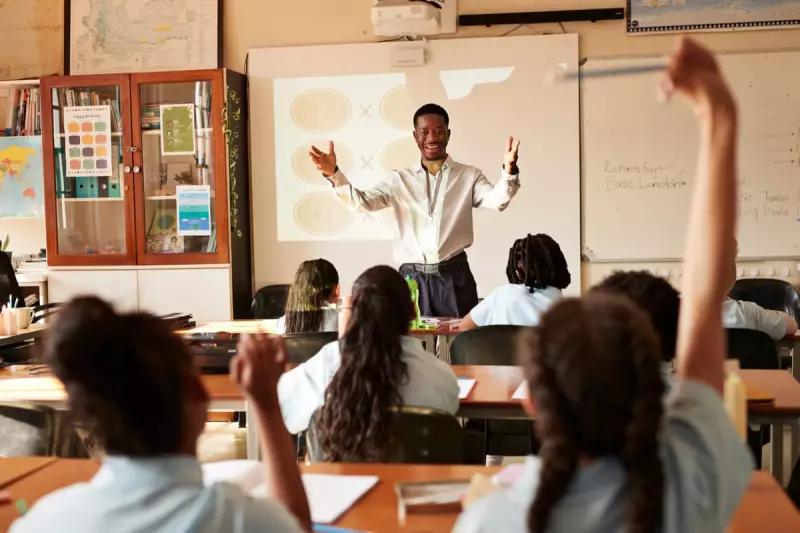
When broadcaster and writer Adrian Chiles agreed to spend a day at a secondary school in Birmingham, he anticipated a rewarding experience. What he discovered instead was a series of unsettling truths about the learning process that left him both enriched and completely exhausted.
The Deep Learning Day That Revealed Shallow Retention
"I like being in Birmingham and I like going to schools," Chiles explains about his decision to accept the invitation. Only the day before his visit did he properly read the details and realise with horror that he was scheduled to lead what the school called a Deep Learning Day. "What could they learn from me? Moreover, what could they learn deeply from me?" he questioned.
This experience proved consistent with his previous school visits. "Whenever I go to schools, I always come away feeling that I've learned a lot more from the experience than any students have learned from me," he observes. The intensity of the day left him in awe of both teachers and students. "I mean, a whole day of learning, deep or otherwise, is exhausting. Whichever side of it you're on, it's a lot."

The Staffroom Notice That Changed Everything
What truly unsettled Chiles was a notice he spotted on the staffroom wall. While acknowledging that many teachers might consider this a tired maxim, the statistics presented challenged his fundamental assumptions about communication and education.
The notice outlined retention rates as follows:
- Learners remember 10% of what they read
- 20% of what they hear
- 30% of what they see
- 50% of what they see and hear
- 70% of what they discuss with others
- 80% of personal experience
- 90% of what they teach someone else
Professional Implications for a Broadcaster and Writer
For someone whose career depends on people remembering what he writes and says, these statistics proved particularly disheartening. "Dispiriting as it is for someone who earns a crust writing things for people to read, and talking about things on the radio," Chiles notes, "only to find out that 90% of the former and 80% of the latter aren't recalled at all."
He reflects on the implications: "That's a lot of wasted ink and keyboard taps and airtime. Disappointing." Even his television background offered little comfort, with the combined audio-visual format scoring only moderately better in retention terms.
"I do occasionally feel the need to tell myself that radio and writing are nobler arts which linger longer than television in the minds of the audience," he admits. "Hmm. Not according to this they don't."
The Social and Psychological Dimensions of Learning
The higher retention rates associated with discussion and personal experience particularly fascinated Chiles. "They rather explain the power of the modern echo chamber," he suggests. "If 70% of what you discuss with like-minded people sticks, as well as 80% of your personal experience – what's become known, without irony, as 'your truth' – you can see how your truth becomes the truth."
Most striking of all was the 90% recall rate for information people teach to others. "The strikingly high 90% recall you have of the point of view – valid or otherwise – that you've so diligently inflicted on others," Chiles observes, highlighting how teaching others solidifies one's own understanding and retention.
"Bit negative all this, I appreciate," he concludes, "but there you go. Every day's a school day." His experience in that Birmingham classroom revealed not just the exhausting nature of learning, but fundamental truths about how we retain information that challenge traditional educational approaches and media consumption patterns.