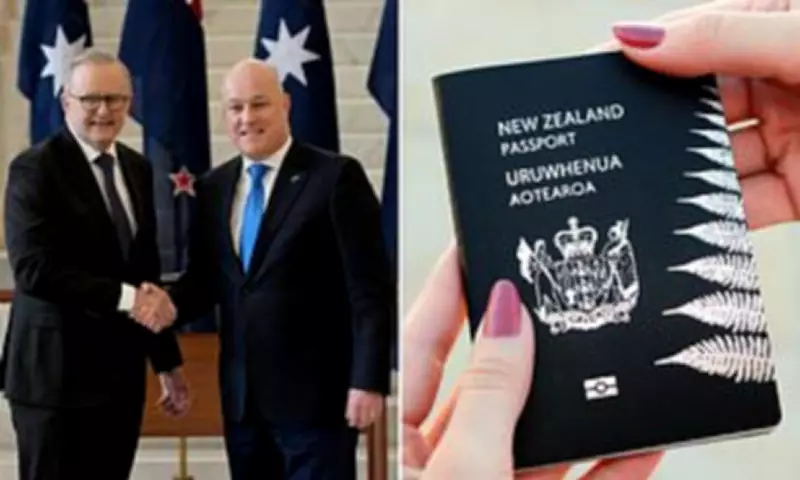
The perennial discussion surrounding New Zealand's potential transition from an independent nation to becoming Australia's seventh state has been dramatically reignited this week. This contentious topic, which has simmered for generations, has returned to the forefront of political discourse following provocative comments from a leading Kiwi analyst.
Pollster Advocates for Union Amid Global Uncertainty
Prominent New Zealand pollster and political commentator David Farrar has publicly declared his support for Australia acquiring New Zealand as its newest state. In a detailed opinion piece published by The Post, Farrar presented a compelling case that New Zealand requires greater scale and strength to navigate an increasingly volatile international landscape.
'We are in an era where countries with might will do what they see as right for them,' Farrar wrote, emphasising the shifting global power dynamics. He specifically pointed to what he described as the unpredictable temperament of the United States under former President Donald Trump as a key factor necessitating closer regional bonds for enhanced protection.

Historical Context and Constitutional Provisions
The Australian constitution contains a specific provision that explicitly allows for New Zealand's admission as a state at any time, a clause that has remained unused for over a century. This legal framework dates back to the Federation conferences held more than one hundred years ago, when New Zealand representatives participated alongside Australian leaders before Australia declared its independence from Britain.
Despite this longstanding constitutional invitation, New Zealand has consistently maintained its separate sovereignty. The two nations nevertheless share exceptionally strong ties, with citizens of both countries enjoying reciprocal rights to work and visit without requiring visas, creating a uniquely fluid trans-Tasman relationship.
Public and Political Resistance to the Proposal
The suggestion of union has met with significant resistance from both the New Zealand public and its political leadership. Recent polling conducted by local outlet Stuff indicates that approximately 56 percent of New Zealanders oppose the idea of joining Australia under a single flag, demonstrating considerable attachment to national independence.
Prime Minister Christopher Luxon's office was quick to dismiss any notion of the two countries combining. 'This won't be happening,' a spokesperson unequivocally stated, adding that 'New Zealand values our close relationship with Australia, but we also value our unique national identity and our sovereignty.'
Intellectual Debate and Differing Perspectives
Farrar's article has sparked vigorous debate among New Zealand's commentariat. Conservative political commentator Liam Hehir offered a contrasting viewpoint, arguing that independence represents a value to be cherished rather than a practical arrangement to be analysed.
'If independence is to end, it will end because it has become impossible to sustain, not because a cost-benefit analysis shows we might do better as someone else's state,' Hehir contended. He further suggested that 'the task is not to redesign ourselves, but to do our very best to adapt and thrive giving up as little about ourselves as possible.'
Social Media Reflects Divided Opinions
On social media platforms, opinions appeared more fragmented and nuanced than the clear opposition indicated by formal polling. Some users pointed to the substantial existing population exchange, with many New Zealanders already residing in Australia, questioning why formal union shouldn't follow practical reality.
One commenter simply asked 'why not' combine the two nations given these existing connections. However, others expressed caution, with one warning that 'it would not be easy for New Zealand and Australia to sink their differences in a unified sovereign state,' acknowledging the distinct cultural and historical identities that have developed separately over generations.

The debate ultimately touches upon fundamental questions of national identity, security strategy, and regional cooperation in an increasingly uncertain world. While the constitutional mechanism for union remains available, the political and public will to activate it appears significantly lacking, ensuring this discussion will likely continue to surface periodically without immediate resolution.