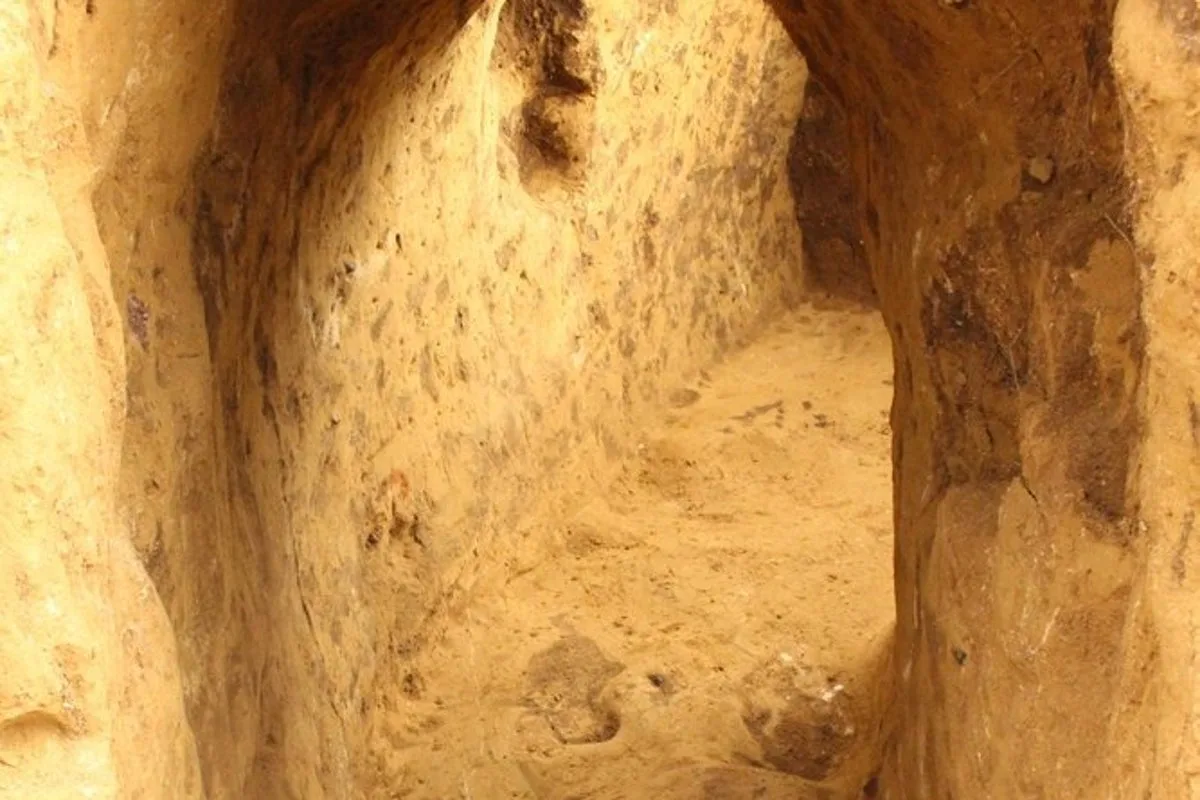
Archaeologists have made a remarkable discovery in Germany, unearthing a medieval underground tunnel system beneath a village that was likely the site of secret cult rituals. The find came to light during excavations of a Stone Age burial site near the village of Dornberg, revealing layers of history spanning millennia.
Uncovering Ancient Secrets
The excavation initially focused on a trapezoidal trench dating back to the fourth millennium BC, along with several poorly preserved late Neolithic remains from the third millennium BC. As researchers delved deeper, they uncovered a stone slab and a long, oval pit measuring approximately 6.5 feet in length and 2.5 feet in width. This pit intersected the Stone Age burial ditch at a right angle, prompting further investigation.
From Grave to Tunnel
Initially, archaeologists assumed the pit was another grave. However, they soon realized it extended into a complex tunnel system. Such shafts, featuring chamber-like extensions, have been previously documented in and around Germany, particularly in regions with firm yet easily workable soil, and are known to date from the Middle Ages.
While the exact purpose of these tunnels remains uncertain, researchers strongly suspect they served as hiding places or spaces for cultic activities. The discovery adds to a growing body of evidence suggesting medieval communities engaged in secretive rituals away from prying eyes.
Artefacts and Evidence
During the tunnel excavations, archaeologists found a trove of artefacts that provide clues to its use. These included a metal horseshoe, fragments of a ceramic pot, a layer of charcoal, and a fox skeleton in one of the curving passages. Analysis of the charcoal layer revealed no red coloration of the substrate, only a hardening effect, indicating the remains of a fire that burned only briefly.
Researchers from the German State Office for Heritage Management and Archaeology (LDA) noted in a statement that this suggests short-lived, possibly ritualistic fires rather than prolonged use.
Intentional Sealing
Further intrigue arose from the tunnel's entrance, which appeared to have been purposefully sealed with a cluster of large stones. Archaeologists believe this was done to conceal the secret activities within. "At the narrowest point of the entrance, an accumulation of larger stones stacked on top of each other was noticeable, which could indicate an intentional closure of the entrance," they wrote.
Historical Context and Speculation
The site's significance as a pagan grave may have contributed to its selection for such clandestine use. Researchers hypothesize that the local population might have generally avoided the area due to its pagan associations, making it an ideal hiding spot for cult rituals. "However, perhaps the site, due to its significance as a pagan grave, was generally avoided by the local population and therefore particularly well-suited as a hiding place," they suggested.
This discovery not only sheds light on medieval subterranean architecture but also opens new questions about the social and religious practices of the time. As excavations continue, archaeologists hope to uncover more evidence that will clarify the tunnel's exact purpose and the nature of the rituals conducted there.