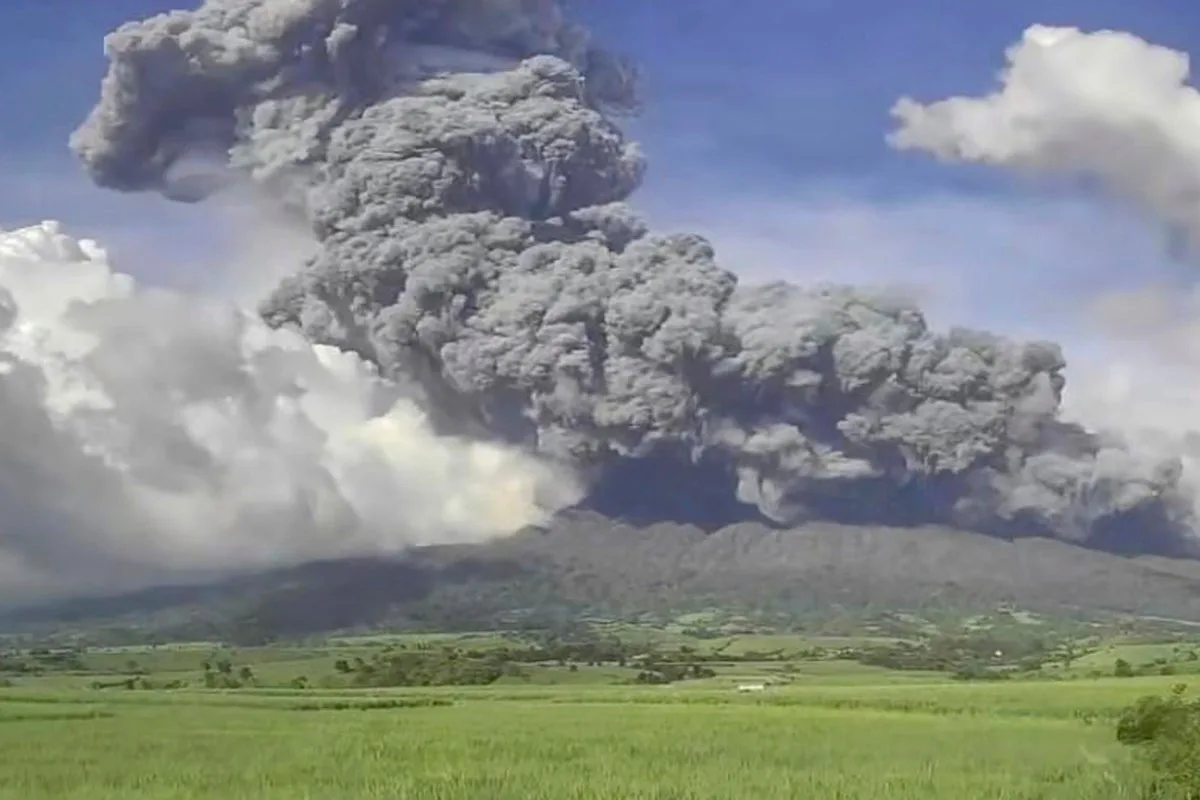
Nearly 87,000 people in the Philippines have been ordered to leave their homes immediately following the strongest eruption of Mount Kanlaon in recent years. The National Disaster Risk Reduction and Management Council on Tuesday directed everyone living within a 10km radius of the volcano to move to safer areas.
Kanlaon, on the central Negros Island, erupted for nearly four minutes on Monday, sending a massive column of volcanic ash high into the sky. The ash fell over a wide area, as far as Antique province, more than 200km across the sea, obscuring visibility and posing health risks, according to chief volcanologist Teresito Bacolcol.
Staying within a 4km radius of the volcano is prohibited as a 'sudden and more explosive eruption' is still possible, Mr Bacolcol added. The Civil Aviation Authority of the Philippines warned aircraft to avoid the area due to possible steam-driven eruptions and precursory magmatic activity. At least six domestic and one international flight were cancelled, and two local flights were diverted.
The Office of Civil Defense reported that 9,403 individuals, or 2,880 families, had been evacuated from five cities and towns. The situation remains critical in La Castellana, Negros Occidental, where an estimated 46,900 people live within the 6km danger zone.
The Philippine Institute of Volcanology and Seismology raised the alert level to indicate a possible magmatic eruption that could progress to more explosive events. Maria Antonia Bornas, head of volcano monitoring, warned of deadly pyroclastic density currents, saying, 'Being hit by these is like being run over by a high-speed vehicle.'
President Ferdinand Marcos Jr said the government is ready to support displaced villagers, with his social welfare secretary flying to the region. Authorities have set up evacuation centres, schools have been shut, and a nighttime curfew imposed. Doctors urged those in danger zones to wear masks.