Julia Kochetova's War Photography: Intimate Portraits of Ukraine's Struggle
Julia Kochetova stands apart from many journalists covering Russia's invasion of Ukraine. As a Ukrainian photographer based in Kyiv, the conflict is deeply personal, shaping her life, relationships, and career. Born in Vinnytsia to an economist and a German lecturer, Kochetova, now 32, has documented the war since its escalation in February 2022, capturing scenes from the frontline to underground shelters with profound humanity.
Life Amidst Conflict
Kochetova's existence is infused with the war that began in 2014. She has organized numerous funerals, a grim reality of her work. Between assignments, she often wakes in Kyiv without electricity due to Russian attacks on infrastructure. Her first Guardian assignment in October 2022 involved photographing ballet dancers, a stark contrast to her usual frontline work. However, the war quickly intruded when Kyiv was attacked with Shahed drones, prompting her to capture an image of a soldier comforting a frightened woman in a car park—a moment she describes as embodying love and resilience.
War Is Personal: An Exhibition of Scars
Kochetova's ongoing body of work, War Is Personal, which won a World Press Photo award in 2024, forms the basis of an exhibition in Amsterdam. She rejects the term "project," insisting it is her life. "I have the same scars as the people I photograph," she says, highlighting the shared trauma. One haunting image from the funeral of a mother and daughter killed in a missile attack shows a child staring into a coffin, a scene Kochetova wishes she could forget but feels compelled to document with gentleness.

Documenting Truth and Humanity
Unlike some predecessors, Kochetova does not believe photography can stop wars, but she values its power for documentation and human connection. Her work avoids military statistics, focusing instead on individual stories. The Amsterdam exhibition includes her poems, drawings by artist friend Oleksandr Komiakhov, and sounds to immerse viewers in the war's reality. She emphasizes the importance of truth-telling against Russian disinformation, citing the documentation of Mariupol as a crucial counter-narrative.
Frontline Insights and Emotional Depth
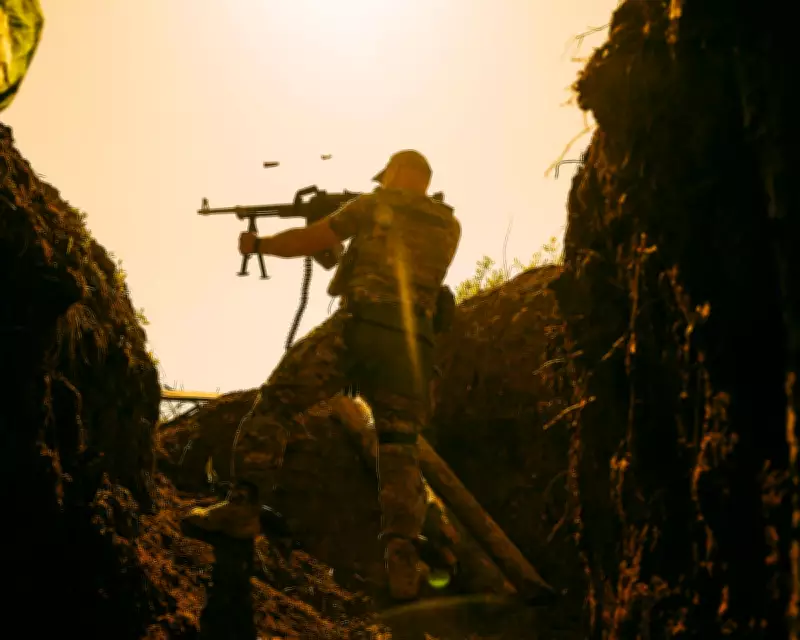
Kochetova's frontline photography reveals the vulnerability and dignity of soldiers. An image from a training course in Kharkiv shows young recruits with Hello Kitty patches, questioning why they must serve. Another photo captures a soldier with a tear in his eye at a medical point, while a wounded man with closed eyes evokes religious paintings, prompting reflections on inner dreams. Even in scenes of mass graves in Izium, she conveys the presence of untold stories through empty landscapes.
Beauty Amidst Ashes
Amid the violence, Kochetova finds moments of beauty, such as a soldier in a trench surrounded by blue and yellow flowers. She explores whether one can "bloom on the ashes" after destruction. Her work is rooted in her Ukrainian identity; she sees herself as a tree with deep roots, committed to documenting her country's plight. A drawing by Komiakhov reimagines a self-portrait of her in fear, symbolizing that her camera provides connection and she is not alone.
Julia Kochetova's photography offers a raw, intimate window into Ukraine's war, blending art and testimony to preserve humanity in the face of devastation.