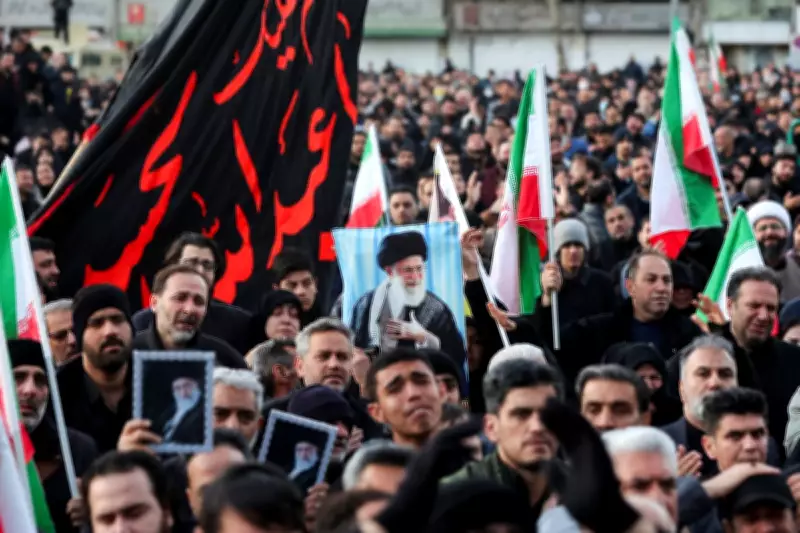
Iran's Regime in Peril After the Death of Supreme Leader Ali Khamenei
The passing of Ayatollah Ali Khamenei, the supreme leader of Iran, marks a pivotal moment for the Islamic Republic. As the constitutional and symbolic heart of the regime, his death has severed a critical head, plunging the nation into a state of profound uncertainty. Dr Burcu Ozcelik, a senior research fellow for Middle East Security at the Royal United Services Institute, argues that while the regime is engineered to endure, it now teeters closer to collapse than ever before.
The Fragility of Domestic Legitimacy
Iran's domestic legitimacy, already weakened by years of repression and economic decline, faces further strain in the wake of Khamenei's demise. The regime's narrative of resistance against the West may incorporate his death into a martyrdom story, but this is unlikely to quell internal dissent. Instead, sustained strikes and pressure could erode key pillars of the Islamic Republic, including military-security networks, clerical authority, and judicial machinery. This erosion might create opportunities for alternative governance structures to emerge from within Iran, though such outcomes remain speculative and fraught with risk.
Internal Dissent and External Pressures
Reports, such as one in The Atlantic, suggest that an Iranian network is poised to act from inside the system. Jaber Rajabi, a former loyalist turned exile, claims that eliminating about ten top figures could trigger regime collapse, stating, "If someone from inside the system opens the window, it will open." However, leadership decapitation does not guarantee collapse; Iran has built-in mechanisms for continuity, allowing for reshuffling and reconstitution. For regime change to materialise, several conditions must align: credible transitional leadership, public buy-in, international backing, and fractures within the coercive apparatus, such as defections in security services.

Succession Scenarios and International Dynamics
In succession discussions, Ali Larijani, secretary of the Supreme National Security Council, is often mentioned as a potential interim steward. Yet, as a non-cleric, he cannot inherit the supreme leader's role, and his involvement in past protest suppression limits his acceptability, particularly for the United States. Any emerging authority in a transformation scenario will likely require Washington's endorsement, especially after US-Israeli campaigns. Figures associated with the Islamic Revolutionary Guard Corps (IRGC) or junta-like takeovers are non-starters for the US, Israel, and many Iranians seeking genuine change.
Military Outcomes and Political Settlements
Air power alone cannot reshape Iran's political order, but sustained pressure may influence the choices of surviving elites. The post-Khamenei leadership will face tough decisions regarding cooperation with the US. Military outcomes will set conditions but not predetermine Iran's future political settlement. A potential gap between US and Israeli strategies could prove decisive; President Trump might halt once Iran's offensive capabilities are degraded, while Israel may push further. However, a scenario involving US ground forces installing a new government in Tehran is not imminent.
Risks of Chaos and the Path Forward
A fundamentally weakened or collapsed regime might be welcomed, but chaos in Iran poses severe risks: cross-border instability, disruptions to energy markets and shipping routes, and a regional security vacuum. Such turmoil would not serve the Iranian people, who have endured immense suffering, including targeted cruelties against women. The path from military pressure to political liberation is neither linear nor guaranteed. While regime transformation is possible, it will not be easily engineered; current campaigns could degrade coercive power or, conversely, harden the system if IRGC elements assume control, leading to a more brutal internal apparatus.
In summary, Iran stands at a critical juncture, with Khamenei's death exposing deep vulnerabilities. The regime's survival hinges on its ability to navigate internal dissent, international pressures, and the complex dynamics of succession, all while avoiding the pitfalls of chaos that could further harm its citizens.