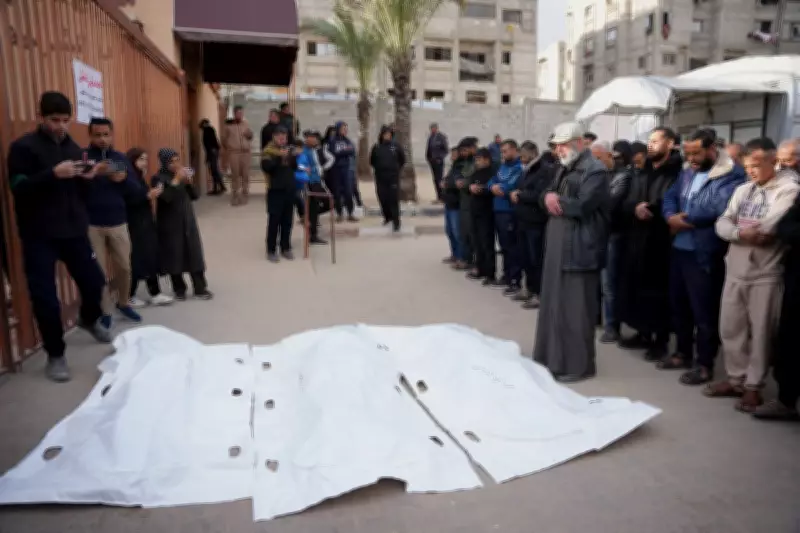
Months after a much-heralded ceasefire was supposed to bring calm to the Gaza Strip, violence has flared once again, casting serious doubt over the durability of the truce and leaving residents questioning whether peace is truly at hand. The fragile agreement, brokered by the United States in October, faces mounting strain as Israeli strikes continue to claim Palestinian lives and key provisions of the deal remain unfulfilled.
Hospital Director's Plea Echoes Across War-Ravaged Territory
As the bodies of two dozen Palestinians killed in Israeli strikes arrived at hospitals in Gaza on Wednesday, the director of Shifa Hospital, Mohamed Abu Selmiya, took to social media to voice a desperate question resonating across the territory. "Where is the ceasefire? Where are the mediators?" he wrote on Facebook, encapsulating the growing despair among Gaza's two million inhabitants. The strikes on Wednesday, which followed another deadly incident on Saturday that killed 30, have brought the Palestinian death toll from Israeli actions since the October truce to at least 556, according to Gaza's Health Ministry.
Ceasefire Agreement: Hostages Freed but Larger Issues Stalled
The ceasefire agreement, a 20-point plan proposed by US President Donald Trump after months of stalled negotiations, was initially hailed as a potential pathway to what Trump called a "Strong, Durable, and Everlasting Peace." A significant early achievement saw Hamas free all living hostages it held at the outset of the deal, in exchange for thousands of Palestinian prisoners and the remains of others held by Israel.

However, the broader, more complex issues the agreement sought to address have largely languished. Critical components such as the deployment of an international security force, the disarmament of Hamas, and the commencement of Gaza's massive reconstruction have stalled. Even the return of hostages' remains stretched far beyond the 72-hour timeline outlined, with Israel only recovering the last body last week, accusing militant groups of violating the ceasefire.
Humanitarian Aid Falls Short Amid Accusations and Counterclaims
The truce also mandated an immediate influx of humanitarian aid, including equipment to clear rubble and rehabilitate decimated infrastructure. Yet, the United Nations and various humanitarian groups report that aid deliveries have fallen significantly short of needs, citing customs clearance problems and other logistical delays. COGAT, the Israeli military body overseeing aid to Gaza, has robustly rejected these claims, calling the UN's assertions "simply a lie."
A Tense Calm: Violence Declines but Deadly Incidents Persist
While violence has sharply declined since the ceasefire paused a war that claimed over 71,800 Palestinian lives according to Gaza's Health Ministry, deadly incidents continue to shatter the uneasy calm. Both Israel and Hamas maintain that the agreement is still in effect and continue to use the term "ceasefire" in official communications. Nonetheless, a cycle of accusation and retaliation persists.
Israel accuses Hamas fighters of operating beyond the truce line that splits Gaza, threatening its troops and occasionally opening fire. Hamas, in turn, accuses Israeli forces of gunfire and strikes on residential areas far from the demarcation line. The strikes on Wednesday, which included the deaths of five children, prompted Hamas to condemn what it called a "grave circumvention of the ceasefire agreement."
International Calls for Restraint and Preservation of the Truce
The escalating violence has drawn international concern. In a joint statement on Sunday, eight Arab and Muslim countries condemned Israel's actions since the agreement took effect and urged restraint from all sides "to preserve and sustain the ceasefire." Palestinians have repeatedly called on US and Arab mediators to pressure Israel to halt the deadly strikes, which often result in civilian casualties.

Israel defends its actions as necessary responses to daily violations committed by Hamas and as measures to protect its troops. "While Hamas' actions undermine the ceasefire, Israel remains fully committed to upholding it," the military stated on Wednesday. Lieutenant Colonel Nadav Shoshani, a military spokesperson, suggested preparedness for potential deception by Hamas, stating, "One of the scenarios the military has to be ready for is Hamas is using a deception tactic like they did before October 7 and rearming and preparing for an attack."
Glimmers of Progress Amid the Gloom
Despite the violence, there have been some tentative signs of progress. The return of the last hostage's remains, the limited opening of the Rafah border crossing with Egypt—though fewer than 50 people were allowed to cross on Monday—and the naming of a Palestinian committee to govern Gaza and oversee reconstruction indicate a residual, if fragile, willingness to advance the agreement.
Last month, US envoy Steve Witkoff, who played a key role in brokering the truce, emphasised the need for "transitioning from ceasefire to demilitarization, technocratic governance, and reconstruction." This transition, however, requires Israel and Hamas to grapple with profoundly divisive issues, including a full Israeli withdrawal from Gaza and Hamas laying down its arms.
A Population Trapped Between War and Peace
For the people of Gaza, the political rhetoric offers little solace. The reality on the ground is one of continued fear and uncertainty. Atallah Abu Hadaiyed, who heard explosions during his morning prayers in Gaza City on Saturday, ran outside to find his cousins lying on the ground, flames curling around them. Speaking from a displacement camp, with tarpaulin strips blowing off his tent, he voiced the confusion and despair of many: "We don't know if we're at war or at peace."
As political leaders cling to the term "ceasefire" and refrain from formally withdrawing from the process, the fundamental question remains: can this battered agreement be salvaged to deliver the lasting peace it promised, or will it unravel completely under the weight of renewed violence and unmet obligations?