Four Years of Conflict: Ukrainian Lives Transformed by War
As the grim milestone of four years since Russia's full-scale invasion of Ukraine passes, the human cost continues to mount. Ukrainians across the nation have endured the loss of limbs, loved ones, livelihoods, and homes, yet a defiant hope persists. This collection of personal narratives, accompanied by pre-war photographs from family albums, reveals the profound and lasting impact of the conflict on ordinary citizens.
From Dance Studio to Sniper's Post
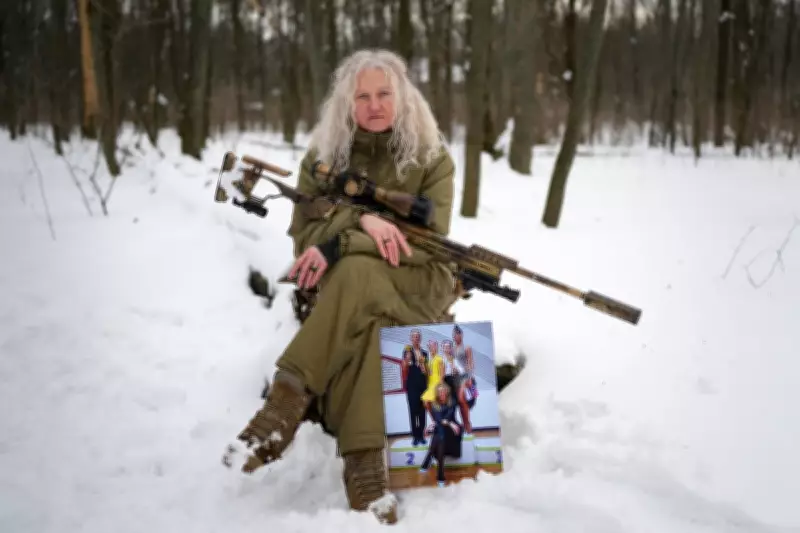
Tetiana Khimion, 47, once shaped her days around ballroom dancing, having practiced since age six. An international-level judge and teacher in Sloviansk, Donetsk, her world was one of competitions and artistry. "We believed that the world was beautiful and kind," she recalled. Today, her white-blond curls spill over an olive-green army jacket as she serves as a sniper in the Ukrainian military. Trained in Europe, she describes sniping as a "creative and mathematical" profession, aligning with her passions. A mother of two grown sons, she enlisted despite her husband's initial hesitation, determined on her path.
A Family Shattered by Airstrike
Oksana Osypenko, 43, a secondary schoolteacher in Chernihiv, cherished a new beginning with her welder husband Oleksandr and their sons, Davyd and Hlib, born in 2020. They saved for an apartment and dreamed of the future. On March 3, 2022, a Russian airstrike killed dozens, including Oleksandr, who was with the territorial defense. His family learned of his death over two weeks later. "I lived for about a year and a half with the feeling that he might walk through the door," Oksana said. Hlib, now five, has lived longer without his father than with him, slowly grasping the absence.

Love and Captivity in Wartime
Liliia, 30, a dancer and theater performer, met her boyfriend Bohdan on a dating app in 2019. Bohdan had voluntarily joined the Azov Brigade in 2015 to combat Russian aggression in eastern Ukraine. When the full-scale invasion began in 2022, he was among the first responders, only to be captured. At the end of last year, a Russian court sentenced him to 18 years in prison. Liliia, who withheld her last name for security, described "constant fear for someone you love" in inhumane conditions. She attends weekly rallies in Kyiv for prisoners of war, struggling to perform on stage while feeling empty inside.
A Young Veteran's Struggle
Ruslan Knysh, 20, was 16 when he watched the dark, unsettling sky from his balcony in Selydove, Donetsk, as the invasion commenced. Feeling defenseless, he later enlisted in 2024 amid regional tensions over his pro-Ukrainian views. Wounded in a drone attack in Kharkiv last October, he lost his arms and legs. During rehabilitation, he uses dark humor, quotes Ukrainian poets, and emphasizes historical awareness. "There are moments when it really overwhelms you," he admitted, but he clings to the belief that fate has its own plans.
Unimaginable Loss in a Village Home
Yaroslav Nehoda, 40, and his wife Antonina tried for two decades to have a child. Their daughter Adelina was born healthy in April last year. They often gathered at his grandfather's post-World War II house in Pohreby, Kyiv region, seeking safety. On October 22, a Russian Shahed drone struck the house, killing Antonina, six-month-old Adelina, and his niece. Nehoda, who was in Kyiv that night, said a half-meter difference could have saved them. He now lives two lives—one of memories and another for the future—but finds it difficult as he is no longer in his twenties.
Emergency Responder in a New Normal
Ivan Khmelnytskyi, 25, once handled customer calls for postal services. On February 24, 2022, he logged into work to find no one online, having slept through nearby explosions. Turned away from enlisting due to lack of training, he later joined the State Emergency Service. Now a sergeant in a rescue unit, he responds to missile and drone strikes, his fear replaced by experience. He sleeps with his phone under his pillow, always ready. "The hardest thing is that this becomes normal," he said, noting Ukrainians are tired but holding on.

Elderly Couple Uprooted Repeatedly
Liudmyla Shytik, 77, and her husband Viktor, 78, built their lives in Vuhledar, Donetsk, where he worked in construction and she was an accountant. When shelling began on February 24, 2022, they sheltered in their basement for nearly a month before evacuating with only documents. Their house was later burned, and they have moved nine times, including to an apartment in Kyiv damaged in a missile strike. Now in social housing near Kyiv, they have two years left of a five-year grant, unsure of their future. "At first I couldn't bear it," Shytik said, but she focuses on family, adding with a smile, "But we will live. We are not going to die."
This documentary photo story, curated by AP photo editors with contributions from journalist Volodymyr Yurchuk in Kyiv, underscores the resilience and heartbreak defining Ukraine after four years of war.