Europe's Moment of Awakening: Macron's Stark Warning on Global Disarray
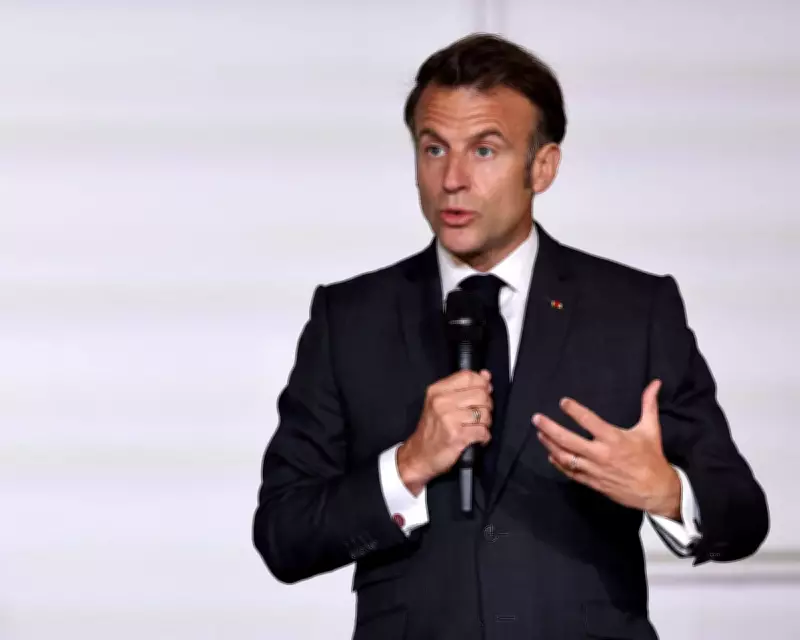
French President Emmanuel Macron has issued a stark and simple warning to Europe: confronted with what he describes as "a world in disarray" and a double, potentially existential challenge from both the United States and China, the European Union must urgently transform itself into a genuine global power. The bloc is facing what Macron termed "a Chinese tsunami" on trade, as China shifts from being an infinite export market to a ferocious, low-price, hi-tech competitor.
On defence and security, the situation is equally dire. Macron stated that the United States, which Europeans had long believed "would guarantee our security forever," is now "openly anti-European," shows "contempt" for the EU, and even seeks its "dismemberment." He added that the US is also "microsecond-level unstable" on trade matters. "We are not moving at the right pace, and we are not operating on the right scale," Macron declared. "This must be the moment of awakening. It is time for Europe to wake up. If we do not decide for ourselves, we will be swept away."
The Greenland Moment: A Catalyst for Continental Focus
Macron referred to what he called Europe's "Greenland moment" – a reference to former US President Donald Trump's attempted acquisition of the semi-autonomous Arctic island, which is part of Denmark. This event, Macron suggested, may finally be focusing continental minds on the urgent need for strategic autonomy. This week, two key events will test whether this focus can translate into concrete action.

Firstly, at a 16th-century chateau in rural Belgium, Europe's leaders will convene to discuss urgent measures to reboot the EU's sluggish economy and enhance its global competitiveness. Secondly, at the Munich Security Conference, leaders will join military officials and experts to debate European security, defence, and the future of the transatlantic relationship.
Economic Reboot: Driving with the Handbrake On
European Commission President Ursula von der Leyen set the tone ahead of the economic summit, stating, "We have the second largest economy in the world, but we are driving it with the handbrake on." Leaders are expected to discuss simplifying, loosening, and scrapping regulations to cut red tape, remove internal barriers, and deepen the single market. Other priorities include facilitating the flow of savings and investments and implementing a "buy European" rule to keep public money within the bloc.
The discussions will be informed by reports from two former Italian prime ministers, Enrico Letta and Mario Draghi, whose 2024 recommendations on the single market and EU competitiveness have so far struggled to gain traction. Research from the International Monetary Fund reveals that EU internal regulatory barriers equate to a 44% tariff on goods and a staggering 110% on services. Furthermore, a thinktank analysis found that only 15% of Draghi's 383 proposals – which he warned were essential to avoid a "slow and agonising decline" – have been actioned.
Defence and Security: The Painful Realisation of Dependence
The Munich Security Conference organisers were blunt in their pre-conference assessment. Their report stated that Europe had reached the "painful realisation" that it needs to be more assertive and militarily independent from a US administration they described as sliding into "competitive authoritarianism." Europeans have understood they cannot effectively resist unfair trade deals or violations of sovereignty if they remain "heavily dependent on the military assistance of the country that is using coercive tactics and slashing existing norms."
Speeches from von der Leyen, Germany's Chancellor Friedrich Merz, and NATO chief Mark Rutte – who recently remarked that Europe could "keep on dreaming" if it thought it could cope without US support – are expected to outline the bloc's potential response to this security dilemma.

Public Opinion: A Radical Shift and a Political Challenge
Europe's citizens appear to have grasped the scale of the threat. A recent six-country YouGov poll found public opinion has turned radically against the United States since the "Greenland moment," with between 62% and 84% of respondents expressing disapproval. The most common view was that Europe's autonomy must now be prioritised over preserving the transatlantic alliance.
However, a new report from the European Council on Foreign Relations reveals the significant political challenge facing leaders. While most European voters now realise the US is no longer a reliable ally and accept the need to increase defence spending, these views are not uniformly distributed. The report, based on polling in 13 countries, identifies several distinct voter groups.
- Euro-hawks (28%): No longer see the US as an ally, support increased national defence spending, and have a broadly positive view of the EU.
- Euro-doves (21%): Sober about the US and attached to the EU, but do not support more defence spending.
- Atlanticists (12%): Tend to still consider the US an ally.
- Renegades (15%): Reject the US, the EU, and more defence spending.
- Nationalists (12%): Do not believe in the EU or see the US as an ally, but support more military spending.
- Trumpists (5%): Still see the US as their ally and are generally not in favour of the EU.
These groups are present in different proportions across countries and political camps. For instance, Euro-doves are most plentiful in Spain and Italy, while Renegades are found among supporters of the populist left, and Nationalists among the populist far right.
The Path Forward: Building a Values Coalition
The report's authors suggest Europe's way forward lies in constructing a "values coalition" built on compromises. This would involve offering more defence spending to Euro-doves, greater realism on the US for Atlanticists like Poland, and concessions for Euro-hawks such as France and Germany. "Our polling delivers a clear message: a mobilised European majority can be composed out of the continent's scattered public," said co-author Paweł Zerka. "But this requires leaders to step up and build bridges across the citizens' archipelago."
Whether this optimistic vision can overcome entrenched national interests and old habits remains the critical question. Macron's "Greenland moment" will ultimately reveal whether Europe can shed its dependencies and chart a new, independent course in a world he describes as being in profound disarray.