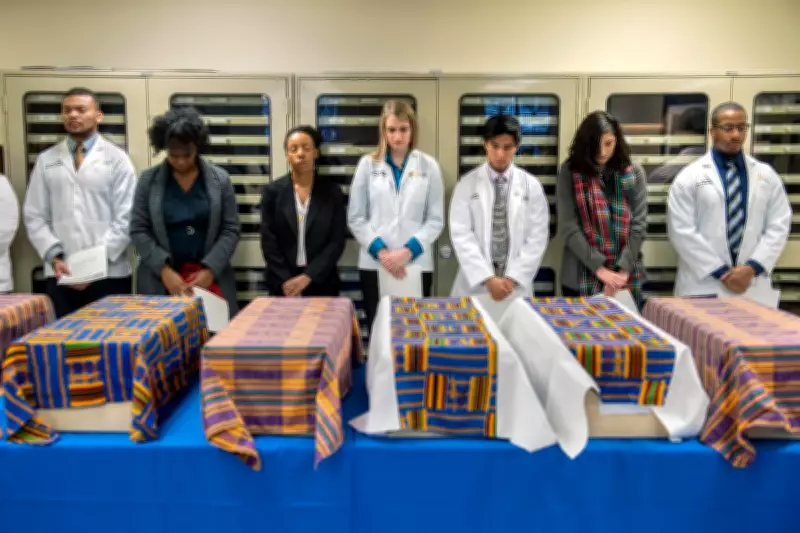
Virginia Commonwealth University (VCU) has approved $3.6 million in funding for a memorial honoring dozens of individuals, predominantly of African descent, whose bodies were exhumed from their graves, dissected by medical students, and discarded in a forgotten well. The university's board of visitors voted on Friday to advance the East Marshall Street Well Project, an initiative aimed at addressing historical injustices that occurred over a century ago. Construction of the memorial and burial site is slated to commence in the summer of 2027.
Restoring Dignity
“Years ago, VCU initiated this journey because we recognized a profound obligation to restore the human dignity of the people who were not afforded respect in their physical existence,” said VCU President Michael Rao in a statement on the university's website. “The East Marshall Street Well Project’s sacred mission is to ensure every life is honored with the permanence and reverence they deserve.” The circular memorial will feature a “unity chamber” inspired by the Toguna structures of Dogon culture in West Africa. According to Stephen Davenport, assistant vice president for social and economic development in the VCU Division of Community Engagement and the project's administrative lead, the design “is intended to encourage humility and thoughtful discussion by purposefully having a low roof to facilitate seated reflection.”
Discovery and Historical Context
In 1994, workers constructing the Kontos Medical Sciences Building on the VCU medical center campus uncovered a brick-lined well filled with human bones. Subsequent examination of the mud revealed hair, skin, remnants of leather shoes, and glass bottles. Archival records from the Medical College of Virginia suggest the remains were deposited in the well between the 1840s and 1860s. A preliminary anthropological analysis indicated signs of postmortem dissection and amputation consistent with anatomical training and surgical practice. The constant demand for cadavers led to routine grave robbing, primarily targeting African American burial grounds to supply the medical school.

Research and Reexamination
Archaeologists had limited time to study the site before construction resumed, and the remains were removed by backhoes and sent to the Smithsonian National Museum of Natural History. Initial estimates indicated a minimum of 44 adults and nine children. Interest revived in 2011 following a film by a VCU professor and a separate report by two forensic anthropologists. DNA study results released in February identified at least 43 distinct adults and three juveniles of “predominantly African heritage,” likely from Central-West Africa, with some individuals showing traces of European ancestry. Skeletal analysis provided insight into the heavy labor endured during their lives and the disregard for their bodies after death.
Associated Press reporter John Raby contributed to this report.