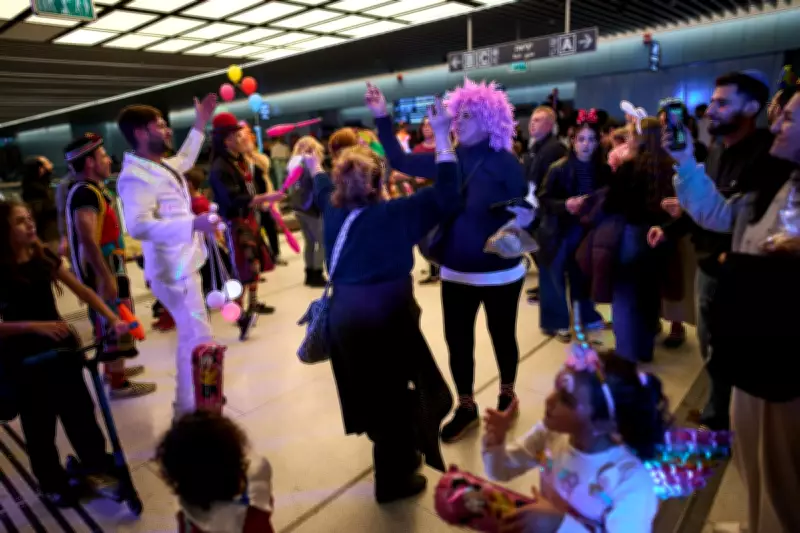
Purim Festivities Relocate Underground Amid Heightened Security Concerns
Jewish communities across Israel gathered in bomb shelters to observe the holiday of Purim this week, taking precautionary measures against potential Iranian missile strikes. The annual celebration, typically characterised by vibrant street parades and costume parties, was moved to fortified underground locations as the nation remains engaged in conflict with Iran's contemporary leadership.
Underground Celebrations in Tel Aviv
In Tel Aviv on Monday, residents of all ages wearing sequined outfits, bunny ears, pirate costumes and peacock feathers streamed into a shopping mall's underground parking facility that doubles as a bomb shelter. The traditional reading of the Purim story was followed by live musical performances and dancing beneath the concrete structure.
"It's all about choosing happiness, choosing to be joyful, no matter what else is happening," explained Mariel Margulis, a Tel Aviv resident who had established a temporary home in the parking garage with her husband and six-month-old son. The family dressed as bathers complete with robes, while their infant son Amichai wore a rubber ducky costume. They created a bathtub-themed play area adjacent to their tent within the shelter.

Historical Parallels and Contemporary Realities
The Purim narrative, documented in the Book of Esther, recounts the story of Haman, an advisor to King Ahashverosh, who plotted to exterminate the Jewish population of the ancient Persian kingdom. The scheme was thwarted by Queen Esther and her cousin Mordechai in Shushan, Persia, located in what is now modern Iran.
"It feels biblical in proportions, what's happening right now, and we're doing the little bit we can, staying calm, staying joyful," Mariel reflected. Nearby, her son Amichai slept through the crowd's loud "boos" intended to drown out the name of Haman during the scripture reading.
Daniel Margulis, Mariel's husband, observed: "It's like the same plot of Purim with a different cast."
Disrupted Traditions and War-Time Adaptations
Purim, cherished by both religious and secular Jewish communities, typically commences on Monday night across most Jewish populations, with ancient walled cities like Jerusalem beginning celebrations a day later. During peaceful periods, families in colourful costumes crowd downtown areas, children consume abundant traditional triangular cookies, and adults customarily dress in elaborate outfits while consuming alcohol.
In Jerusalem under normal circumstances, musicians perform from balconies overlooking main thoroughfares, with street parties extending through the evening in historic stone alleyways. This year's celebrations were anticipated to be particularly large following a two-year hiatus, as many municipalities had cancelled or reduced Purim events during the Israel-Hamas conflict. However, festivities were again disrupted after Israel and the United States launched military operations against Iran on Saturday.
Families Navigate Security Precautions
"We came because the children didn't want to miss Purim; they were genuinely excited to wear costumes," said Elysa Rapoport, a Tel Aviv investment professional. Her daughters dressed as Barbie Cowgirl and Rumi from K-pop Demon Hunters. With most public Purim events cancelled, the family planned their route to the underground celebration to include quick access to multiple shelters along the way.
Iranian missile alerts have repeatedly sent Israeli citizens scrambling for shelter protection throughout days and nights. "This just feels surreal," Rapoport remarked, observing hundreds of people dancing under fluorescent lights in the parking facility. Nearby, residents and their pets who had relocated to the shelter for the conflict's duration relaxed on air mattresses while browsing their mobile devices.
Community Spirit Amid Challenging Circumstances
Gabi Grinshtain, a thirty-nine-year-old environmental consultant, noted: "These aren't the most optimal conditions; we're accustomed to our synagogue, but we're here together with the entire nation of Israel. These are significant days, and the setting matters less than the communal experience."

The adaptation of Purim celebrations to bomb shelters represents both the resilience of Israeli society and the ongoing security challenges facing the nation. While the holiday's traditional outdoor revelry was necessarily curtailed, the underground gatherings maintained the essential spirit of joy and community that defines the Purim observance, even as participants remained vigilant to potential threats from above.