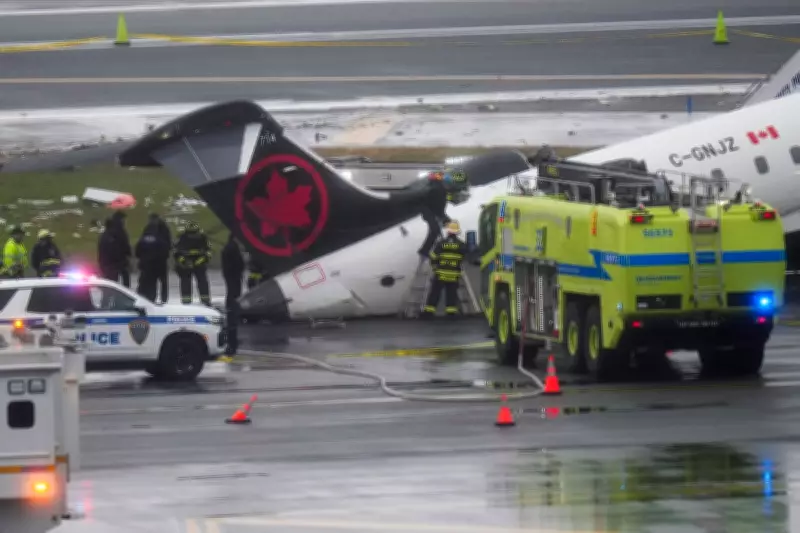
Key Takeaways from the NTSB Report on the LaGuardia Plane Crash
Federal investigators released a preliminary report on Thursday detailing a series of issues and failures that led to last month's deadly collision between a regional jet and a fire truck at New York's LaGuardia Airport. The National Transportation Safety Board (NTSB) report highlighted that the fire truck drove through a runway stop light, lacked a transponder, and faced heavy air traffic and an ongoing emergency.
On March 22, Air Canada Express Flight 8646, a regional jet from Montreal carrying 76 people, struck a fire truck seconds after landing. Pilots Antoine Forest, 30, and Mackenzie Gunther, 24, were killed, and 39 others were injured, including the two fire truck occupants. This was the first deadly crash at LaGuardia in 34 years.
Busy Air Traffic Controllers
Two air traffic controllers were on duty, consistent with normal scheduling, but LaGuardia was busier than usual due to flight delays. According to aviation analytics firm Cirium, arrivals and departures after 10 p.m. more than doubled the scheduled number. Planes were landing every few minutes, and controllers had to manage an emergency involving a strong odor on a departing United Airlines jet. The fire truck involved in the crash was leading a convoy responding to that emergency. While the senior controller coordinated the United response, the other handled ground vehicle movements and takeoffs and landings. Aviation safety expert Jeff Guzzetti noted, "These controllers were just way busy, just too busy."

No Transponder on the Fire Truck
LaGuardia is one of 35 major U.S. airports with an advanced surface surveillance system (ASDE-X) that uses radar and transponder data to prevent collisions. The fire truck and its convoy lacked transponders, preventing precise tracking. The system's radar had trouble distinguishing the vehicles, causing targets to intermittently merge on the display, and no alarm sounded to alert controllers.
Red Lights Were On
Air traffic control transmissions show the Air Canada flight was cleared to land at 11:35 p.m. About two minutes later, 25 seconds before the crash, the fire crew asked to cross the same runway. When the controller cleared the truck to cross, the plane was about 100 feet above ground. A system of red warning lights on the runway remained illuminated until the truck reached the runway edge, about three seconds before the collision. The report states the lights are designed to turn off two to three seconds before a plane reaches an intersection. Former airline pilot John Cox said, "That's an automated system so even though the controller says you're cleared to cross, the lights mean there's an airplane that is either on the runway or about to be." Guzzetti added that darkness and wet pavement may have made the lights hard to see.
Stop, Stop, Stop
Nine seconds before the crash, the controller realized the impending collision and told the fire crew: "Stop, stop, stop, stop. Truck 1. Stop, stop, stop, stop." The fire truck's turret operator recalled hearing "stop, stop, stop" but was unsure who it was for until hearing "Truck 1." He then saw the truck had entered the runway and spotted the plane's lights. Cox noted the initial ambiguity in the controller's call but questioned whether the truck could have stopped in time, as it had reached 29 mph before entering the runway. Given its speed and weight, the vehicle "isn't going to stop on a dime," he said.