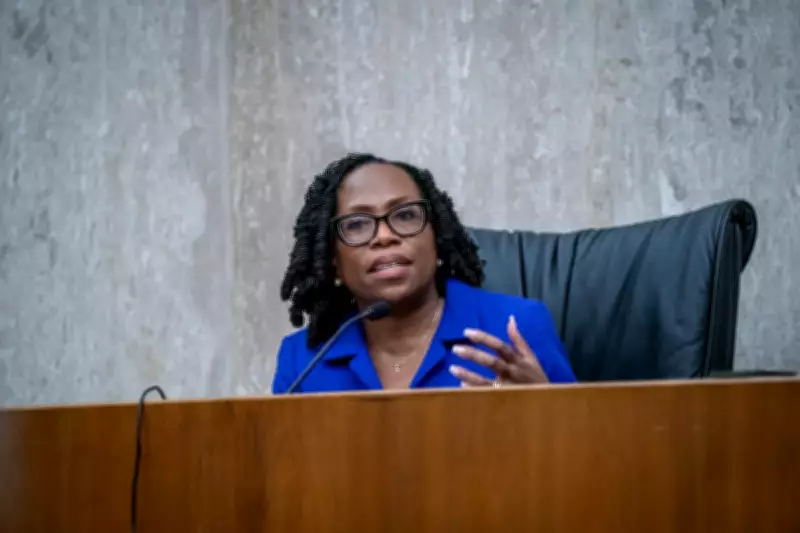
Justice Jackson Delivers Scathing Critique of Supreme Court's Emergency Orders
In a powerful address at Yale Law School, US Supreme Court Justice Ketanji Brown Jackson has launched a sustained attack on her conservative colleagues' use of emergency orders to benefit the Trump administration. Jackson, the court's newest justice, condemned these rulings as "scratch-paper musings" that can "seem oblivious and thus ring hollow," highlighting a deepening rift within the nation's highest judicial body.
Emergency Docket Under Fire
Jackson's nearly hour-long speech focused on roughly two dozen court orders issued last year that allowed former President Donald Trump to implement controversial policies on immigration, federal funding cuts, and other areas, despite lower courts finding them likely illegal. While designed as short-term measures, these emergency orders have largely enabled Trump to advance key parts of his conservative agenda, at least temporarily.
The court's emergency docket involves appeals in cases still pending in lower courts, where the Supreme Court is asked to intervene swiftly without oral arguments. According to reports, the Trump administration filed 34 emergency applications, with the court siding with Trump in most instances. Jackson argued that this represents a shift from historical reluctance to step into cases early in the legal process.

A Call for Restraint and Accountability
Jackson criticized the orders for being issued with minimal explanation, describing them as "back-of-the-envelope, first-blush impressions of the merits of the legal issue." She emphasized that the court insists these "scratch-paper musings" be applied by lower courts in other cases, compounding their impact. Worse still, she noted a failure to acknowledge the real people affected, making the rulings appear detached from human consequences.
During a question-and-answer session with Yale Law School Dean Cristina Rodriguez, Jackson rejected the court's assessment that preventing the president from implementing a policy constitutes a harm outweighing that faced by challengers. "The president of the United States, though he may be harmed in an abstract way, he certainly isn't harmed if what he wants to do is illegal," she stated firmly.
Broader Judicial Tensions and Apologies
Jackson's remarks follow similar criticisms from Justice Sonia Sotomayor, who recently addressed emergency orders at the University of Alabama. Sotomayor later issued a rare public apology for comments made about Justice Brett Kavanaugh, expressing regret for remarks that referenced his family. In her apology, she said, "I made remarks that were inappropriate. I regret my hurtful comments. I have apologized to my colleague."
This incident underscores the delicate decorum among justices, where public disagreements on legal matters are common, but personal or familial references are typically avoided. It contrasts sharply with former President Trump's past criticisms of justices he nominated, such as calling Neil Gorsuch and Amy Coney Barrett an "embarrassment to their families."
Political Context and Judicial Balance
The Supreme Court's composition has shifted significantly, with Trump appointing three justices during his first term, resulting in a six-three conservative majority. President Joe Biden nominated Jackson in 2022 to replace retiring Justice Stephen Breyer, maintaining the liberal bloc at three justices. Jackson has previously criticized emergency orders in dissenting opinions and in an unusual joint appearance with Kavanaugh, but her Yale speech marked a notable public appeal for change.
She acknowledged internal conversations among justices about emergency orders but decided to speak publicly to act as "a catalyst for change." Jackson warned against the court continually engaging with divisive policy issues, stating, "There is value in avoiding having the court continually touching the third rail of every divisive policy issue in American life."
As the Supreme Court navigates these tensions, Jackson's critique highlights ongoing debates over judicial restraint, emergency powers, and the court's role in shaping policy during politically charged times.