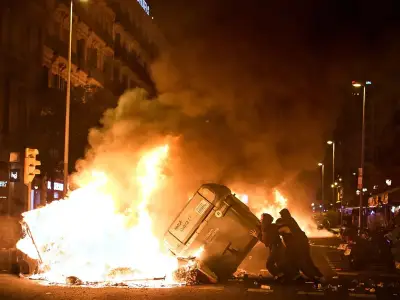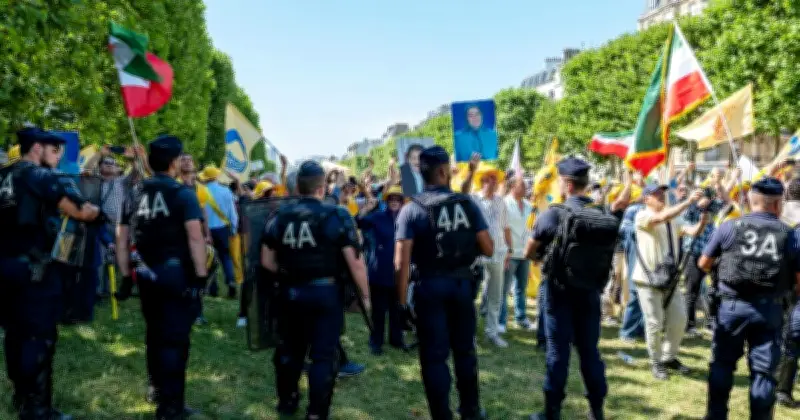
French police officers stopped an Express journalist from interviewing demonstrators at a 'Free Iran' protest in Paris after the rally was shut down due to a bomb threat. The incident occurred on June 20, 2026, when up to 100,000 anti-Iranian regime demonstrators were expected to gather at Place Vauban to campaign for the end of the Ayatollah's rule. However, following reports of two bomb threats—one allegedly linked to the Iranian Revolutionary Guard Corps (IRGC)—a judge ordered the march to be cancelled.
Journalist Denied Access
Despite the last-minute ban, tens of thousands of supporters, unaware of the cancellation, were still due to descend on the capital. Early reports suggested 20 people had been arrested and 12 seriously wounded in scuffles with police. In one notable interaction, journalist Paul Baldwin was denied access to interview disappointed demonstrators by a French police officer. In a video recorded by Paul, he says: "I'm not allowed to go in there and report on it?" The officer, shrugging his shoulders, responds: "It's not my problem." Paul counters: "You know I am a journalist and you are stopping me from doing my job?" The officer, dressed in full riot gear, refuses to budge. Paul points out: "So you are a French policeman and you're stopping a British journalist from doing my job?" He calmly explains: "I can't do my job," to which the officer again responds: "Not my problem." Paul notes: "It's not very democratic is it," and adds: "Democracy means that journalists are allowed to operate." The police officer refused to back down despite Paul's protestations.
Context of the Protest
The rally against the hardline Islamic regime in Iran comes as Tehran claimed it was once more closing the vital Strait of Hormuz oil and gas waterway in the Middle East, just days after Donald Trump had announced a 14-point peace deal. The strait, which carries some 20% of the world's oil and gas and nearly 50% of global fertiliser supply, reopened briefly that week after being closed since the US and Israel launched an attack on Iran on February 28. The closure sent fuel prices soaring and has been driving inflation in the global economy. Washington had claimed a deal was done with Iran on Wednesday to end the war and re-open the strait, with JD Vance due to fly to Switzerland to finalise a settlement. But the process was thrown into chaos on Saturday after the IRGC claimed the strait would be shut once more, blaming Israeli strikes against Hezbollah in Lebanon for derailing the talks. Despite the apparent failure of the deal, US Vice President JD Vance and a team from Washington are still expected to meet with Iranian negotiators and mediators from Pakistan in Switzerland on Sunday.
Organisers' Response
A source close to the event organisers, the National Council of Resistance of Iran (NCRI), said: "The rally was threatened by acts of terrorism and the court said if the police didn't stop it the terrorists would place a bomb in the crowd. They said there was an active threat from the monarchists and the regime." A spokesman for the NCRI added: "The Paris Administrative Court ruled today that the police ban on the June 20 demonstration was based on generic grounds devoid of any contextual information. However, intelligence reports submitted to the Court show that the June 20 rally 'is exposed to the risk of a major attack by the Iranian regime or Iranian monarchists.'" The Express has contacted the police authorities in Paris for comment.