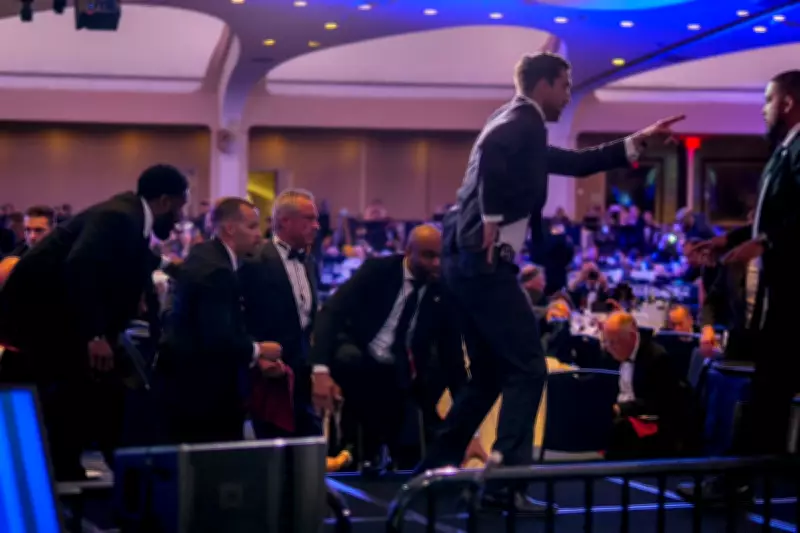
Former Secret Service agents have warned that the attempted attack on the White House Correspondents' Association dinner exposed gaps in security that must be closed to prevent future incidents. While the agency praised its protective model, experts argue that improvements are needed.
System Worked but Needs Improvement
Bobby McDonald, who protected former presidents Bill Clinton and George W. Bush, told The Independent: "The system worked. Could it be much better? Yes. We had a positive outcome, not a successful one." He stressed that the Secret Service must quickly develop enhanced security measures after President Donald Trump insisted the event be rescheduled within 30 days.
McDonald added: "I think they have to have some discussions about creativity. They're going to have to blow up their plan."

Official Response
Secret Service spokesperson Anthony Guglielmi said in a statement: "While the protective model for the White House Correspondents' Dinner event proved effective, the key takeaway for future events is that enhancements should be expected at every level, as that is how the model is designed to function." He noted that every protective decision is driven by intelligence amid a dynamic and elevated threat environment.
The White House did not immediately comment, but Trump praised the Secret Service for acting "quickly and bravely" and doing a "fantastic job."
The Attack
Cole Tomas Allen, 31, of Torrance, California, allegedly armed with a shotgun, handgun, and knives, crashed through a checkpoint but was stopped before entering the ballroom at the Washington Hilton hotel. The same hotel where President Ronald Reagan was shot in 1981.
Allen reportedly checked in on Friday after traveling by train and sent relatives a manifesto criticizing security efforts as focused "outside," adding: "Not a single person there considers the possibility that I could be a threat." He wrote: "What I got is nothing."
Security Layers
Former Secret Service agent Bill Gage described the agency's protective model as "concentric and overlapping layers of security." He said the decades-old protocols include emptying the event space, posting agents at every entrance, using bomb-sniffing dogs, and setting up metal detectors. "The big takeaway is the protective model worked. He got past the magnetometer but didn't get to the next layer."
Gage noted the Washington Hilton has over 1,100 rooms and the dinner drew about 2,300 guests, presenting significant challenges. "It is incredibly difficult for the Secret Service to secure a very busy hotel on a very busy street."
Lessons Learned
McDonald said numerous things could have been done to further safeguard the ballroom, including better time and space distance between checkpoints. He suggested serpentine barriers before magnetometers and equipping agents with ballistic shields. "If he was wearing a suicide vest instead of the weapons he was carrying, we could have had a very different outcome."
Both agents agreed that the attack, like previous attempts on Trump, was a "low-tech attack by people with no training." Gage said there were likely no tripwires to identify Allen beforehand, noting: "We're a free country. We don't keep tabs on our citizens. This isn't China."
McDonald concluded that the US must accept increased security delays at hotels, as seen in other countries: "We have to finally accept the fact that we have to be more accepting of a delay before getting into a hotel because you have to go through some sort of security element."