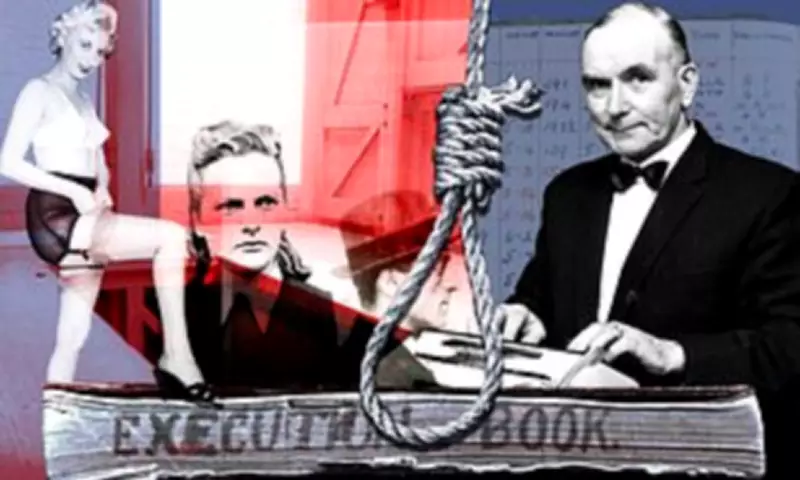
The Unlikely Executioner: Pub Landlord and State Hangman
Albert Pierrepoint presented a most improbable figure as Britain's foremost symbol of state-sanctioned death. To regulars at his pub, the Help The Poor Struggler near Oldham, he appeared the quintessential northern landlord: cheerful, dry-witted, with a steady hand on the beer pump and a talent for running his establishment without fuss. Few patrons could possibly imagine that those same capable hands had ended more lives than any other individual in modern British history.
For more than twenty-five years, Pierrepoint maintained an extraordinary double existence - the jovial publican who simultaneously served as the Home Office's executioner-in-chief. Among the hundreds he dispatched were murderers, traitors, Nazi war criminals, jealous lovers, and violent spouses. In 1955, he performed his most historically significant execution: hanging Ruth Ellis, the last woman ever sent to the gallows in Britain.
The Inflated Death Toll: Truth Behind the Numbers
Pierrepoint prided himself on his professional composure and remarkable speed, famously claiming he could complete an execution in just eight seconds before catching a train home to open his pub. However, historians have now raised serious questions about the accuracy of his extraordinary boasts. The hangman had long claimed to have executed more than 600 people throughout his career, but meticulous examination of official records suggests he may have deliberately inflated these numbers.

Historian Steve Fielding, author of Pierrepoint: A Family of Executions, has painstakingly verified the true figure at 433 executions - significantly fewer than Pierrepoint's claimed total. "I think Albert was trying to make out he was more important than he actually was," Fielding told the Daily Mail. "All hangmen were bound by the Official Secrets Act, and I believe they assumed the full truth would never reach the public domain."
This numerical discrepancy appears particularly striking for a man whose professional reputation rested upon exact measurements and precision timing. In his private diary - a chilling ledger listing the condemned by name, age, height, and weight - Pierrepoint arrived at a total of 550 hangings, claiming there were "missing pages" that would account for additional executions.
The Family Business: Britain's Execution Dynasty
To understand the contradictions at Albert Pierrepoint's core, one must examine the Pierrepoint family itself - Britain's execution dynasty. It began in February 1901 when Henry Pierrepoint, Albert's father, wrote a speculative letter to the Home Secretary expressing his "desire" to become public executioner. That brief note set in motion events that would bind the Pierrepoint name to capital punishment for the next half-century.
Henry quickly rose through Home Office ranks, conducting 105 executions before alcohol destroyed his career. His brother Thomas joined the family business in 1906, eventually executing nearly 300 people before retiring in 1946. Albert, who as an eleven-year-old imagined death as "an adventure" and execution as "romance," excelled under his uncle's tutelage.
The Second World War transformed Albert from tradesman to national figure. Between 1945 and 1949, he executed more than 200 war criminals from Bergen-Belsen and Auschwitz, including Josef Kramer (the "Beast of Belsen") and Irma Grese, the notoriously cruel 21-year-old camp guard. He also hanged British traitors William "Lord Haw-Haw" Joyce and John Amery, who reportedly shook his hand before execution saying, "I've always wanted to meet you, Mr. Pierrepoint, though not in these circumstances."
Controversial Cases and Changing Public Opinion
In the early 1950s, Pierrepoint carried out some of Britain's most controversial executions - cases that would ultimately shape public opinion and push the country toward abolition. One of these was Timothy Evans, the nervous young Welshman convicted of murdering his wife and baby daughter in 1950. Evans insisted he was innocent, accusing his neighbor John Christie of the crimes. Pierrepoint hanged him with his usual efficiency.

Three years later, Christie was revealed as a serial killer, and Evans was posthumously found innocent. The Rillington Place murders, as they became known, were later immortalized in film, with Pierrepoint serving as a non-credited adviser. According to Fielding, Pierrepoint's behavior during this consultation was revealing: "Albert oversaw the execution scene, and some secretaries on the set were being sick because he would be so graphic and so light-hearted about it."
The execution that perhaps most profoundly affected public sentiment came on July 13, 1955, when Pierrepoint hanged Ruth Ellis, the 28-year-old blonde nightclub hostess who had shot her lover, racing driver David Blakely. Ellis immediately became a symbol of a nation growing increasingly uneasy with capital punishment. Pierrepoint was spat at by crowds as he arrived to perform his duties.
The Darker Truth: Enjoyment and Embellishment
For decades, Pierrepoint insisted he was merely a dutiful civil servant performing an unpleasant task on behalf of the state. He claimed to take no pleasure in death, only pride in doing his job efficiently and humanely. However, an unearthed 1987 radio interview, aired five years before his death, suggests a different reality. When asked about state-sanctioned killing, Pierrepoint admitted, "I've enjoyed every bloody minute of it."
In 2023, author and historian Ben Macintyre delivered a particularly incendiary reassessment, branding Pierrepoint "one of Britain's worst serial killers." Macintyre wrote: "More recent research and evidence and changing attitudes toward capital punishment suggest he was something very different... A callous, self-important brute who claimed to be motivated by sacred impulses, fastidiously recorded his trail of death, relished his own macabre notoriety, killed several innocent people, and went on hanging people without remorse."
After retiring in 1956, Pierrepoint secured a lucrative newspaper deal to reveal the last moments of notorious criminals he had executed. The series, Pierrepoint Speaks, enraged the Home Office, which threatened legal action. Only after interviewing witnesses - whose memories clashed with Pierrepoint's dramatic accounts - did officials decide his "startling revelations" were little more than journalistic embellishment rather than breaches of state secrets.
Legacy of a Grim Dynasty
Albert Pierrepoint died in 1992 at age 87 in a nursing home in Southport, Merseyside. With his death ended the Pierrepoint dynasty - three men who, over fifty-five years, hanged more than 830 people across eight countries. Capital punishment was eventually abolished in Britain in 1969.
Fielding ultimately rejects claims that Pierrepoint was a serial killer, instead viewing him as a profoundly contradictory figure. "I find him a very contradictory person," Fielding said. "A lot of the things he said in his book weren't actually true... But assertions that Pierrepoint enjoyed killing, or was a serial killer, were rubbish. He didn't walk around with a black hood on. He was a separate person. He went to the prison, did the job, then went back behind his bar and served his customers. It was just a day's work."
Yet the questions persist: Was Albert Pierrepoint truly the reluctant executioner he claimed to be, or was he someone who secretly enjoyed the power and status his unique position conferred? The evidence suggests a complex man who carefully cultivated his public image while privately inflating his grim accomplishments - a cheerful pub landlord who happened to be Britain's most prolific agent of state death.