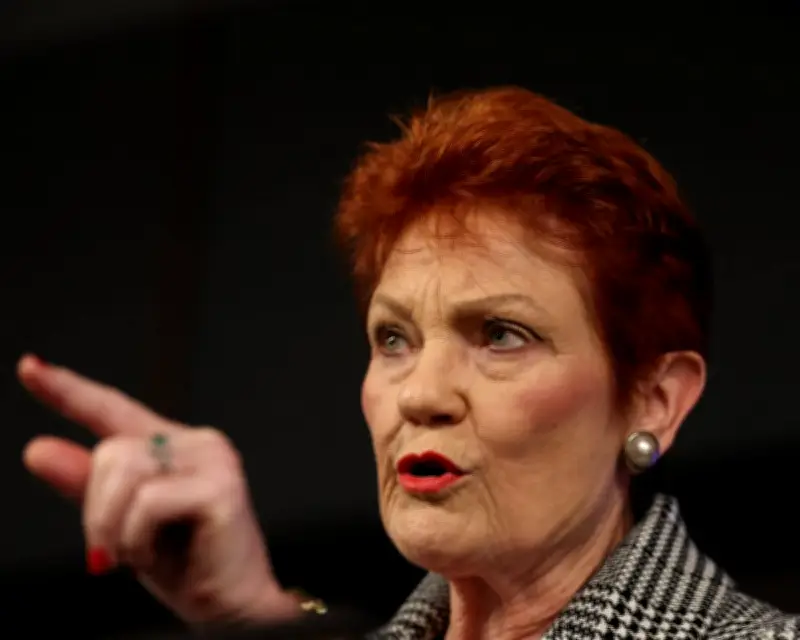
The Media Arts and Entertainment Alliance (MEAA) has condemned One Nation leader Pauline Hanson's attack on Guardian Australia senior correspondent Sarah Martin, with Prime Minister Anthony Albanese calling on journalists to defend public broadcasters SBS and the ABC.
After her landmark address to the National Press Club in Canberra on Wednesday, Hanson called Martin "trashy" for asking about her daughter Lee Hanson's employment by a NSW One Nation senator, despite living and working in Tasmania. Martin revealed in February that Lee Hanson has been spearheading the party's expansion in Tasmania while receiving a taxpayer-funded salary of about $150,000 a year for her work for a NSW One Nation senator.
Hanson said Martin would be banned from future events because of critical coverage, accusing her of harbouring an "obsession" with Hanson herself and billionaire patron Gina Rinehart. She had previously said she would ban the ABC and the Guardian from attending her events.
MEAA Condemns Attack
The MEAA called the attack "bitter, personal and unprofessional" and warned attempts by One Nation to ban Guardian Australia and the ABC from press conferences constituted an assault on the freedom of the press.
"Hanson's actions stand in stark contrast with her remarks that she welcomes the scrutiny of the media on her party, its people and its politics," the statement said. "[Martin] is an experienced and professional journalist who was attending her place of work to do her job of holding the powerful to account. Journalists must be provided with safe workplaces, free from abuse, so we can uphold the public's right to know."
Political Reactions
The union called for journalists to stand with colleagues seeking to report in the public interest when they are attacked or targeted by politicians. The prime minister said parties seeking to exclude media organisations or cut public broadcasting were misguided.
"I would hope that all media organisations come out and oppose that, because they should, because they're vital roles in our democracy," he said.
The federal parliamentary press gallery committee president, Jane Norman, issued a statement on behalf of journalists working in Parliament House. "The ability to scrutinise and question politicians is one of the fundamental functions of our work as journalists," it said. "Against this backdrop, the gallery strongly objects to threats made by One Nation – or by any political party – to ban certain journalists and organisations from doing their jobs as important observers and interpreters of federal politics. Journalists have an essential role to play in a free and open democracy, and such restrictions will weaken the country's political system."
Hanson's Broader Attacks on Media
Hanson used the speech to call for SBS to be shut down and for the ABC to transition to a subscription model for metropolitan Australia and only some regional services to receive taxpayer funding.
RMIT University media academic Alexandra Wake said the plan would "weaken one of the last widely trusted pillars of the Australian media system and one that supports our much-valued democracy. At a time of rising misinformation and declining trust in media globally, reducing support for the country's most reliable news providers would not only undermine informed citizenship, but erode social cohesion and democratic resilience," she said.
An SBS spokesperson declined to comment on One Nation's plans, consistent with its obligations around impartiality. The ABC told Guardian Australia the principle of universal access was increasingly important "in a world where the majority of content is only available behind a paywall."
"Australians should be able to continue to rely on the ABC as the most trusted source of news and information," a spokesperson said. "Australian music and other creative industries would also be substantially negatively impacted without a freely available ABC and its numerous varied services."