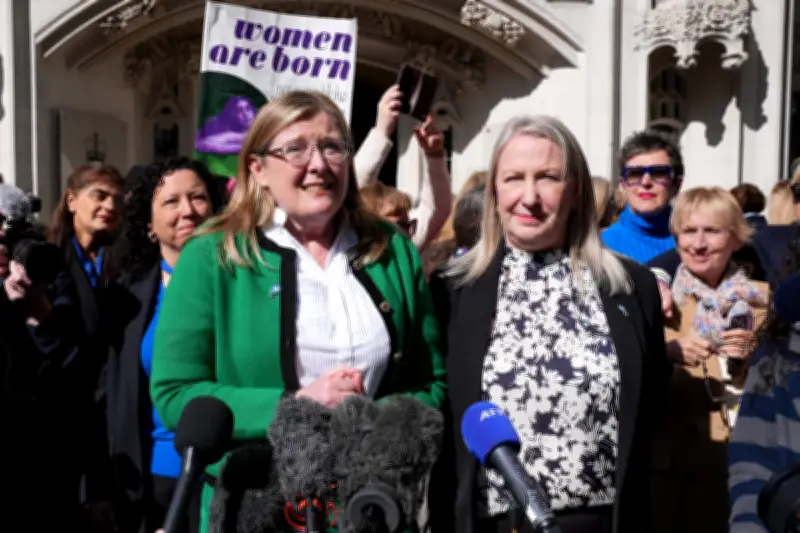
A campaign group has hailed a “victory” for vulnerable women prisoners after a judge ruled it is unlawful for trans women to be housed in the female prison estate.
Lady Ross has published her decision following the petition for judicial review brought by For Women Scotland (FWS), which challenged the Scottish Government’s policy on the treatment of transgender prisoners.
The group had challenged the lawfulness of the Scottish Prison Service (SPS) policy of holding some trans women – who are biological men – in women’s prisons. It came after FWS won a Supreme Court case in April last year which saw judges at the UK’s highest court make clear the term “woman” in the Equality Act refers to a biological woman.
In her decision published on Friday, Lady Ross ruled the prisons guidance is “unlawful”.
Susan Smith of FWS said: “We are delighted to have won such a comprehensive victory in our judicial review on Scottish prison policy. All the arguments from the Scottish ministers were comprehensively rejected by the court, not least their claim that housing trans-identified male prisoners in the male estate would breach their convention rights. We hope that, in future, the Scottish Government will start to listen to us rather than the lobby groups who drafted these policies and have so egregiously misled MSPs and MPs. We should never have needed to take this case and we hope this will be the last time that we are forced to go to law to defend the rights of women. Ultimately, this is a victory for the very vulnerable women in the prison estate.”
During hearings in February, Gerry Moynihan KC for the Scottish Government told the Court of Session in Edinburgh it is right for ministers to take a “case-by-case” approach on transgender prisoners. Mr Moynihan said the issue was not a “trivial matter”, citing case law and article eight of the European Convention on Human Rights in relation to the rights of trans people to live in their acquired gender.
Lady Ross however said in her ruling that while trans prisoners have rights under article eight, this does not extend to a right to be accommodated in a prison for the opposite biological sex. Article eight rights are qualified and there is a justification for maintaining sex segregation in prisons, she said. She also said that while there are obligations in terms of article two to protect life and article three not to subject prisoners to inhuman or degrading treatment, there is “no positive obligation, in general terms, based on article two or article three, to accommodate a trans prisoner in a prison for the opposite biological sex”.
Lady Ross also wrote: “Insofar as the prisons guidance allows SPS to accommodate trans prisoners in prisons for the opposite biological sex, it is in conflict with the requirement that prison accommodation be provided separately for men and women. That constitutes a mis-statement of the law.” She concluded that “in all the circumstances, the prisons guidance is unlawful”.
The case came amid the outcry over trans rapist Isla Bryson – formerly known as Adam Graham – who was initially sent to Cornton Vale women’s prison in Stirling after being found guilty in 2023 of raping two women, before then being moved to a male prison.
The Scottish Government and Scottish Prison Service have been approached for comment.