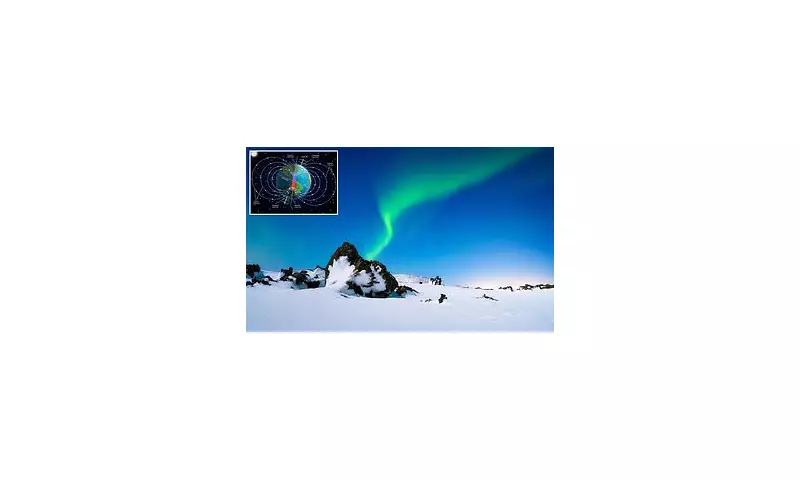
A leading Earth scientist has issued a stark warning that our planet possesses not one, but two North Poles, and the accelerating drift of one of them poses a silent threat to the global navigation systems we rely on daily.
The Dual Poles: True North vs. Magnetic North
According to research professor Scott Brame of Clemson University, while we are familiar with the concept of 'true north' – the fixed point at the top of the Earth's rotational axis – there is a second, more elusive point: the 'magnetic North Pole'. This magnetic pole is the one to which every compass needle points and is the fundamental reference for countless modern navigation tools, from smartphone maps to car GPS systems.
For centuries, this magnetic pole has been wandering across northern Canada. However, its leisurely pace has undergone a dramatic change. Since the 1990s, its speed has rocketed from roughly six to nine miles per year to approximately 34 miles per year, a shift that has profound implications for digital navigation.

Why Your Phone's Map Could Lead You Astray
The core of the problem lies in how our devices calculate direction. They use the World Magnetic Model, a constantly updated map of Earth's magnetic field, to translate GPS location data into a reliable bearing. If the magnetic pole moves faster than scientists can predict and the model isn't refreshed in time, the foundational reference point becomes inaccurate.
This discrepancy could lead to significant errors in everyday apps. People could be given wrong directions, sent on longer routes, or even face genuine safety risks in remote areas where precise navigation is critical. Brame, an expert in geology and hydrogeology, emphasises that regular updates to these global models are essential to prevent such scenarios.
The Turbulent Core: What's Driving the Acceleration?
The reason for this magnetic wanderlust lies deep within our planet. Earth has a solid inner core surrounded by a molten outer core of liquid iron and nickel. The churning motion of this metallic ocean, driven by immense heat, generates the planet's magnetic field.
A 2020 study published in Nature Geoscience concluded that the recent acceleration of the magnetic North Pole is primarily caused by changes in the flow patterns of this molten iron. While the broad mechanism is understood, the exact trigger for these specific changes in the outer core's behaviour remains a mystery to scientists.
This creates a charming seasonal conundrum, as Brame illustrates. If Santa Claus, whose legendary home is at the geographic North Pole, used a simple compass on Christmas Eve, he would need to correct for the 'declination' – the angle between true north and magnetic north at his location. Modern smartphones handle this automatically with a built-in magnetometer, but both methods ultimately depend on knowing where magnetic north truly is at any given moment.
The lesson is clear: our digital world is intimately tied to the planet's ancient, physical processes. As the magnetic pole continues its rapid journey, the silent, behind-the-scenes work of scientists updating our global models becomes ever more vital to ensure our technology keeps us on the right path.