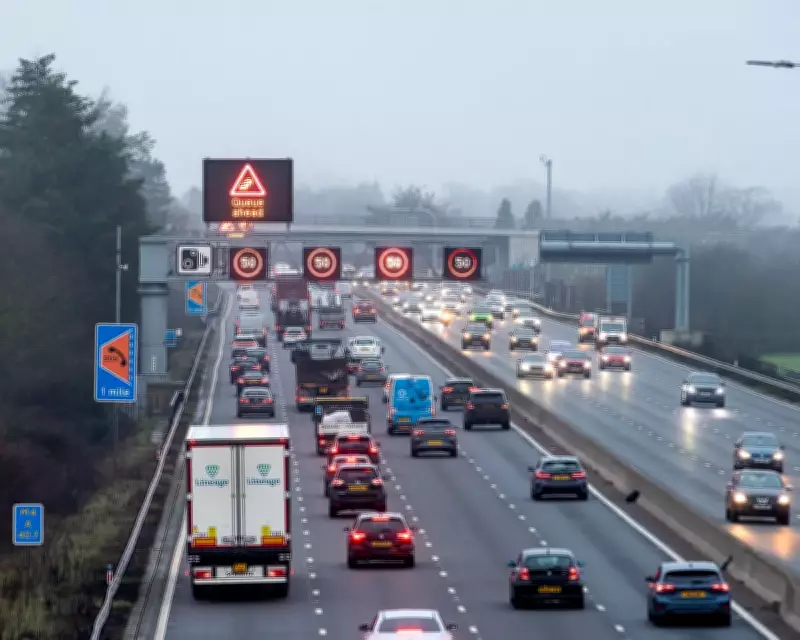
Official evaluations from National Highways have concluded that most of Britain's smart motorway schemes represent poor or very poor value for money. The long-awaited reports, which assess projects converting hard shoulders on major motorways like the M1, M4, M6, and M25, were finally published after being held back by the Department for Transport since 2023.
Financial Assessments Reveal Widespread Underperformance
Of the 11 motorway schemes evaluated over a five-year period since opening and given financial assessments, only two received positive ratings. The remaining nine were classified as delivering poor or very poor value for the substantial public investment. These 11 schemes, completed between 2017 and 2019, cost approximately £2.3 billion at 2010 prices.
AA Condemns "Catastrophic Waste" of Resources
The Automobile Association has responded strongly to the findings, describing smart motorways as a "catastrophic waste of time, money and effort." AA President Edmund King highlighted that many schemes have resulted in slower journeys, increased traffic congestion, and worsened motorway safety records. Recent AA polling indicates that 47% of drivers feel anxious or nervous when using smart motorways.

Mixed Safety Performance and Traffic Management Issues
The reports present a complex safety picture, with some sections showing slight increases in fatalities and serious injuries. On the M3 and specific stretches of the M1 between junctions 29 and 42, there were measurable increases in serious incidents. National Highways acknowledges that while most schemes met their safety objectives, additional work has been necessary to enhance safety through measures like 150 additional emergency areas and improved stopped vehicle detection technology.
Traffic management has also proven problematic, with Elliot Shaw, National Highways' chief customer officer, noting that "traffic on some smart motorway sections is not travelling as quickly as was forecast." This slower-than-expected traffic flow has contributed significantly to the poor value assessments, alongside lower-than-projected traffic growth following the 2008 financial crisis.
Controlled Motorways Emerge as Successful Alternative
One notable exception to the generally poor performance was the M25 scheme between junctions 16 and 23. This project, which involved widening and converting to a "controlled motorway" while retaining the hard shoulder, delivered high value for money with improved safety records and faster journey times. The AA has pointed to this model as the standard that should be adopted for future motorway improvements.
Industry and Government Responses
Transport Action Network director Chris Todd criticized the reports for displaying "a remarkable lack of curiosity over how the danger has increased from vehicles stopped in live running lanes." He suggested the evaluations raise more questions than they answer about the fundamental safety of smart motorway designs.
Despite the critical findings, both National Highways and the Department for Transport maintain that smart motorways provide important benefits. A National Highways spokesperson stated: "Our latest analysis continues to show that overall, smart motorways remain our safest roads. They are also providing much needed extra capacity for drivers, helping to reduce congestion and lower carbon emissions."
The Department for Transport echoed this perspective, noting that the reports demonstrate smart motorways' ability to "make journeys reliable and increase road capacity, so more vehicles can travel safely." However, the overwhelming evidence of poor value for money in most schemes suggests significant challenges remain for this controversial approach to motorway management.