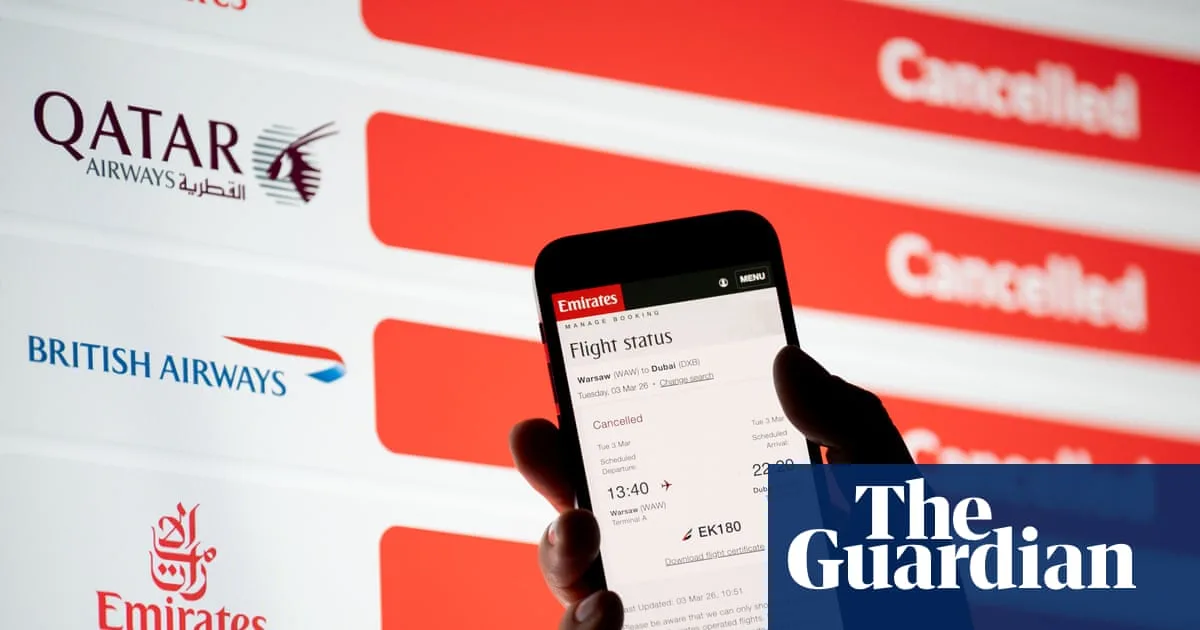
Iran Conflict Triggers Global Aviation Crisis: Thousands Stranded as Airlines Cancel Flights
Thousands of holidaymakers and business travellers have been left stranded across the globe as the escalating conflict between Iran and joint US-Israeli forces has sparked unprecedented disruption to international air travel. Major airlines including British Airways, Emirates, and Qatar Airways have been forced to cancel or divert flights at short notice after vast swathes of Middle Eastern airspace were abruptly shut down.
Airspace Closures Bring Busiest Aviation Corridors to Standstill
The aviation chaos represents the most significant disruption to global air transport since the COVID-19 pandemic, with Flightradar24 data showing civilian flights avoiding Iranian and Iraqi airspace entirely. Airspace across Iran, Iraq, Israel, Kuwait, Bahrain, Qatar, and the United Arab Emirates has been either fully or partially closed, bringing one of the world's busiest aviation corridors to a complete standstill.
More than 3,400 flights were cancelled on Sunday alone across seven major Middle Eastern airports, according to flight tracking data. The knock-on effects have spread far beyond the region, with Dubai, Doha, and Abu Dhabi typically handling approximately 90,000 transit passengers daily between them according to aviation analytics firm Cirium.
Major Airlines Implement Emergency Cancellations
Multiple carriers have taken immediate safety measures in response to the escalating military situation:
- British Airways has cancelled flights to Tel Aviv and Bahrain through March 3, scrapped services to Amman, and made schedule adjustments affecting Gulf routes including Doha and Dubai. One Heathrow to Doha service was forced to turn back mid-air.
- Emirates has suspended all flights to and from Dubai following temporary closure of UAE airspace.
- Qatar Airways has temporarily halted operations due to Qatari airspace closing.
- Virgin Atlantic cancelled Heathrow services to Dubai and Riyadh.
- Lufthansa Group (including Lufthansa, SWISS, Austrian Airlines, Brussels Airlines and ITA Airways) has suspended flights to Tel Aviv, Beirut, Amman, Erbil, and Tehran until at least March 7.
- Air France has cancelled services to Dubai, Riyadh, Beirut and Tel Aviv.
- Air Canada has cancelled flights to Israel until March 8 and to Dubai until March 3.
- Turkish Airlines has halted flights to Lebanon, Syria, Iraq, Iran and Jordan.
Additional carriers including Etihad Airways, flydubai, American Airlines, Wizz Air, KLM, Finnair, Norwegian, Delta Air Lines, Middle East Airlines, Air India, IndiGo and Air India Express have all implemented significant cancellations or suspensions affecting Gulf routes.
Safety Concerns Mount Amid Regional Strikes
The aviation disruption follows retaliatory attacks across the Gulf region after joint US-Israeli strikes on Iran. Dubai International Airport confirmed four people were injured following strikes, while one person was killed and seven others wounded in a drone strike at Zayed International Airport in Abu Dhabi. Strikes were also reported at Kuwait International Airport with multiple injuries.
On Saturday, two ballistic missiles were fired in the direction of Cyprus. UK Defence Secretary John Healey stated the missiles were not believed to have been "targeted" at Cyprus, but warned Iran's attacks were becoming "increasingly indiscriminate, widespread and uncontrolled."
Travel Experts Warn of Prolonged Disruption
Industry analysts predict the travel chaos could last for several days, with comparisons drawn to a previous US-Israeli strike on Iran in 2025 that caused 12 days of disruption.
"To be honest, if you haven't left home, chances are you won't be leaving home if you're supposed to travel to or through these destinations for at least several days, if not longer," industry analyst Henry Harteveldt told AP. "And if you are returning home, you will have to be very creative about how you get home."
Travel expert Simon Calder told the Mirror that predicting when services will fully resume remains difficult, though some airlines have suggested limited resumptions could begin from Sunday afternoon if safety assurances are received.
"At the moment though, if I had a flight booked back from Doha then, my goodness me, my absolute sympathy with anybody who is stuck in a war zone with missiles coming in," Calder said. "It is unbelievable and I am so, so sorry it is happening."
Passenger Rights and Government Warnings
Jo Rhodes, a travel expert at consumer group Which?, warned passengers they will not be entitled to compensation for cancellations caused by the conflict due to "extraordinary circumstances." However, passengers flying with UK or EU airlines, or departing UK or EU airports with any carrier, should receive assistance during delays including food, drink, and where necessary, overnight accommodation. Full refunds are available for cancelled journeys.
The Foreign Office has urged British nationals in affected countries to "immediately shelter in place" and avoid all travel to Israel and the Palestinian territories. Britons in Bahrain, the UAE, Qatar, and Kuwait have also been advised to remain indoors and follow local authority instructions.
Former US air traffic chief Mike McCormick suggested parts of the region's airspace could potentially reopen within 24 to 36 hours depending on military developments, but stressed the outlook remains highly uncertain as the conflict continues to evolve.