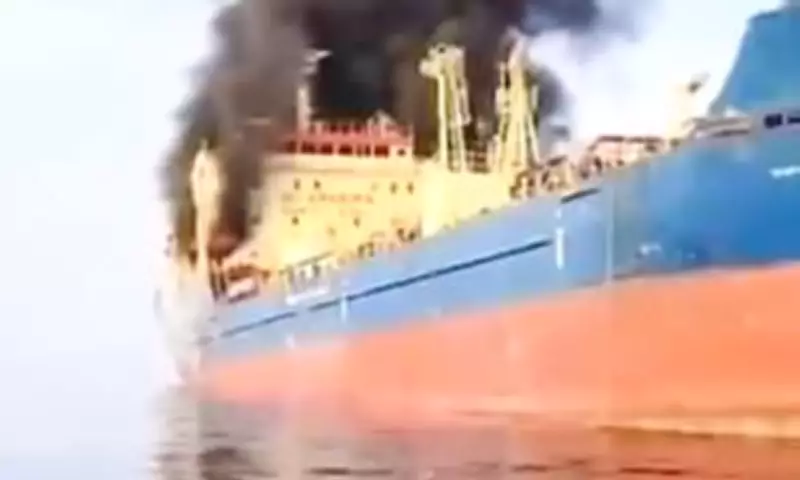
A dramatic incident unfolded today as a tanker burst into flames after being struck by an Iranian attack, leading to an immediate halt in shipping through the strategically crucial Strait of Hormuz. Global markets are now bracing for a potential surge in oil prices, with experts warning of significant economic repercussions.
Shipping Grinds to a Halt Amid Security Threats
The threat of Iranian reprisal attacks has caused at least 150 tankers to drop anchor, as major shipping companies refuse to navigate the 100-mile-long passage, which narrows to just 24 miles at its tightest point. This decision comes in response to a VHF radio transmission from the Iranian Revolutionary Guard, highlighting the clear and present danger to vessels.
One tanker, identified as the Palau-flagged Skylight, was left burning in the sea, forcing the evacuation of its Indian and Iranian crew. Officials in Oman reported that four mariners were injured in this morning's attack. Separately, Al Jazeera indicated that a Marshall Islands-flagged tanker, MKD VYOM, was reportedly hit by a projectile off the coast of Oman.

Reprisals for Khamenei's Death Escalate Tensions
These maritime incidents are part of broader reprisals following the American-Israeli operation that resulted in the death of Ayatollah Ali Khamenei yesterday. Attacks have extended to naval bases used by the United States and a port in Dubai. Specifically, Iran struck the port of Duqm in Oman, a key logistical hub for the US Navy capable of hosting aircraft carriers.
Yesterday, Dubai's Jebel Ali Port was impacted by debris from an aerial interception, sparking at least one fire. Today, reports emerged of three rockets fired at a naval base in Abu Dhabi, with two intercepted. In response, ports in Dubai, Oman, and Bahrain have suspended operations, compounding the disruption.
Global Oil Supply at Risk
The Strait of Hormuz is a vital conduit for global energy, with approximately 20% of the world's oil and 25% of liquefied natural gas flowing through it. Although Iran has not officially blockaded the sea route, experts predict shipping may not resume for several days, threatening to send oil prices soaring. This could lead to petrol price increases on a scale not seen since Russia's invasion of Ukraine four years ago.
Susannah Streeter, Chief Investment Strategist at Wealth Club, warned that halting supplies through this critical passage could cause a 'shock' for financial markets, just as inflation appeared to be coming under control in countries like the US and the UK. She stated, 'Financial markets are set for another shock of volatility following fresh strikes in Iran. Oil prices had already been creeping up as nerves became more frayed and they are set to shoot sharply higher given the risks of disruption to global oil supplies.'
Market Reactions and OPEC+ Response
Michael Brown of market analysts Pepperstone noted that the price of crude oil is set to rise 'significantly higher,' at least temporarily. However, he added a note of caution, saying, 'It's important to remember that geopolitical events tend not to be a trigger for durable or longer-lasting market moves in any asset.'
In a related development, OPEC+, which includes key oil producers such as Saudi Arabia and Russia, announced a greater-than-expected increase to the cartel's oil production quotas of 206 thousand barrels per day, set for April. The cartel cited 'a steady global economic outlook and current healthy market fundamentals,' without directly mentioning the Iran conflict.
Immediate Impacts and Safety Concerns
The American military has issued a warning, stating it cannot guarantee the safety of ships travelling through the Strait of Hormuz, where the Persian Gulf flows into the Arabian Sea. This has led major companies like European giants MAERSK and CAM CGM to suspend shipping, concerned about threats from rockets, drones, and mines.
Shipping data revealed that at least 150 tankers, including crude and liquefied natural gas vessels, dropped anchor in open Gulf waters beyond the Strait of Hormuz, with dozens more stationary on the other side of this chokepoint. According to Reuters estimates based on ship-tracking data from the MarineTraffic platform, these tankers were clustered off the coasts of major Gulf oil producers including Iraq, Saudi Arabia, and LNG giant Qatar.

Video evidence from yesterday showed a rocket landing in the water 200 meters away from another vessel anchored off the UAE coast, underscoring the volatile security situation. As tensions escalate, the global community watches closely, with the potential for prolonged disruption to energy markets and broader economic stability hanging in the balance.