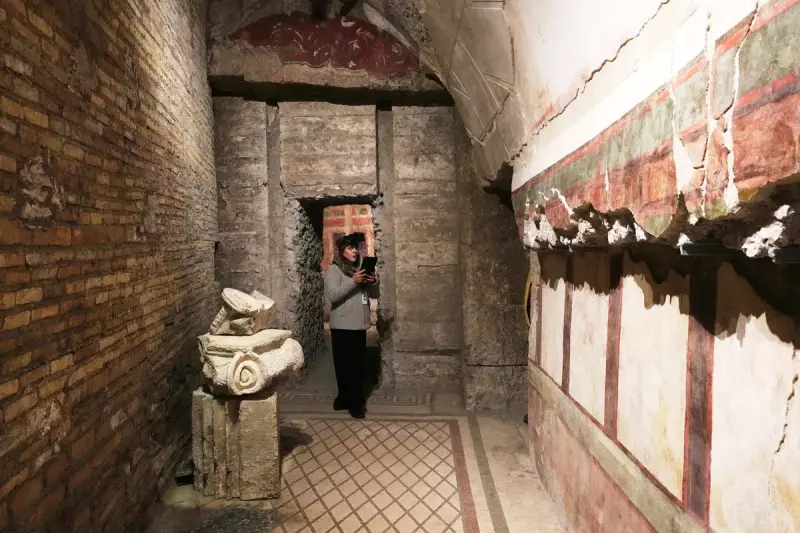
For the first time, the public can explore one of ancient Rome's best-preserved homes from anywhere in the world, thanks to a pioneering livestream tour. The House of the Griffins, a stunning Republican-era residence buried beneath the Palatine Hill, is opening virtually from 3 March 2026.
A Hidden Gem Revealed Through Technology
First uncovered in early 20th-century excavations, the House of the Griffins has remained largely inaccessible due to its precarious underground location. Situated near the Colosseum, the home was built during the Roman Republican era (509-27 B.C.) and was later sealed when Emperor Domitian constructed his palace above it in the first century A.D.
Now, visitors will not physically descend its steep staircase. Instead, they will watch a live feed as a guide, like the park's Valentina featured in previews, wears a head-mounted device to navigate the intimate rooms. This innovative approach protects the delicate, newly restored frescoes from damage caused by excess humidity and carbon dioxide from crowds.

An Elite Home Frozen in Time
According to project chief Federica Rinaldi, the house's owners were clearly affluent. The quality of decoration rivals the elegant homes found in Pompeii. The domus gets its name from a magnificent arched fresco depicting two griffins—mythical creatures that are half-eagle and half-lion.
"Its location at the highest point of the hill, its distribution over several levels... and its preservation make it today an almost textbook reference," Rinaldi stated. "It was certainly a domus of the highest standard." The interiors feature richly coloured faux marble designs and intricate floor mosaics creating three-dimensional cube patterns.
Managing Tourism and Expanding Access
The weekly livestreams, held on Tuesdays with sessions in Italian and English, are part of a broader strategy to alleviate pressure on Rome's most crowded sites. Simone Quilici, head of the Colosseum Archaeological Park, said it's a "great occasion to value the full territory of the park."
The restoration was funded by the European Union and is one of ten projects within the park. Access requires a reservation and an additional ticket on top of the standard Colosseum-Palatine Hill entry fee, with groups limited to just a dozen people per session. This initiative cleverly uses technology to both preserve history and democratise access to a fragile archaeological treasure.