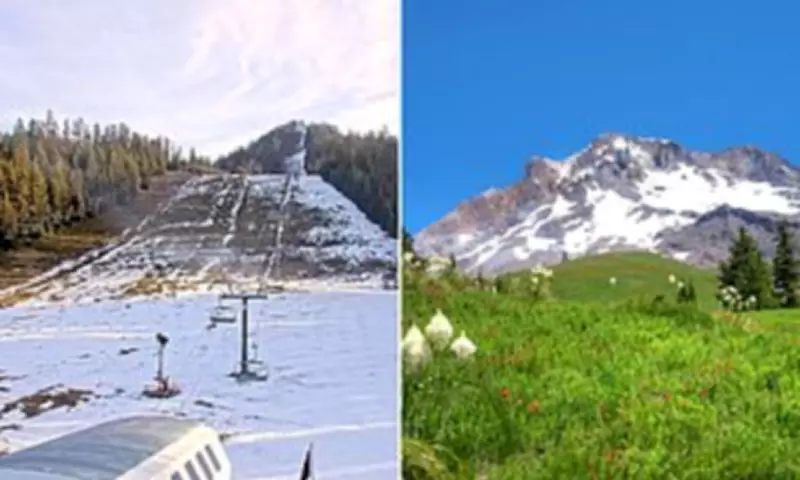
The winter sports industry in Oregon is facing an unprecedented crisis as a severe snow drought continues to grip the region, placing the entire ski season in jeopardy. With resorts reporting dramatically reduced operations and some forced to close indefinitely, the situation highlights broader environmental concerns affecting water resources across multiple Western states.
Mount Hood Resorts Struggle with Limited Operations
On Oregon's iconic Mount Hood, the situation has become increasingly dire for ski resorts that typically serve as winter destinations for Portland residents and visitors alike. Skibowl, a prominent resort on the mountain, made the difficult decision to suspend all skiing operations until sufficient snowfall returns. This announcement came as other resorts on the mountain faced similar challenges in maintaining normal operations.
Mount Hood Meadows, another major resort on the mountain, found itself operating with just seven of its eleven lifts scheduled to open recently. The resort's typically optimistic snow reports have been forced to acknowledge the reality of the situation, with one recent update describing "Spring-like conditions" characterized by sunny skies, warm temperatures, and limited snow coverage.

Trail Closures and Reduced Capacity Across Oregon
The impact extends beyond Mount Hood to other popular skiing destinations throughout Oregon. Willamette Pass, located further south in the Cascade Mountains, has been operating with only two of its six lifts open, providing access to just one trail out of the thirty typically available to skiers. This represents a staggering reduction in capacity that significantly impacts both recreational opportunities and economic activity.
At Timberline Lodge on Mount Hood, the situation appears equally challenging with only five of nine lifts operational. The resort's snow base measurement of just forty inches represents a dramatic sixty-inch deficit compared to historical averages for this time of year. Mount Ashland, situated in the southernmost part of the state, has taken the extreme measure of pausing all operations indefinitely due to insufficient snowpack.
Broader Western States Snow Drought
Oregon's struggles form part of a larger pattern affecting multiple Western states identified by federal authorities as experiencing severe snow drought conditions. The implications extend beyond winter sports, as healthy snowpack during winter months directly contributes to water reserves during spring and summer when melting snow feeds rivers, lakes, and reservoirs.
Vail Resorts, the world's largest ski company, reported that only eleven percent of its terrain in the Rocky Mountains was open during December, with snowfall in November and December measuring fifty percent below typical levels. Company executives described the early season as one of the worst in over three decades for western United States snowfall.
Regional Variations and Artificial Snow Solutions
While the broader Western region faces challenges, some variations exist between states and elevations. Utah has fared slightly better than neighboring states, particularly at higher elevation resorts like Snowbird which have managed to open nearly all trails. However, lower elevation resorts in Utah have been forced to rely heavily on snow-making equipment throughout the winter, whereas typically such measures would only be necessary at the season's beginning.
Experts note significant differences between natural and artificial snow, with McKenzie Skiles, director of the Snow Hydrology Research-to-Operations Laboratory at the University of Utah, explaining that man-made snow consists of smaller, icier particles that don't provide the same experience as natural powder days. This presents particular challenges in a state like Utah whose tourism motto promotes "The Greatest Snow on Earth."

East Coast Contrast and Northern Rockies Exception
In stark contrast to Western struggles, East Coast ski resorts are experiencing one of their best seasons in decades thanks to multiple snowstorms and persistently cold temperatures. Northern Vermont resorts including Jay Peak, Killington, and Stowe all report snow bases exceeding one hundred fifty inches, with Jay Peak actually boasting more snowpack than Alaska's Alyeska Resort, which typically receives the highest precipitation levels in the nation.
For those seeking something closer to the traditional Western skiing experience, the Northern Rockies region offers somewhat better conditions, though with significant qualifications. Michael Downey, drought program coordinator for Montana, notes that only Montana and western Wyoming are in decent shape, and even then only at elevations above six thousand feet. Medium and lower elevations in these areas face conditions as poor as experts have ever recorded.
The current situation represents a dramatic reversal of traditional patterns, with Western skiing long prized for its challenging runs, lighter crowds, and famously powdery snow now struggling while Eastern resorts enjoy exceptional conditions. This shift highlights the complex relationship between climate patterns, regional weather systems, and the winter sports industry that depends so heavily on predictable seasonal conditions.