Exploring the GeoKarst: A Cross-Border Journey Through Slovenia and Italy's Subterranean Wonders
GeoKarst: Slovenia and Italy's Cross-Border Cave Network

The GeoKarst region, a newly established cross-border geopark funded by the European Union, offers a breathtaking exploration of the unique landscapes spanning western Slovenia and eastern Italy. This area is renowned for its porous limestone rock, which creates a distinctive terrain both above and below ground, featuring thousands of caves, gorges, and medieval villages near Trieste.

Delving into the Depths: The Cave Networks of Karst

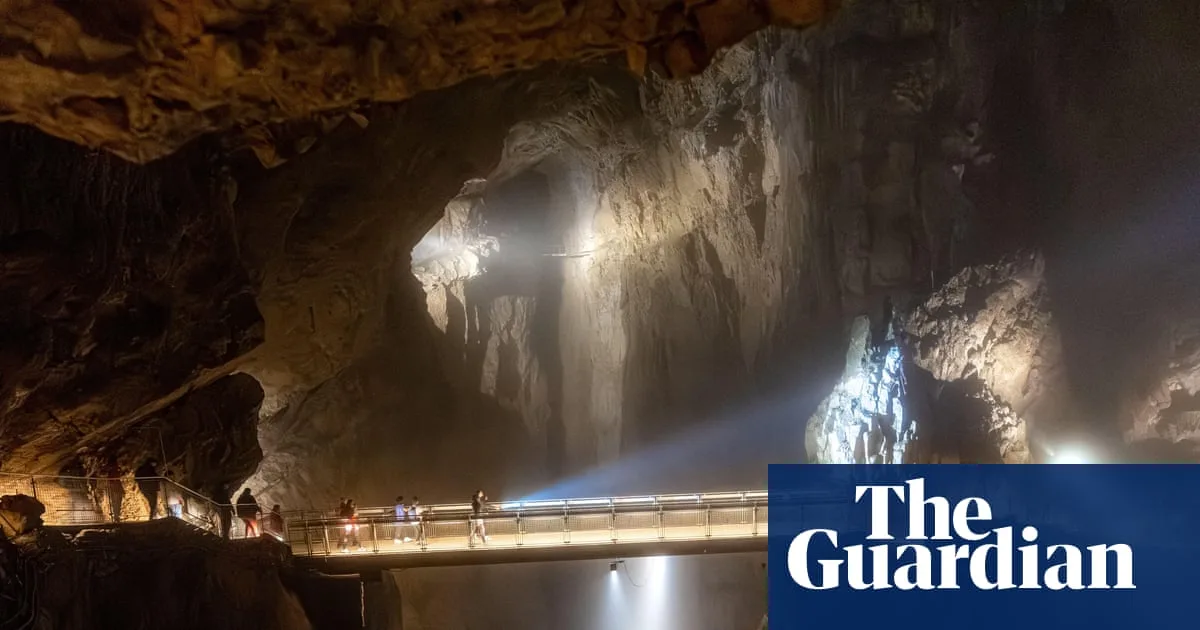
One of the highlights of this region is Vilenica, believed to be the world's first cave ever opened to tourists, with visitor records dating back to 1633. When the lights are turned off, visitors experience total darkness, accompanied by the gentle sound of dripping water and a palpable sense of unease. Upon illumination, the cave reveals a grand antechamber sculpted by erosion, filled with soaring stalagmites and plunging stalactites. These formations are streaked in shades of red, terracotta, and orange due to iron oxide, and dotted with shimmering crystals, creating a magical sight.

This cave is part of a vast network of thousands of caves in the Karst region, known for its soluble limestone rock. Above ground, the landscape is marked by rocks with lined striations and hollows called dolines, where the limestone has collapsed. Below ground, however, is where the true wonder lies, with enormous caves, sinkholes, and subterranean rivers.

The Majestic Škocjan Cave

Later in the day, a visit to Škocjan cave provides an awe-inspiring experience. Here, an underground river thunders through a chamber almost 150 metres high, creating an almost surreal sensory experience. The rush of the rapids echoes around the walls, highlighting the power and beauty of this natural phenomenon. This cave contains deep chasms and a rapidly flowing river, making it a must-see destination for any traveller.

A Cross-Border Region with a Shared Identity

As one travels through the Karst region, the undulating hills of a comparatively untouched countryside come into view, dotted with bilingual villages that connect eastern Italy and western Slovenia. This border shifted several times over the 20th century, but increasingly, the area views itself as one region spanning two countries. To combat the overtourism plaguing Italy and Slovenia's better-known destinations, GeoKarst aims to attract visitors seeking a slower, more authentic, and local experience.

The establishment of the GeoKarst geopark showcases the shared history, nature, and culture of the region, with hopes of securing a Unesco designation in the future. This initiative highlights the unique landscape of caves, gorges, and medieval villages, promoting sustainable tourism and community spirit.

Medieval Charm in Štanjel

Winding around the region's hills leads to Štanjel, a medieval village that evokes the charm of Provence but without the crowds. Its cobbled streets feel like a step back in time, with origins dating to prehistoric and Roman eras. The flint-grey buildings, made of sturdy local Karst stone, have remained intact for hundreds of years. At sunset, visitors can enjoy a glass of crisp local vitovska wine at Bistro Grad, a restaurant decorated with dried flowers, while taking in sweeping views of the gilded valley below.

Trieste: A Blend of Cultures and Nature

Crossing into the Italian side of Karst, Trieste emerges as a vibrant university city that blends Italian culture with Viennese art nouveau architecture, a legacy of its time as the Austro-Hungarian empire's sole port. This cultural blend has fostered a uniquely open-minded and tolerant spirit. Locals note that unlike elsewhere in Italy, one can eat, sip an espresso, or drink a glass of wine alone without judgment, reflecting a strong attachment to Austrian influences, especially among older generations.

Trieste is also loved for its easy access to nature. Just 15 minutes from the city centre, the 3-mile Via Napoleonica route offers panoramic views of Trieste's bay and connects the small towns of Opicina and Prosecco, the birthplace of the eponymous sparkling wine.

Local Flavours and Communitarian Spirit

Eating well in the Karst region is easy, as most produce is sourced from local farmers. A unique experience is visiting an osmice, such as Cantina Parovel, a family-run farm and vineyard. Here, homemade cheese, wine, prosciutto, honey, and olive oil are served on picnic tables shaded by pines. The Parovel family exemplifies the region's cross-border heritage, with three generations born in the same village under different sovereignties: Austro-Hungarian empire, Italy, and Slovenia.

Their osmice is accessible via a spectacular 4-mile hike through the Rosandra valley, starting in the village of Mihele and partly following stage 36 of the Alpe Adria Trail. The landscape is dotted with wild cherry trees and roe deer, and lucky travellers might stumble upon improvised "wine caves"—hollows where local wines and cheeses are left on an honesty-bar basis, with carved wooden seating overlooking the valley.

This experience encapsulates the GeoKarst region's two most distinctive features: its striking landscape and welcoming, communitarian spirit, making it a perfect destination for those seeking authenticity and natural beauty away from the crowds.