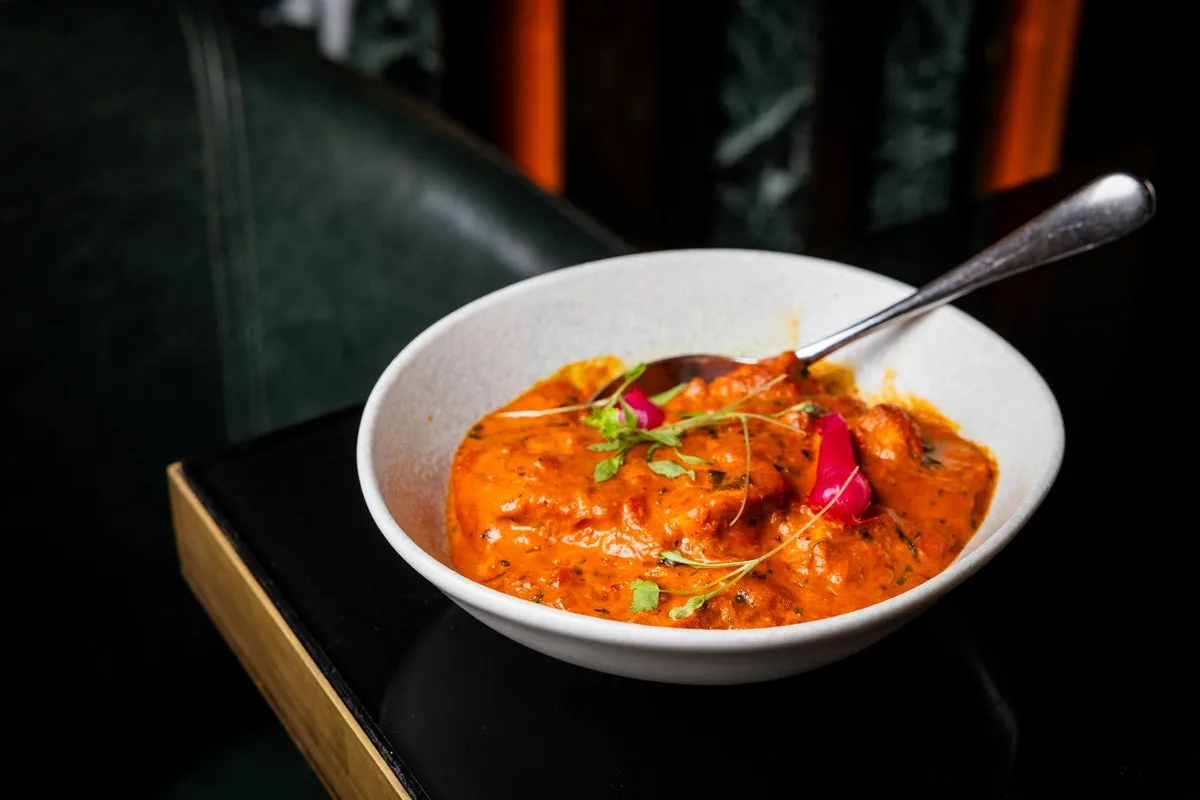
Few dishes better capture the story of Britain’s relationship with “foreign” food than chicken tikka masala. Ask 10 people where it came from and you may get 10 different answers – an Indian original refined in the UK, a British invention wearing Indian spices, or something in between. In the texture of its sauce and the softness of its cream, it tells a story not just of flavour, but of adaptation, belonging and evolving identity.
Its roots lie in northern India, where pieces of chicken were marinated in yoghurt, spices and acid, then cooked in a blazing tandoor. Served as dry tikka, it was a direct, uncompromising bite: char, tang, heat. But when Indian and South Asian chefs began opening restaurants in postwar Britain, they met a more cautious palate, one that preferred sauce over scorch, comfort over challenge. Thus began the slow alchemy that turned tikka into tikka masala – the chicken in sauce – a bridge between two gastronomic worlds.
Legend ties its birth to a Glasgow curry house in the 1970s, where a dissatisfied customer found his chicken tikka too dry. The chef, Ali Ahmed Aslam, responded by mixing a tin of tomato soup, cream and spices, and ladling it over the meat. The gamble worked: the dish quickly became a bestseller. By the 1980s, chicken tikka masala had entered the national menu, appearing not just in curry houses but in supermarket freezers, cookbooks and even political speeches. Robin Cook once called it “a true British national dish.”
This is not just a curry’s origin story, though. It is a chapter in the much longer tale of how Britain has digested foreign tastes and turned them, sometimes tentatively, into something its own. In this light, a recent UK study takes on extra resonance. Researchers from the University of Birmingham and the University of Munich found that people who more frequently consumed a wider variety of international cuisines were less likely to view immigrants as “cultural or economic threats.” Enjoyment of diverse foods was associated with a drop in support for anti-immigrant policies.
Chicken tikka masala sits at the intersection of all this: an immigrant dish shaped by the host culture, a flavour hybrid that’s neither wholly Indian nor wholly British, but indisputably both. It represents not just how Britain eats, but how Britain negotiates identity – embracing difference, adapting tradition, redefining “home”.