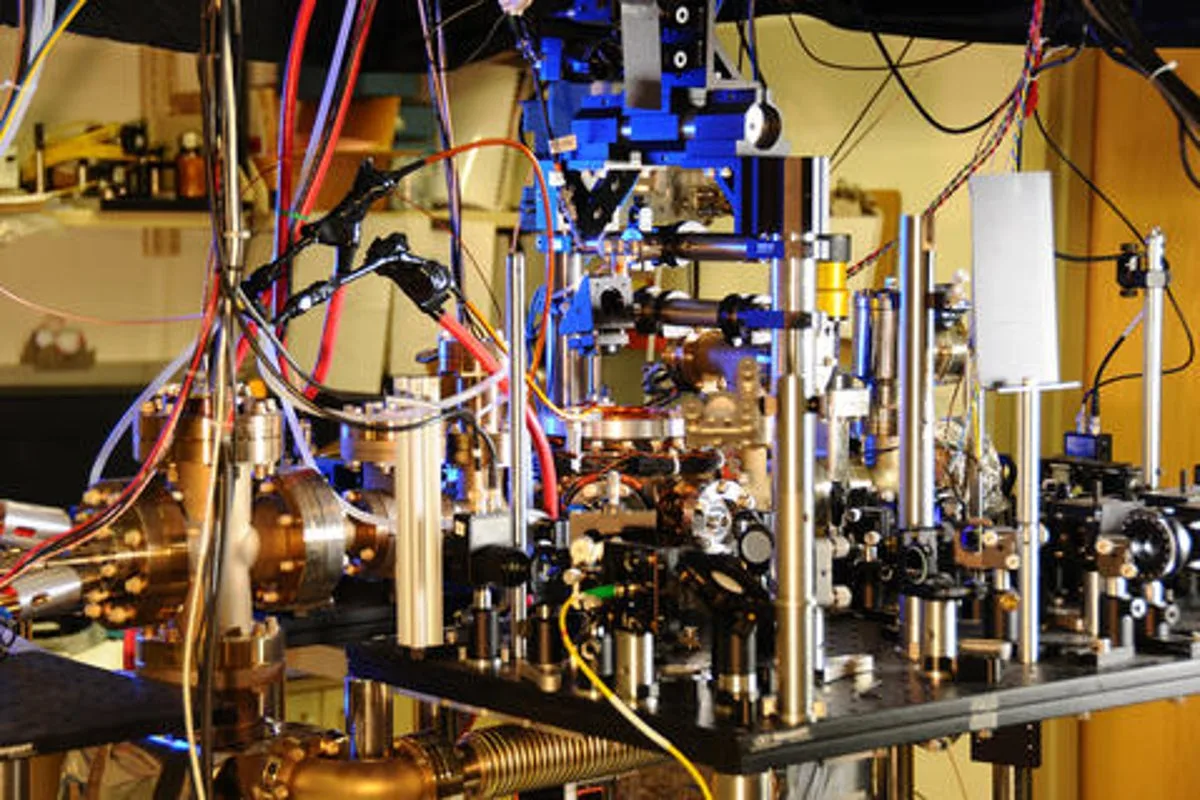
A power outage at a key atomic clock facility caused the US official time to slow by nearly five millionths of a second last week, according to the country's timekeeping watchdog. The disruption occurred on 17 December when a severe windstorm knocked out power at the Denver laboratory of the National Institute of Standards and Technology (NIST), and a backup generator subsequently failed.
The official time is calculated as the weighted average of NIST's 16 atomic clocks, which use the natural resonant frequencies of atoms for extreme accuracy. The power disruption led to NIST's coordinated universal time slowing by 4.8 microseconds, NIST spokesperson Rebecca Jacobson said in a public email. For context, a human blink takes about 350,000 microseconds.
Battery backup kept individual atomic clocks running, but disrupted synchronisation between the clocks and systems measuring and disseminating the official time. NIST quickly restored backup power by activating a diesel generator held in reserve. “We regained some monitoring ability, showing that the disseminated UTC signal likely did not deviate by more than 5 us and appeared stable,” Ms Jacobson said.
Although the deviation is negligible for most organisations, it could affect high-end systems relying on precise timing, such as GPS, satellite navigation, telecommunications networks, and high-frequency financial trading. Jeff Sherman, NIST group leader, noted that common-view time transfer using GPS satellites as 'transfer standards' seamlessly transitioned to using clocks at NIST's Ft. Collins campus, mitigating the impact for many users.