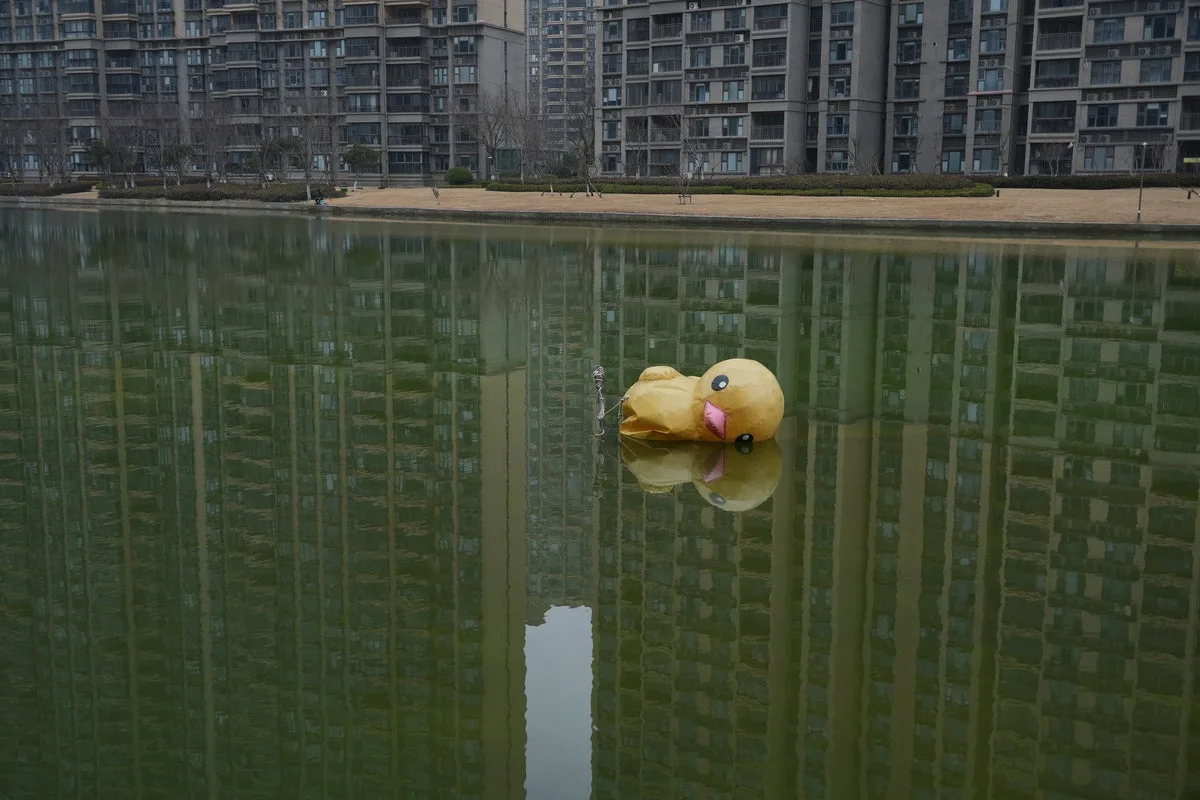
China's Ghostly Venice Replica Transforms into Affordable Escape
The "Life in Venice" housing development, a multibillion-dollar architectural imitation of the iconic Italian city situated on China's eastern coastline, now stands eerily silent. Its tens of thousands of homes are hollow concrete and alabaster shells, a testament to a collapsed property dream. Yet, this remote and partially abandoned complex has recently begun attracting an unlikely new demographic: young Chinese professionals fleeing the intense pressures of metropolitan life.
The Allure of Ultra-Cheap Living
One such new resident is Sasa Chen, a 28-year-old former finance worker from Shanghai. She pays a mere 1,200 RMB (approximately $168) per month for her apartment within this faux Venetian setting in Jiangsu province. This extraordinarily low cost of living has allowed Chen to achieve what many in the West term FIRE—Financial Independence, Retire Early—enabling her to retire at just 28 years old.
"I have all the time in the world, the freedom of doing whatever I want," Chen stated. "I am living the life that I want." She describes her new existence as featuring a sea view, clean air, and minimal expenses, a stark contrast to her previous life.
A Broader Trend of Urban Exodus
Experts identify Chen as part of a significant and growing trend across China. A rising number of young people are migrating from megacities to smaller towns and cities, capitalising on plummeting real estate prices that followed the COVID-19 pandemic. This marks a dramatic reversal from previous generations who prioritised upward mobility and flocked to booming urban centres.
The cooling of China's once red-hot economy, coupled with soaring expectations, dwindling opportunities, and fierce competition, has driven this shift. Many large Chinese corporations, particularly in the high-paying tech sector, enforce the grueling "996" work culture—9 a.m. to 9 p.m., six days a week. Under this intense pressure, some young professionals are abandoning their careers entirely, joining the "lying flat" resistance movement which advocates shunning traditional career paths and capitalism in favour of a "low-desire life."
The Rise and Fall of "Life in Venice"
Originally conceived in the early 2010s as a luxurious weekend resort for wealthy Shanghai residents, the "Life in Venice" development was designed to offer a peaceful coastal retreat. However, demand for its 46,000 units collapsed after China's debt-fueled property market bubble burst. The developer, real estate giant Evergrande, declared bankruptcy in 2024.
Today, the site is largely a ghost town. Less than one in five apartments are occupied. Abandoned boats litter its rundown pier, and "For Sale" signs dominate empty storefronts. Home prices at the complex have more than halved since the market downturn. Yet, a smattering of residents like Chen have moved in, some even fishing in the development's artificial canals, finding tranquility amidst the abandonment.
Redefining Success and Lifestyle
Chen's story is emblematic. She previously earned up to 700,000 yuan ($98,480) annually at a major Shanghai finance firm but despised the relentless grind. "It felt like marching to my own death," she remarked. After three years, she meticulously saved 2 million yuan ($290,000) and executed her escape plan. With her new ultra-low rent, she calculates she can live at "Life in Venice" indefinitely without returning to work.
While the complex lacks certain metropolitan amenities like specific chain restaurants or major hospitals, it provides basic conveniences such as grocery stores and local eateries where a meal costs under three dollars. Chen now wakes at 10 a.m., spending her days cooking, relaxing, and walking on the beach. "I never believed that work is the meaning of life," she said.
The National Scale of the Movement
Chen is far from alone. While precise data on workforce departures is scarce, demographic shifts are telling. From 2019 to 2024, Beijing lost 1.6 million people in their twenties and early thirties—a population comparable to Philadelphia—according to the capital's statistic office.
"People are quitting this competition, this very clear, linear, upward career track," observed Xiang Biao, director of the Max Planck Institute for Social Anthropology. "It’s a broader trend."
China's economic growth has cooled, registering about 5% in 2025—still robust globally but a far cry from past double-digit expansions. Concurrently, youth unemployment remains a challenge, with 16.5% of 16-24 year-olds not in education being unemployed as of a recent December.
Other Havens for the Disillusioned
This migration extends beyond "Life in Venice." Take 29-year-old Ban Zhao, who moved from a bustling eastern city to a small town in Yunnan province. For just 800 yuan ($110) a month, she rents a three-bedroom apartment, converting one room into a yoga studio. She and her boyfriend work under 20 hours weekly offering online yoga classes, spending the rest of their time enjoying the scenic environment.
"I can do whatever I want and not do whatever I don’t want," Ban said. "I live in heaven."
Other destinations include Hegang, a remote northeastern mining city where apartments are now cheaper than cars due to depopulation. Realtor Yang Xuewei has sold over 100 bargain units, with prices as low as $3,000 for a one-bedroom and $13,000 for a four-bedroom home, attracting clients nationwide and even some foreigners.
A Pragmatic Response to Economic Realities
Chen Zhiwu, a finance professor at the University of Hong Kong, interprets this shift as a natural, pragmatic response to contemporary economic conditions. Higher living costs and fewer opportunities in major cities are compelling young people to reconsider their futures and seek affordability elsewhere.
"It’s natural," Professor Chen stated. "Young people are facing reality and thinking hard about their futures." This collective re-evaluation is reshaping lifestyles and residential patterns across China, as a generation seeks respite from the relentless urban rat race in the quiet, affordable corners of a changing nation.






