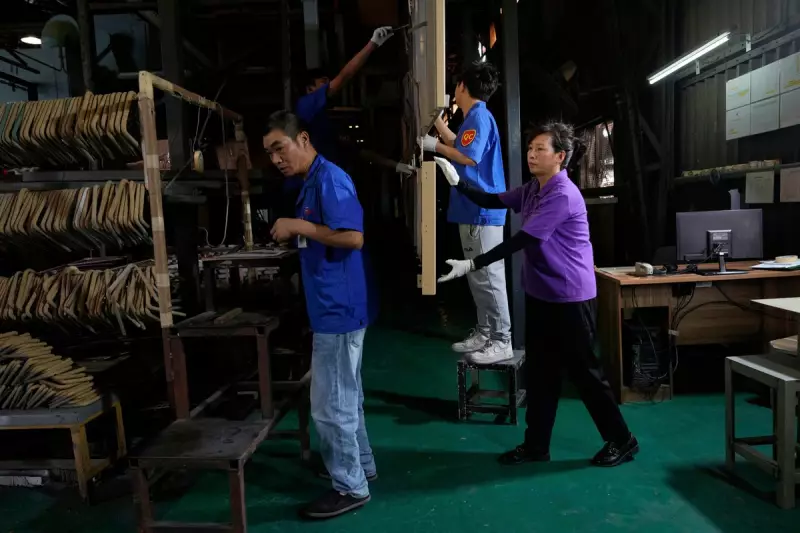
China's vast manufacturing sector remained in contraction territory for an eighth successive month during November, fresh data reveals, highlighting persistent economic headwinds despite a recent truce in the trade war with the United States.
Official PMI Data and Trade War Context
According to an official survey released on Sunday, 30th November 2025, the official manufacturing Purchasing Managers' Index (PMI) registered at 49.2 for the month. This marks a marginal improvement from October's reading of 49, as reported by China's National Bureau of Statistics.
The PMI is a critical gauge of industrial health, measured on a scale from 0 to 100. Any figure below the 50-point mark indicates a contraction in activity. This latest result was in line with what financial analysts had anticipated.

The data arrives in the wake of a significant diplomatic development. Following a meeting between US President Donald Trump and Chinese leader Xi Jinping in South Korea on 30th October, President Trump announced the US would cut its tariffs on Chinese goods.
While this tariff reduction could eventually make Chinese exports more competitive in the American market, analysts caution it is too early to determine if exports have genuinely regained their momentum.
Domestic Economic Pressures
Beyond international trade, the Chinese economy faces substantial internal challenges. A protracted slump in the property market, characterised by falling home prices, continues to erode consumer confidence. Investments in real estate have also declined.
Furthermore, intense price competition within numerous domestic sectors, notably the automobile industry, is placing considerable pressure on businesses. Economists argue that more government policy support is essential to help stimulate the economy.
However, such support may not be immediately forthcoming. Lynn Song, chief economist for Greater China at ING bank, noted earlier this month that "policymakers appear to be delaying further policy support."
Policy Support and Growth Targets
Authorities have previously rolled out stimulus measures, including trade-in subsidies for home appliances and electric vehicles. Yet, with some of these subsidies scheduled to be phased out, analysts predict sales and demand are likely to drop.
Zichun Huang, China economist at Capital Economics, commented last week that the fading boost from these consumer goods trade-in policies may be weighing on domestic demand for manufactured goods, adding that "signals on domestic demand have been mixed."
Chinese officials have set an economic growth target of around 5% for the entirety of 2025. The economy expanded by 4.8% in the July-September quarter. Regarding this goal, ING's Lynn Song suggested that "this year’s growth target is likely to require minimal additional support to be reached."