

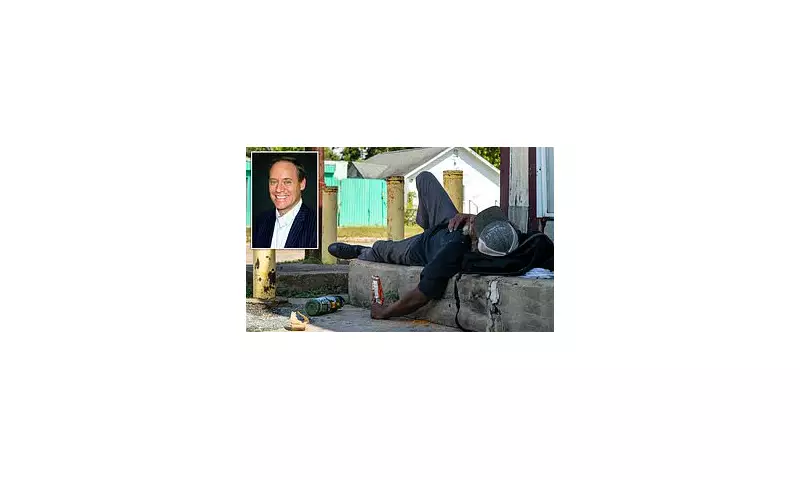
A prominent financial strategist has ignited a fierce debate by declaring the official United States poverty threshold to be wildly inaccurate and claiming that a family of four needs an income of nearly $140,000 to avoid poverty.
The Outdated Formula and a New Calculation
In a viral Substack essay, investor and portfolio manager Michael Green argued that the current federal poverty measure is fundamentally flawed. The benchmark, set at $32,150 for a family of four, was created in 1963 by economist Mollie Orshansky. Her method involved calculating a minimum food budget and tripling it, a model Green asserts is obsolete.
Green contends that housing, healthcare, and general living costs were far more manageable six decades ago. "Everything changed between 1963 and 2024," he wrote, highlighting the dramatic surge in expenses for housing, childcare, and transportation.

He recalculated what he believes is a modern poverty line by factoring in average costs for childcare, food, transport, housing, and healthcare. His conclusion: a family of four requires approximately $136,500 per year to cover basic necessities—roughly four times the official guideline.
A Backlash from Economic Experts
Green's analysis was met with immediate and sharp criticism from other economists. Kevin Corinth, an economist at the Enterprise Institute, labelled it the "worst poverty analysis I have ever seen" and "completely disconnected from reality."
Corinth pointed out to The Washington Post that it is "laughable to put a poverty line far above the median income in the United States." According to recent census data, the typical US household earns about $83,000, while a family of four earns closer to $109,000.
A key criticism focused on Green's use of national average costs for housing and childcare, which critics argue do not reflect the realities of low-income families who access subsidised services or live in lower-cost areas.
Clarification and Lasting Implications
Following the controversy, Green clarified his stance in an interview with Fox. He explained that the $140,000 mark was not intended to suggest that those earning less are "literally poor," but rather represents a threshold where a family could cover all expenses without government assistance and begin saving for the future.
He acknowledged his data was partly based on figures from suburban New Jersey, an area with a high cost of living, but maintained that it still proves the "official poverty line is arithmetically bankrupt."
This fiery exchange underscores the deepening political and social concerns surrounding the cost of living crisis and how economic hardship is measured. It raises critical questions about whether decades-old government metrics still hold relevance for modern financial survival.






