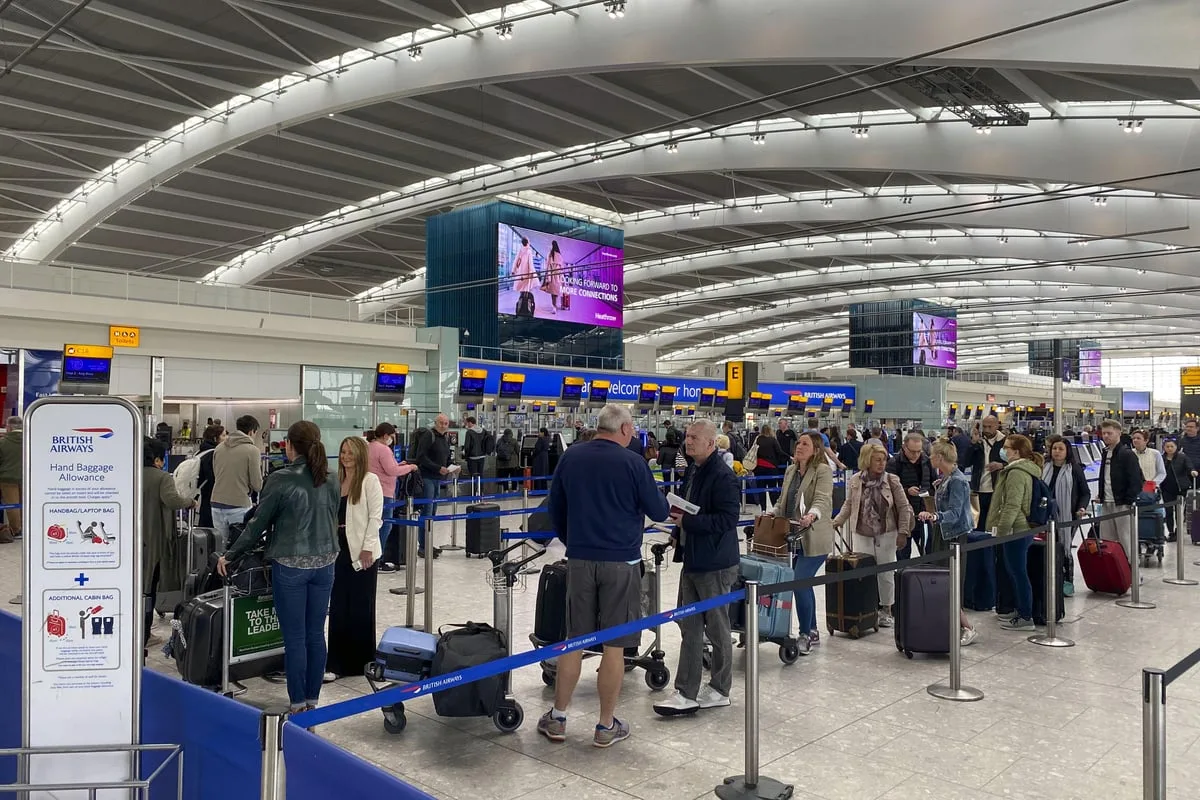
Summer holidays could be thrown into disarray as airlines may be forced to cancel up to 85,000 flights in June if the conflict with Iran persists, travel experts have warned. Concerns over a jet fuel supply crunch, stemming from the disruption of Middle Eastern supplies since late February, are intensifying across Europe as the peak travel season approaches.
Fuel Prices Surge Amidst Conflict
Fuel prices have skyrocketed following US-Israeli strikes on Iran, which have disrupted traffic through the critical Strait of Hormuz. This has led to the worst crisis for airlines since the pandemic. In the past two weeks alone, airlines have cut two million seats from May schedules. According to analytics firm Cirium, the total number of seats across all carriers this month fell from 132,619,704 in mid-April to 130,674,864 in late April. The number of flights also dropped by more than 13,000 over the same period, from 859,167 to 846,162. Gulf airlines such as Qatar, Etihad, and Emirates have been hit hardest by the war, facing airspace closures, airport disruptions, and rising fuel costs.
Potential for Further Cancellations
The situation could worsen, with one expert suggesting that 10 per cent of flights could be at risk in June if supplies remain constrained, equating to approximately 85,000 flights. Paul Charles from travel consultancy The PC Agency told the Mail: 'Airlines are now being forced to cut flights and make difficult decisions ahead of the peak season. It is better for them to cancel flights well in advance so that passengers are less inconvenienced than a last-minute change of plan. As the Iran conflict continues, there will need to be many more cancellations as the jet fuel supply is squeezed.'
Charles added that the total number of cancellations depends on the market, as some airlines are less affected than others. However, certain carriers are now planning for the 'worst-case scenario' and a prolonged period of reduced supplies. Recent changes to UK government slot rules mean airlines do not have to fear losing their slots the more they cancel.
Global Jet Fuel Prices on the Rise
The average global jet fuel price increased for the first time in a month last week to $181 (£134) per barrel, according to International Air Transport Association data. This 1 per cent week-on-week rise followed three consecutive weeks of decline after a peak of $209 (£155) at the start of April, up from $99 (£73) at the end of February.
Expert Warnings
Economics expert Richard Murphy, emeritus professor at Sheffield University Management School, warned there was 'a very good chance you may not be able to get your summer holiday this year', adding: 'I'm sorry, but that's a fact.' Writing on his Tax Research blog, he continued: 'It is a microcosm of what the whole economy is about to face. Fuel shortages, supply chain disruption, and business failures are converging. All of this is likely to become acute by late June: weeks away.'
Murphy criticised the government's response, stating: 'The Government is pretending that things will be fine when the evidence says otherwise, and this is not just about poor communication. It is political irresponsibility at a moment of national risk.'
Matt Smith, Kpler director of commodity research, described the jet fuel crisis as a 'slow motion car crash'. He told CNBC: 'In terms of jet fuel exports on a global basis, we see about 2 million barrels a day being exported normally. Last month we saw 1.3 million barrels a day. So it's not just the fact that you're not getting jet fuel out of the Middle East because they are the large exporters of the stuff. But it's the fact that Asia is not getting the crude that it needs to refine into the jet fuel, so they're trying to meet their domestic needs and they're struggling to meet the export needs as well. So it's a series of dominos that are falling here. Jet is the first one to go, Asia is the first region. But it's going to spread across the globe.'
Asked whether more flight cancellations will follow, he added: 'Absolutely, yeah, it really is, and it's going to go across the different regions. It's going to be the fact they're cancelling because they don't have the jet fuel to be able to run the flights but it's also those costs as well. This is something that's coming. It's a slow motion car crash and we're kind of sleepwalking through it almost.'
Airline Responses to the Crisis
European airlines are responding in various ways to the jet fuel crisis:
- Aegean Airlines: Expects suspended Middle East flights and a spike in fuel prices to have a 'notable impact' on its first-quarter results.
- Air France-KLM: Expects a $2.4 billion (£1.8 billion) increase in its fuel bill this year and downgraded its capacity outlook to an increase of 2 per cent to 4 per cent from 2025. It previously expected an increase of 3 per cent to 5 per cent. The group announced plans to increase long-haul ticket prices, with cabin fares set to rise by €50 (£43) per round trip. KLM said on April 16 it would cancel 160 flights in Europe in the coming month due to rising fuel costs.
- EasyJet: Warned of a bigger half-year pre-tax loss of between £540 million and £560 million, including £25 million in extra fuel costs in March.
- IAG (British Airways owner): Said it would raise ticket prices to reflect higher jet fuel costs, despite its fuel hedges, as it was 'not immune' to the broader fallout from fuel cost volatility.
- Lufthansa: Unveiled a new 'Economy Basic' low-cost fare option for short- and medium-haul flights, limiting free carry-on bags to only a 'laptop bag or a small backpack'. The group previously said 20,000 short-haul flights would be removed from its schedule through October, equivalent to about 40,000 metric tons of jet fuel.
- SAS: Said it would cancel 1,000 flights in April because of high oil and jet fuel prices, after cancelling a 'couple hundred' flights in March.
- TAP: Said its price hikes would partially mitigate the impact of fuel price changes on its revenue.
- TUI: Cut its full-year underlying profit outlook and suspended revenue guidance, citing about €40 million (£35 million) in extra costs due to the war in March, including repatriation efforts and operational disruptions.
- Turkish Airlines and Lufthansa (SunExpress): Imposed a temporary fuel surcharge of €10 (£9) per passenger on routes between Turkey and mainland Europe. Turkish Airlines decided not to distribute any dividend from its 2025 net profit, opting to retain earnings to preserve cash.
- Virgin Atlantic: Is adding fuel surcharges to fares but will still struggle to return to profitability this year, its CEO said.
- Volotea: Introduced a new pricing policy linking ticket prices to fuel costs, potentially adding a post-purchase surcharge of up to €14 (£12) per passenger, per flight.
Potential for Increased Baggage Fees
Others warned that airlines may increase baggage fees to recoup higher fuel costs. Alen Baibekov, chief executive of Economy Bookings, told the Daily Mirror: 'There will continue to be large increases in baggage charges going forward. There are a number of factors putting downward pressure on airline profitability including increasing fuel costs, higher aircraft maintenance costs, increasing costs at airports and increased price competition among carriers.' He added that because most consumers compare air travel costs based on advertised ticket prices, airlines are focusing on charging for baggage, which they 'can do easily'.
Lufthansa Warns of Rising Risks
Germany's Lufthansa warned of rising risks to its financial performance due to the Middle East war, even as it maintained its outlook for the year. 'The risk-opportunity profile has shifted toward risks,' the firm said in a statement. 'While no restrictions in kerosene supply are currently expected at any of the Lufthansa Group hubs, potentially reduced fuel availability later in the year represents an additional risk factor.' Though Lufthansa is relatively protected compared to some competitors, having locked in the price for about 80 per cent of its 2026 fuel supplies, extra kerosene costs were forecast to amount to €1.7 billion (£1.5 billion) this year. The group said that 'shifts in passenger flows' as flyers switch from Gulf transit hubs to Lufthansa destinations in Africa and Asia would partially offset the hit, and 'further cost-saving measures' would also help.
UK Vulnerability and Government Response
Investment bank Goldman Sachs warned that Britain is particularly vulnerable to jet fuel shortages, with supplies potentially falling to 'critically low levels'. The UK government has introduced a temporary rule change allowing airlines to group passengers from different flights onto fewer planes to save fuel. This could see passengers moved from their original service to a similar one to reduce wasted fuel. However, consumer group Which? criticised the move, saying rules should not be 'bent in favour of airlines'.
The Prime Minister warned last week that Britons may need to change their summer holiday plans due to the jet fuel crisis. Sir Keir Starmer said people might rethink 'where they go on holiday this year' if the war continues to impact airlines. His intervention went further than the government's current messaging, which states there is 'no current need to change upcoming travel plans'. A UK Government spokesperson said: 'UK airlines are clear that they are not currently seeing a shortage of jet fuel. Aviation fuel is typically bought in advance and airports and suppliers keep stocks of bunkered fuel to support their resilience. We continue to work with fuel suppliers, airports, airlines and international counterparts to keep flights operating. We are also consulting on measures to help airlines plan realistic flight schedules which will avoid last-minute disruption and protect holidays.'
The International Energy Agency has called it the world's largest oil output disruption and warned on April 16 that Europe had six weeks of jet fuel left before shortages begin.