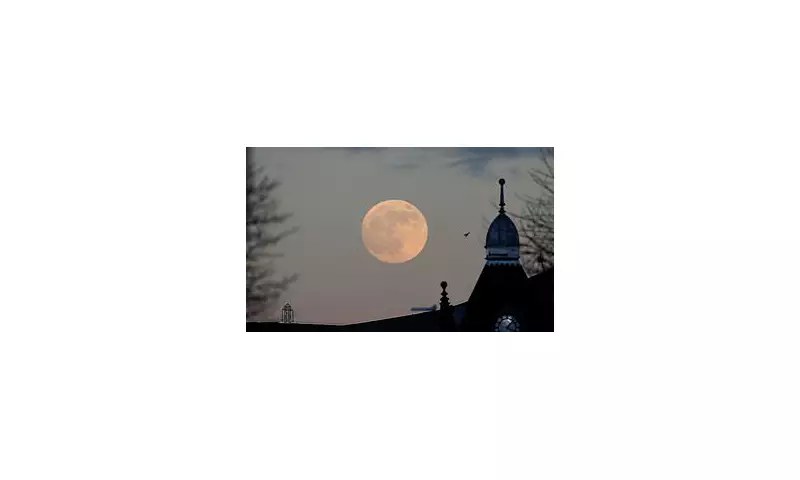
A dazzling celestial spectacle is set to grace British skies tomorrow evening, as the first supermoon of the year promises an unusually brilliant display. The so-called Wolf Moon will not only be bigger and brighter than a typical full moon but will receive a rare triple boost in luminosity, potentially making it the most striking lunar event of 2026.
The Triple Brightness Boost Explained
Tomorrow's lunar show benefits from a remarkable and rare convergence of astronomical factors. Firstly, it is a classic supermoon. This occurs when a full moon coincides with the moon's closest approach to Earth, known as perigee. On January 3rd, the moon will be a mere 225,130 miles (362,312 km) from our planet, making it appear roughly 14% larger and up to 30% brighter than a full moon at its farthest point.
Secondly, in an unusual alignment, this supermoon happens within hours of Earth reaching its own closest point to the sun, an event called perihelion. NASA notes that sunlight reaching Earth during perihelion is about 6.5% more intense. Since the moon acts as a giant mirror, this extra solar energy translates into an even more radiant lunar glow.

The third enhancer is the winter atmosphere itself. Cold, dry air across the UK and Europe, brought by high-pressure systems, allows more light to pass through with less atmospheric distortion. This creates crystal-clear viewing conditions, further amplifying the moon's apparent brightness.
How and When to See the Wolf Supermoon
Astronomers emphasise that no special equipment is needed to enjoy this event. Jess Lee, an astronomer at the Royal Observatory Greenwich, confirms it will be a "lovely sight even from a city or a town." The moon will be visible from around 16:00 GMT on January 3rd until 09:00 on January 4th.
For the most dramatic view, look to the horizon shortly after moonrise. Due to the "moon illusion," our brain perceives the lunar disc as significantly larger when it sits low in the sky beside familiar terrestrial objects. In the UK, moonrise will begin from approximately 15:15, though exact times vary by location.
While urban light pollution won't obscure the moon, seeking darker skies always enhances the experience. Prime UK viewing spots include elevated areas like Primrose Hill in London, Snowdonia National Park, Exmoor National Park, and the South Downs, where you rise above low-lying haze.
A Rare Winter Treat with Clear Skies Forecast
In a fortunate turn for British stargazers, the Met Office predicts largely favourable conditions. Most of England and Wales should see only patchy cloud, with some light cloud cover expected in Scotland and northeast England. However, yellow and amber weather warnings for snow and ice are in effect across parts of the nation, so anyone venturing out should dress warmly and check local forecasts.
This Wolf Moon is particularly notable as supermoons are not monthly events; 2026 will host only three in total. After tomorrow's display, the next opportunities will be the Beaver supermoon on November 24th and the Cold supermoon on December 24th.
The tradition of naming full moons, such as January's "Wolf Moon," dates back hundreds of years, often reflecting seasonal behaviours in nature. So, wrap up warm, find a good vantage point, and look up tomorrow evening to witness one of the year's most luminous natural wonders.