One of the year's most dependable celestial displays, the Leonids meteor shower, is set to reach its dramatic peak this week, offering a captivating show for dedicated sky-watchers across the United Kingdom.
When and Where to Watch the Celestial Fireworks
The meteor shower's intensity will sharply increase, with the peak expected during the night of 16–17 November. For the best views, observers in the UK and the rest of the northern hemisphere should set their alarms for the early hours of the morning. This is when the constellation Leo is highest in the sky and the darkness is most profound.
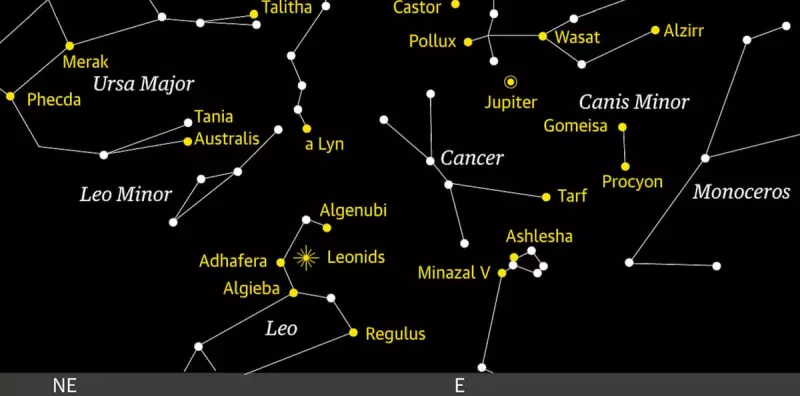
The chart for London, looking east at midnight as the 16th becomes the 17th, shows the ideal positioning. To maximise your chances, wrap up in warm clothing, find a comfortable deck chair, and prepare to be patient.
The Science Behind the Spectacle
The shower gets its name from the constellation Leo, the lion, as the meteors appear to stream from the region of the 'lion's head'. This specific area is an asterism—a pattern of stars—known as the Sickle due to its distinctive curved shape.
These fleeting streaks of light are actually remnants from the tail of comet 55P/Tempel-Tuttle. A cloud of dust particles left behind by the comet enters Earth's atmosphere, creating the visible phenomenon. Viewers can expect to see approximately 10-15 bright meteors per hour during the peak.
What Makes the Leonids Special
The Leonids are notably fast-moving, hurtling into our atmosphere at incredible speeds of around 70 km/s. This velocity results in straight, vivid trails that often linger in the air for a moment after the meteor has vanished.
While this shower is famous for its potential to produce meteor storms with thousands of meteors an hour, astronomers do not predict such a dramatic outburst for 2025. Nevertheless, the reliable display of a dozen or so meteors each hour promises a rewarding experience for anyone who takes the time to look up.