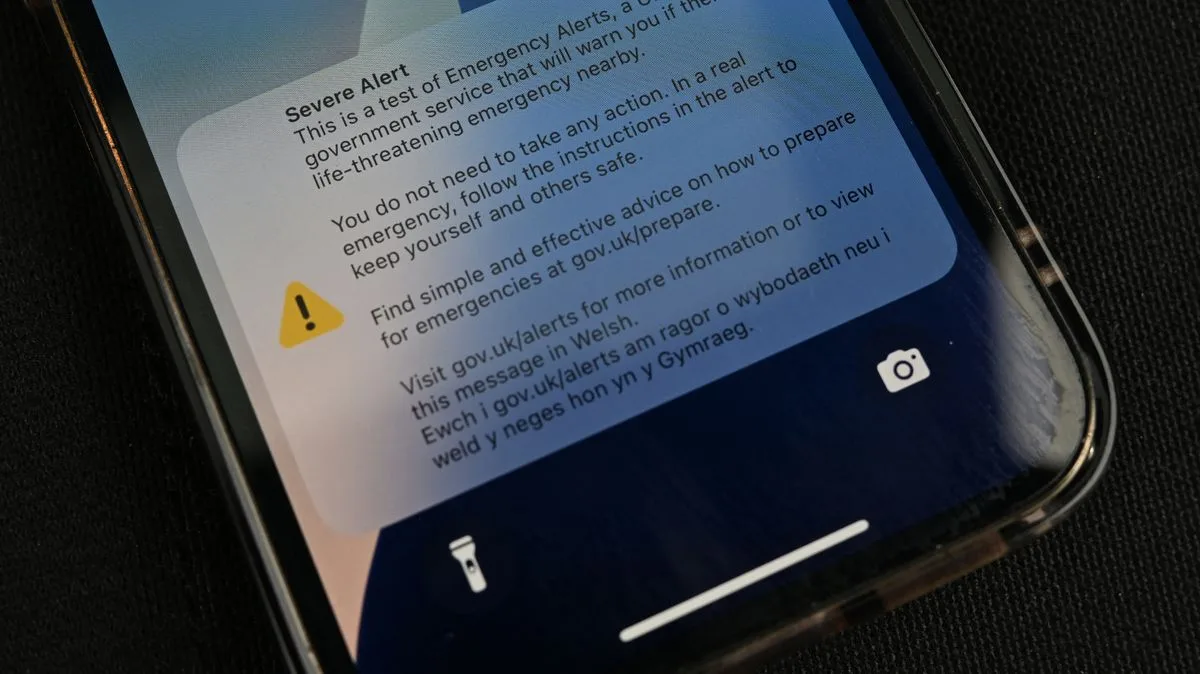
An out-of-control Chinese rocket has plunged into the Southern Pacific Ocean, concluding a tense period during which the United Kingdom prepared its emergency alert system amid concerns about falling debris. The UK government had earlier instructed mobile network providers to ensure the national alert mechanism was operational, anticipating a potential impact scenario.
Safe Ocean Landing Ends Uncertainty
The rocket, identified as the Chinese Zhuque-3 launched in early December, crashed to Earth at 12:39 GMT. According to tracking data from the US Space Force, the vehicle landed approximately 1,200 miles (2,000 km) southwest of New Zealand. This location places it safely in remote oceanic waters, far from populated landmasses.
With an estimated mass of 11 tonnes, the European Union's Space Surveillance and Tracking (SST) agency had previously flagged the object, designated ZQ–3 R/B, as "quite a sizeable object deserving careful monitoring." The vast majority of space debris that enters Earth's atmosphere either incinerates during re-entry or lands undetected, but experts have confirmed this particular rocket's safe descent.
UK Preparedness and Expert Analysis
The UK government's precautionary measures involved asking mobile network operators to verify the readiness of the emergency alert system. A government spokesperson emphasised that this was a routine readiness check and did not indicate an alert would be issued, stating: "It is extremely unlikely that any debris enters UK airspace. As you'd expect, we have well rehearsed plans for a variety of different risks including those related to space, that are tested routinely with partners."
Dr Marco Langbroek, a space debris tracking expert from Delft University of Technology, noted that he "strongly suspects" the US Space Force observed the re-entry fireball using space-based satellite assets. This observation helped conclude intense speculation about the rocket's landing site, after earlier predictions had suggested potential trajectories over Northern Europe and the UK.
Rocket Launch and Technical Details
The rocket was launched by the private Chinese space firm LandSpace from the Jiuquan Satellite Launch Center in Gansu Province on December 3, 2025. The experimental vehicle, modelled partly on the SpaceX Falcon 9 design, successfully achieved orbit. However, its reusable booster stage reportedly exploded during its landing attempt.
The upper stages and a dummy payload, consisting of a large metal tank, subsequently began a gradual orbital decay. The rocket's shallow re-entry angle made precise prediction of debris impact locations exceptionally challenging. Professor Jonathan McDowell, an astronomer from the Harvard–Smithsonian Center for Astrophysics and a noted authority on space debris, had earlier commented to the Daily Mail: "It will pass over the Inverness–Aberdeen area at 1200 UTC, so there's a small – a few per cent – chance it could re-enter there, otherwise it won't happen over the UK."
Context of Space Debris and Historical Precedents
Incidents of rocket and satellite debris returning to Earth are not uncommon, with debris passing over UK airspace approximately 70 times each month. The overwhelming majority of this material burns up completely due to atmospheric friction. In rare instances, larger fragments or components made from heat-resistant materials like stainless steel or titanium can survive to the surface, though they typically disperse over oceans or unpopulated regions.
This event is not the first involving a Chinese rocket. In 2024, fragments from a Long March 3B booster stage fell mere metres from residential homes in China's Guangxi province. The only recorded case of a person being struck by space debris occurred in 1997, when a woman was hit, though not injured, by a small fragment from a US Delta II rocket.
Growing Concerns Over Space Junk
As commercial space launch activity increases globally, so does the volume of uncontrolled re-entries. Researchers have warned that the risks associated with space debris are escalating. A recent study from the University of British Columbia suggested a 10 per cent probability that one or more people could be killed by falling space junk within the next decade.
Furthermore, analysts highlight potential threats to aviation, with estimates indicating a 26 per cent chance of debris intersecting with some of the world's busiest air corridors in any given year. While the current probability of an aircraft being struck remains very low, a significant impact could lead to major airspace closures and travel disruption. A 2020 study projected that the risk to individual commercial flights could rise to approximately one in 1,000 by 2030.
The broader issue of orbital debris, often termed 'space junk', encompasses an estimated 170 million pieces of discarded material, including spent rocket stages, defunct satellites, and even minute paint flakes. Only around 27,000 of these objects are actively tracked. Travelling at velocities exceeding 16,700 mph, even small fragments possess significant destructive potential against operational satellites and space infrastructure.
Two major incidents have substantially worsened the orbital debris problem: the 2009 collision between an Iridium communications satellite and a Russian military satellite, and China's 2007 anti-satellite weapon test which destroyed an old weather satellite. These events underscore the ongoing challenges and international concerns regarding space sustainability and safety.