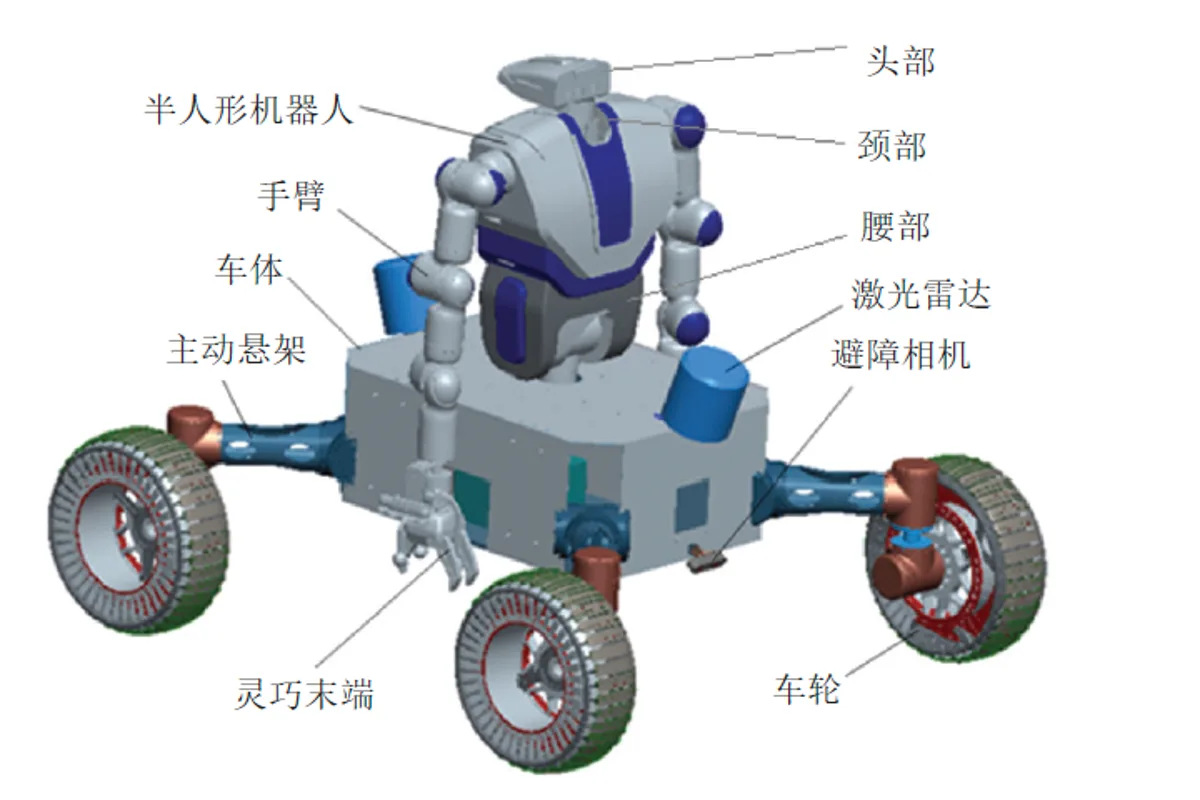
China has revealed a groundbreaking wheeled humanoid robot that scientists envision as a critical component for constructing a research station on the Moon by the year 2035. With the lunar environment posing significant dangers to human life, initial missions to establish a base will depend heavily on autonomous machines to ferry equipment and construction robots capable of utilizing local materials.
A Multipurpose Machine for Lunar Operations
In a new study published in the Journal of Deep Space Exploration, researchers from the Beijing Institute of Spacecraft System Engineering describe this innovative robot, which features a humanoid upper body mounted on a wheeled platform. The machine is specifically designed to perform a wide array of tasks essential for building and maintaining a lunar base prior to human arrival.
Key functions include assembling infrastructure, transporting construction materials, collecting scientific samples, and conducting equipment maintenance. This autonomous capability is expected to significantly reduce risks and enhance efficiency in the challenging extraterrestrial setting.
Superior Mobility and Stability
The robot's design prioritizes stability and practicality over traditional bipedal locomotion. Its waist can rotate a full 180 degrees in either direction, while it can bend forward up to 90 degrees. Each hand features four degrees of rotational freedom, enabling precise manipulation of tools and objects.
Scientists emphasized that "compared with bipedal walking, a wheeled active suspension moves faster and is more stable, providing a steady platform for work by the upper body." This choice was informed by the mechanical complexity, fall risks, and high energy consumption associated with walking robots.
Advanced Sensory and Movement Capabilities
Equipped with stereo cameras that mimic human eyes, the robot can calculate depth, distance, and object shapes through comparative image analysis. Its neck moves vertically and horizontally, offering a wide viewing angle, while each arm rotates in seven distinct ways—including at the shoulder, elbow, and wrist—mirroring human articulation.
This extensive range of motion is deemed essential for executing the precise mechanical tasks required in lunar base construction. Additionally, an advanced suspension system allows the robot to maintain balance while traversing uneven terrain, such as craters and loose lunar soil.
Building on Proven Technology
Researchers highlighted that wheeled rovers have a proven track record in space exploration, citing China's Yutu lunar rover and Zhurong Mars rover as successful examples. They noted that such wheeled designs are more practical for long-term lunar operations, offering reliability and efficiency.
The prototype is intended to serve as a "reference for the research, development and application of related equipment" necessary for establishing lunar bases. As NASA targets an April moon launch, this development underscores China's ambitious strides in space technology and its commitment to advancing extraterrestrial habitation.