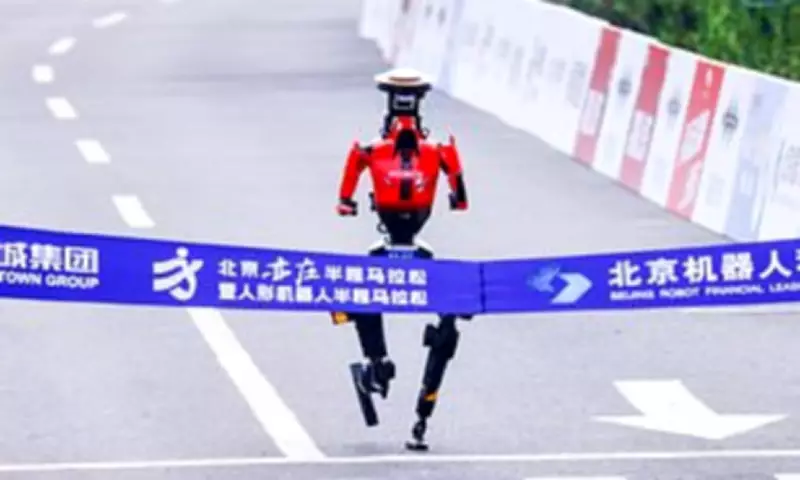
In a dramatic reversal of fortunes from just twelve months ago, a new generation of humanoid robots has left human athletes trailing in their wake at the Beijing half marathon. The event, which saw over one hundred robotic competitors race alongside twelve thousand human participants, was separated by physical barriers to prevent collisions, but the technological gap proved impossible to ignore.
A Record-Shattering Performance
Lightning, the winning robot developed by Chinese smartphone manufacturer Honor, achieved a blistering time of 50 minutes and 26 seconds over the 13.1-mile (21-kilometer) course. This performance not only defeated the best human runner on the day but also demolished the existing world record of 57 minutes and 20 seconds, set by Ugandan athlete Jacob Kiplimo merely a month prior.
This represents a staggering threefold improvement over last year's robotic victor, which required two hours and forty minutes to complete the same distance. The pace of advancement is underscored by the fact that nearly half of this year's robotic entrants navigated the winding course fully autonomously, without any human intervention or remote control.

Engineering Behind the Breakthrough
Xioadi Du, an engineer from Honor's championship team, revealed that Lightning was the product of intensive development over the past year. The robot was fitted with exceptionally long legs, measuring between 90 and 95 centimeters, to mimic the biomechanical advantages of elite human runners. Furthermore, a sophisticated liquid cooling system was integrated to manage the intense heat generated by its powerful leg motors during sustained high-speed operation.
According to reports from the state media outlet Global Times, one Honor robot actually posted an even faster unofficial time of 48 minutes and 19 seconds. However, it was disqualified from the podium under the weighted scoring rules because it was remotely controlled, highlighting the event's emphasis on true autonomous capability.
Not All Smooth Running
The race was not without its robotic casualties, serving as a reminder that the technology remains in a nascent stage. Several competitors experienced familiar failures, including navigation errors that caused them to veer off course or collide with barriers. In one particularly dramatic incident, a robot tripped and collapsed before even crossing the start line, shattering into dozens of pieces as it continued to thrash on the ground.
Nevertheless, the overall quality and performance of the humanoid robots displayed a quantum leap forward from the shambolic spectacle of the previous year's event, where machines frequently tripped, shuffled, and shattered under the physical strain.
Public Reaction: Awe and Apprehension
The mood amongst spectators was a complex mixture of awe and underlying anxiety. Han Chenyu, a 25-year-old student who watched from behind a safety barrier, described the event as 'pretty cool' but admitted to concerns about the broader implications. 'As someone who works for a living, I'm a little worried about it sometimes,' she told AFP. 'I feel like technology is advancing so fast that it might start affecting people's jobs.'
Another onlooker, 41-year-old Xie Lei, reflected on the historical shift. 'For thousands of years, humans have been at the top on planet Earth. But now, look at robots. Just in terms of autonomous navigation, at least in this specific sport event, they're already starting to surpass us,' he said, adding that while it evoked a sense of sadness for humanity, it also opened vast new realms of technological imagination.
Broader Context and National Ambitions
China has been increasingly keen to showcase its national prowess in humanoid robotics. Earlier this year, during the country's most-watched television show, the CCTV Spring Festival gala, dozens of Unitree robots performed complex kung fu routines with weapons, demonstrating agility and coordination just meters away from human child performers.

The drive for robotic advancement is particularly pressing for China, which faces one of the world's fastest-ageing populations and a shrinking workforce. According to World Health Organization projections, the population over 60 years old in China is expected to reach 28 percent by 2040. Leading Chinese firms like AGIBOT, Unitree Robotics, and UBTech Robotics Corp are at the forefront of developing robots intended for roles in factory labor, social care, and elderly assistance.
The Future of Work
Engineer Xioadi Du emphasized that the pursuit of speed in robotics has meaningful downstream applications. 'Running faster may not seem meaningful at first, but it enables technology transfer, for example, into structural reliability and cooling, and eventually industrial applications,' he stated, while cautioning that the technology still has significant room for growth in the coming years.
Analyses, such as those from management consultancy McKinsey, suggest that physical jobs in predictable environments—including machine operators and fast-food workers—are at the greatest risk of automation. Conversely, occupations in unpredictable settings, like gardening, plumbing, or caregiving, are expected to see less automation due to technical challenges and economic factors.
The Beijing half marathon has thus served as a powerful and very public benchmark, illustrating not just a race won, but the accelerating pace of a technological revolution that is beginning to outstrip human physical limits in defined domains.