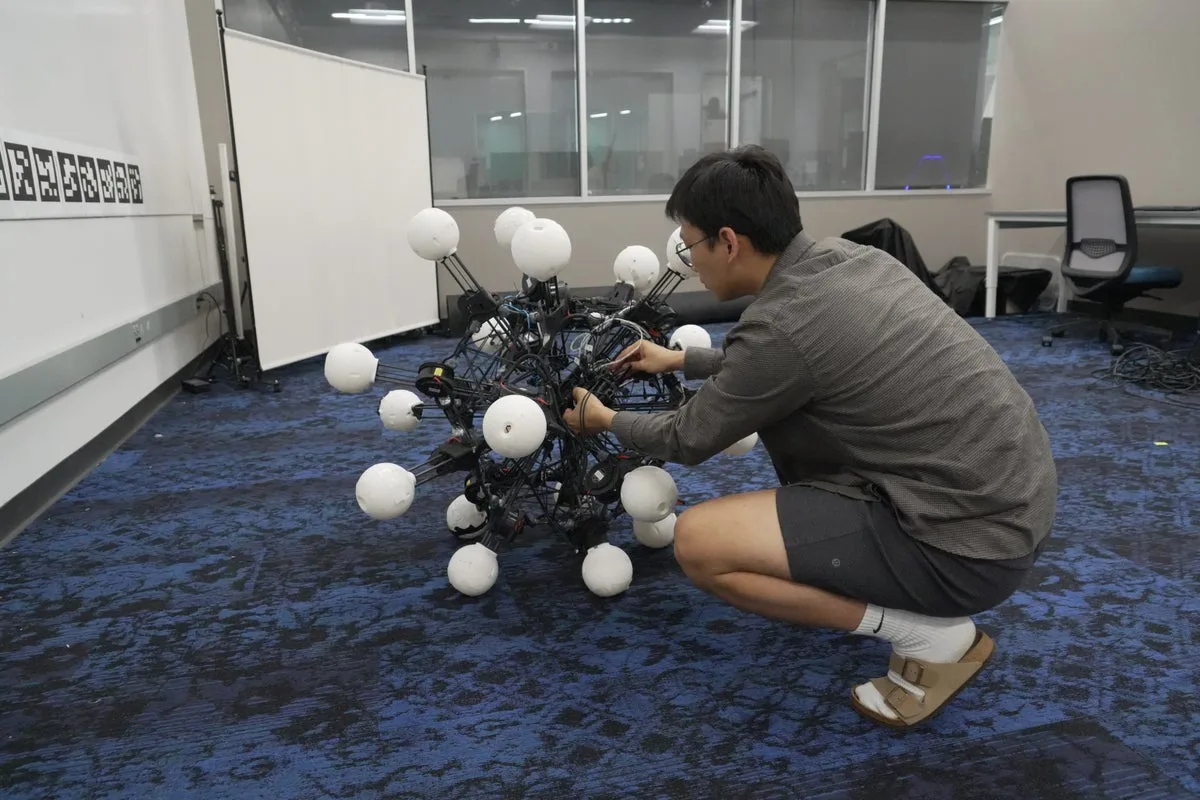
Engineers at Duke University have introduced Argus, a novel robot with 20 telescoping legs and depth-sensing cameras that enable it to see and move in any direction instantly. Named after the many-eyed giant of Greek mythology, the robot is designed around a principle called 'dynamic symmetry', which prioritises uniform movement over mimicking natural shapes.
Argus has no designated front, back, top, or bottom. Its legs radiate from a central core, allowing it to roll over obstacles, stabilise after being pushed, and even climb between parallel brick walls. In tests, it has navigated sandy beaches and forest undergrowth, and continues to function even if a leg breaks or a motor fails.
Professor Boyuan Chen, who leads the research, explained that the design focuses on how fast the robot can move in any direction rather than the arrangement of its limbs. 'Who said, you know, if you have a robot to help us in a most effective way, it has to look like us?' he said.
The team developed a metric called 'dynamic isotropy' to rate robots on how uniformly they can accelerate in all directions, on a scale from 0 to 1. Most current robots, including humanoids and drones, score below 0.6, while Argus achieves 0.91. Graduate student Jiaxun Liu, co-author of a study published in Science Robotics, noted that watching Argus navigate rough terrain under heavy collisions felt unlike any other robot they had worked with.
Chen hopes the design principle could inspire search and rescue robots, underwater or aerial vehicles, or even robotic grippers. 'Instead of building a robot hand that looks like a human hand … one idea is to think about having Argus be the hand itself, and it can manipulate objects in any direction,' he said.