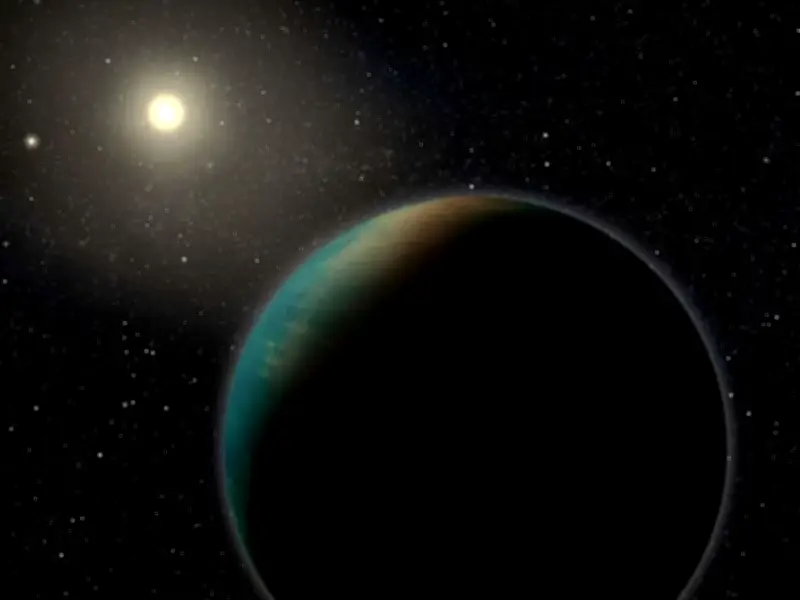
Harvard University astronomers have identified a rocky 'super-Earth' located 48 light-years away that retains its own atmosphere, marking a significant milestone in the quest for extraterrestrial life. The planet, designated LHS 1140 b, orbits within its star's habitable zone and is approximately 1.7 times Earth's width and 5.6 times its mass.
Atmosphere Confirmed on Habitable-Zone Exoplanet
Lead author Dr. Collin Cherubim stated: 'An atmosphere is essential for a planet to support life as we know it. This is the first time anyone has found an atmosphere on a rocky planet in the habitable zone of another star.' The discovery was made using the WINERED Spectrograph at Chile's Magellan Observatory during a rare double-transit event.
While thousands of exoplanets have been cataloged, proving the existence of an atmosphere has been extremely challenging. The team focused on a cool red dwarf star, which offers better conditions for detecting atmospheric signals.

Detection Method and Results
Co-author Dr. Shreyas Vissapragada explained: 'Red dwarf stars present a good opportunity for this kind of search because they are small and cool, so habitable-zone planets orbiting these stars are relatively accessible using the transit method.' The team searched for helium in the upper atmosphere, where signals are easier to detect than water or carbon dioxide.
During the double-transit, LHS 1140 b showed a glowing halo of escaping helium, confirming its atmosphere. 'This was clear evidence of an atmosphere on a habitable-zone exoplanet. It was an absolute thrill to see the transit spectra and slowly realize the implications,' said Vissapragada.
Implications for Alien Life
Calculations indicate the atmosphere has survived harsh space radiation for over three billion years. Astronomers now plan to search for biosignatures that could indicate living organisms. Robin Wordsworth, a study author, remarked: 'Twenty years ago we wondered whether other terrestrial-type planets even existed. Then we learned they're common, and found some in the habitable zone. The next question was whether any of them had managed to keep an atmosphere. Now we know at least one has.'