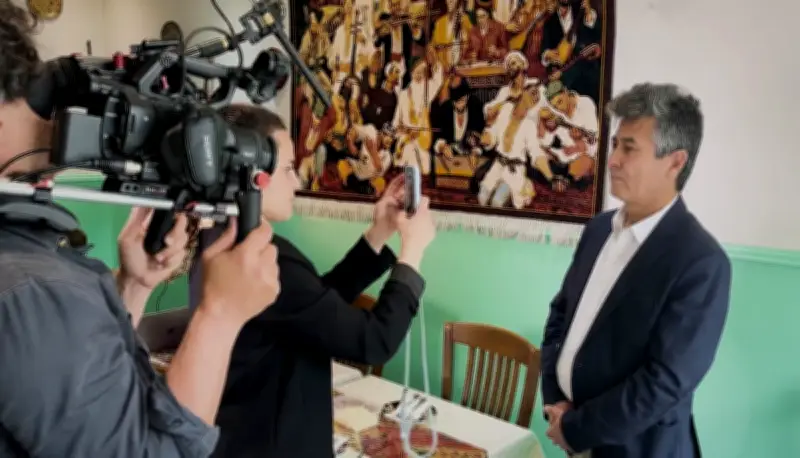
Restaurateur Ablikim Rahman is photographed prior to the creation of his AI avatar for the film. Photograph: PR
‘Ordinary people are being erased’: one director’s audacious fightback against AI – featuring Frinton
Marc Isaacs’ film Synthetic Sincerity may look like a documentary, but its fictional premise – a lab that scrapes movies to harvest human emotions – shines a hard light on just how far AI can go.
In Marc Isaacs’ latest film, the subversive documentary maker reveals that an AI research laboratory recently licensed his entire body of work. That’s a quarter-century of droll, deadpan studies of ordinary life in Britain – from the poetic Lift, about the comings and goings in a London tower block, and The Curious World of Frinton-on-Sea, set in the sleepy retirement town dubbed “God’s waiting room”, to Philip and His Seven Wives, in which a secondhand furniture dealer declares himself to be a Hebrew king. Isaacs agreed to let data analysts at the University of Southern England feed these and other documentaries into their system to harvest authentic human emotions from which AI characters could then be created. His film about the experience takes its name from the university’s lab: Synthetic Sincerity.
But how synthetic is the film itself? “Well, we made up the University of Southern England,” admits Isaacs, 59, over lunch at Etles, a Uyghur restaurant near his home in London. The choice of venue is no accident: its chef and owner, Ablikim Rahman, who flutters around us today bearing bowls of thick, glossy leghmen noodles, appears in Synthetic Sincerity being photographed by the AI boffins and turned into an avatar. This is Rahman’s first film, though he hasn’t seen it yet: “Soon,” he says with a sheepish smile.
Sitting across from Isaacs is the film’s 67-year-old writer, Adam Ganz. “Making it a fictitious university meant we didn’t need anyone’s permission,” Ganz explains. So has Isaacs genuinely been approached to license his work for AI? “No,” the director says with a shrug, “but I’ve heard about people who have.”
He and Ganz aren’t trying to pull a fast one with Synthetic Sincerity. Rather, they use its artificiality to wriggle into places that more straightforward documentaries can’t reach. These wilful fabrications began with their two previous pictures. The Filmmaker’s House, confined largely to Isaacs’ home as he is inundated by visitors over the course of one day, and This Blessed Plot, about a Chinese student shooting a film in a pretty rural corner of Essex, each departed radically from documentary convention. This Blessed Plot stars several figures who appeared as themselves in Isaacs’ earlier work but are recast in the newer film as fictional characters; one even plays a ghost.
Though the three pictures have the appearance of documentaries, they all feature non-actors performing scenarios and dialogue written by Isaacs and Ganz. In Iran, the technique has proliferated, producing masterpieces such as Abbas Kiarostami’s Close-Up, which Sight and Sound magazine named as one of the 20 greatest films of all time. In the UK, the staged or scripted reality genre is more readily associated with TV mainstays such as Made in Chelsea and The Only Way Is Essex, though it has also resulted in homegrown cinematic gems: Michael Winterbottom’s 2002 refugee drama In This World, say, or A Bigger Splash, Jack Hazan’s 1973 film about David Hockney, which is often described erroneously as a documentary.
Isaacs, who counts Louis Theroux among his admirers, was never an orthodox director even before this bold swerve sideways. As someone who rejects the idea of “pure” documentary, meddling has always been part of his repertoire. In Outsiders, from 2014, he filmed casual conversations at a roadside fast-food van in the East Midlands without revealing that the customers had all been cast in advance and bussed in. But when TV channels and streamers began clamouring for sensationalist “docbusters”, Isaacs seized the chance to, as he put it in 2021, “wake myself up” by venturing into the Iranian-style hybrid form. Had he gone to sleep? “I think so. And the industry had gone to sleep, too.”
He is no more optimistic now about the state of mainstream documentary. “It’s even worse,” he says, citing glitzy Netflix productions such as Beckham. Ganz agrees: “British documentaries used to be the best way you’d know what other people were up to. Every week on the BBC or Channel 4 there’d be an extraordinary diversity of different lives. Now ordinary people are being erased. You’re not encouraged to learn about anyone who either isn’t a celebrity or isn’t like you.” They both cringe at the memory of Sofia Coppola’s new film about Marc Jacobs, Marc by Sofia, which they recently saw together. “It was like watching AI,” says Ganz.
Synthetic Sincerity is quite the antidote. Before its nimble 70 minutes are over, the film has addressed the AI revolution, the democratisation of images and the concept of authenticity itself as well as touching on Israel’s bombing campaign against Lebanon, the displacement of the Uyghur people and the advent of pro-China censorship in UK universities. It is all handled with its director’s customary wit, humanity and lightness of touch.
Especially effective is the comic double-act between the ingenuous Isaacs, showing his face in one of his own films for the first time, and a female AI avatar who flatters, provokes and occasionally upbraids him (“It’s rude to interrupt, Marc”). She is played by Ilinca Manolache, the Romanian actor who used an AI filter to appear as an Andrew Tate-style toxic influencer in Radu Jude’s Do Not Expect Too Much From the End of the World; she is now shooting Martin Scorsese’s What Happens at Night alongside Leonardo DiCaprio and Jennifer Lawrence. For Synthetic Sincerity, Isaacs filmed her on Snapchat then fed the results through AI. “It’s funny that as an actor she is so enthusiastic about embracing …” Her own imminent extinction? “Exactly that.”
Isaacs is surprised that not everyone has twigged the film’s premise is a put-on; he thought one giveaway would be the scene early on in which the avatar invites him to “come to the place where I was made”, drawing him into the orbit of the AI lab. “Some people get quite annoyed,” he says, recalling a festival screening in Thessaloniki. “This guy came up to me afterwards and said: ‘OK, you’ve made your point. You’ve shown me you don’t believe in anything.’ I think his issue was that we had made him doubt what he saw. But right from the earliest documentaries, the idea of truth has always been complicated.”
It is for this reason that form and content are so harmoniously matched in Synthetic Sincerity. Common anxieties surrounding AI and its integrity are echoed in the more localised suspicions that viewers of Isaacs’ film will doubtless entertain as they ponder how much of what they are watching is real – and what “real” even means. To underline the point, Isaacs incorporates footage from a BBC documentary he made years ago which was never broadcast. The subject was a supposed Iraq war veteran and budding bounty hunter who turned out to be a liar and a fantasist. It isn’t only AI that can be inauthentic and prone to glitches.
The man in Thessaloniki may fume but feeling destabilised by the film is a good starting point, reckons Isaacs. “When people say: ‘What’s the takeaway?’… Ugh, I hate that phrase. The raising of questions is the whole point. Who are film-makers to provide the answers? Just because you’ve directed a film it doesn’t make you authoritative.”
It might come as a surprise that he and Ganz harbour a certain cautious practicality about AI. “Why not use it for fight sequences with hundreds of warriors?” asks Ganz. “You might as well. The real difficulty will be representing the world people live in.”
For his part, Isaacs was determined not to make a dystopian film. “We didn’t want to go down the road of doom and gloom. Audiences have responded to the scenes where AI gives Ablikim a voice to say things he can’t say as himself. As far as film-making goes, I’m genuinely waiting for some auteur to do something extraordinary with AI. But that can only happen if it’s being used to talk about itself in an interesting way. Even then, it won’t create an industry, or the next French new wave.”
When I ask how AI has impinged on his own working practices, he flashes a guilty look at Ganz. During preparations for their next film, which will star Manolache and be set among north-west London’s Romanian community, Isaacs took the initial script ideas and ran them past ChatGPT for suggestions. “Some of what came back wasn’t bad,” he says brightly. “Then I texted the results to Adam, and he replied: ‘Fuck off.’” Synthetic Sincerity is in UK cinemas from 17 July