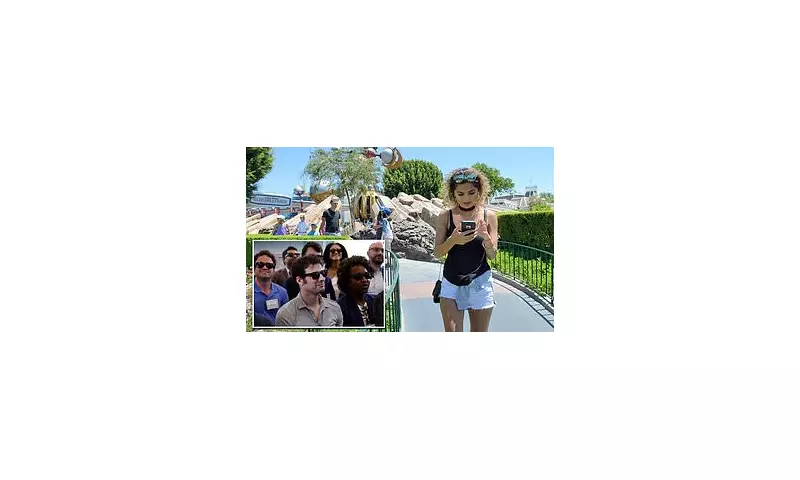
Walt Disney Imagineering has unveiled an ambitious plan to tackle what it describes as a growing threat to the magic of its theme parks: visitors constantly staring at their phones rather than enjoying the immersive experiences around them.
The Problem: Phones Shattering Shared Experiences
Bruce Vaughn, president of Walt Disney Imagineering, recently appeared on Disney's We Call It Imagineering YouTube series to address how mobile devices are damaging the collective experience that has defined Disney parks for generations. "You're there together with friends and family and people that you care about, and every time you have to look down at a device or a phone, it breaks that spell," Vaughn explained.
The executive acknowledged that the very technology designed to enhance modern life is inadvertently disrupting the carefully crafted magical environments Disney has spent decades perfecting. Rather than banning screens entirely, Disney has chosen a more innovative approach.

The Solution: AI-Powered Smart Glasses
Disney's surprising solution involves moving screens from visitors' hands directly onto their faces through AI-powered smart glasses developed in partnership with Meta. The collaboration focuses specifically on Meta's Ray-Ban smart glasses, which range in price from $379 to $800.
"We have a really wonderful partnership with Meta to leverage their Ray-Ban smart glasses for both guest facing applications and also behind the scenes design applications as well," Vaughn confirmed during the discussion.
The technology would allow guests to keep their phones securely in their pockets while still receiving real-time digital guidance through voice-driven assistance. The glasses feature built-in cameras, microphones, and speakers that essentially function as a virtual theme park guide directly in visitors' ears.
How the Smart Glasses Would Transform Park Experiences
Vaughn described numerous practical applications for the technology throughout Disney parks. Instead of tapping through apps or navigating digital maps, guests could simply look at their surroundings and ask questions aloud.
"The glasses can enhance the ways we tell stories for our guests, unlocking a world of information about the land that they're in," he said. "Just by looking around, I can ask questions about some of the architectural details, and I get the answer right in my ear."
The same technology would revolutionise shopping experiences within the parks. Asa Kalama, an executive creative director at Walt Disney Imagineering, elaborated: "Maybe I want to learn a little bit more about a merchandise item for my child. All I have to do is look at it and ask, 'Tell me more information about it,' and then, right in my ear, I get all of the product information."
Vaughn framed this technological shift not as adding more gadgets to the park experience, but rather as hiding technology more effectively. "If you can use extended reality, I never stop looking at the environment," he noted. "I'm in awe at the people I'm with. It's going to be less disruptive."
Mixed Reactions from Disney Enthusiasts
Despite Disney's enthusiasm for the project, some dedicated park visitors have expressed scepticism about the smart glasses solution. On online forums, several Disney enthusiasts questioned the practicality and widespread adoption of the technology.
One user commented: "To be honest a Ho-Hum. Regardless of the model and price range I ask what is the value other than as a short-term novelty. Not an exciting announcement. Very short term."
Another raised concerns about cost: "Because of the cost, it wouldn't be economically feasible to think a large percentage of guest adoption. Sure you may get an adult with a pair, but then the rest of the family would be missing out. I don't see a family of four having four pairs of these because those are expensive accessories."
A third user predicted limited practical application: "You get an A for imagination. Interesting piece of technology, sure. Practical, no. Limited applications, yes. Profitable? No. Expensive toy that will end up gathering dust on a desk or shelf."

Balancing Technology and Tradition
Vaughn stressed that Disney isn't pursuing technology simply for novelty's sake. "We're not just using technology for technology's sake," he insisted. "We're using it in service of that story that we're really going for."
The ultimate goal, according to Vaughn, is complete immersion. "If we're doing our jobs properly, all of the technology goes away and our guests get immersed in the story that we're trying to tell," he said.
Unlike phones that can be temporarily pocketed, the smart glasses would maintain a constant digital connection through cameras, microphones, and real-time AI processing of the wearer's visual field. However, Vaughn believes this will ultimately reinforce rather than disrupt shared experiences.
"Extended reality is going to reinforce the shared experience," he maintains, suggesting that the technology could mark the next evolution in how visitors interact with Disney's magical environments while preserving the wonder that has made the parks legendary.