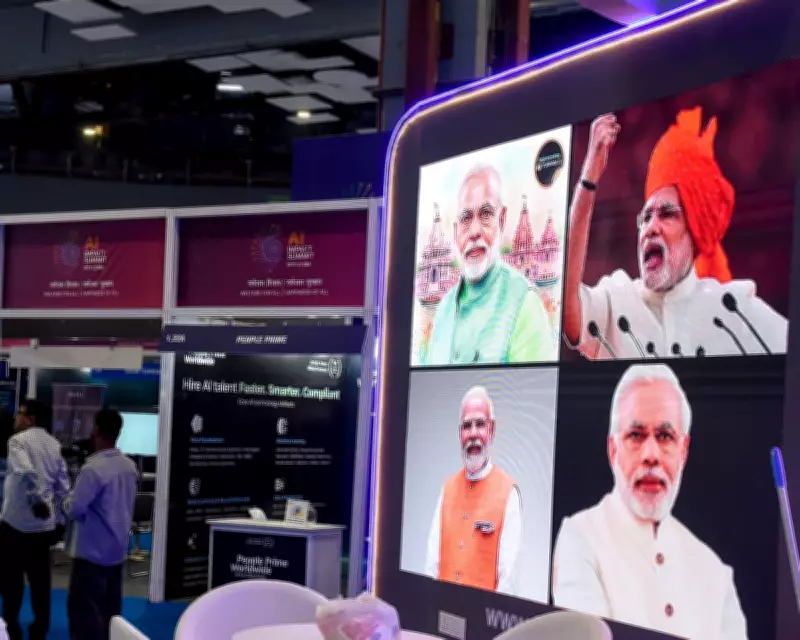
AI Summit in Delhi Ignites Fears Over Surveillance and Election Influence
Campaigners are raising alarms that Indian Prime Minister Narendra Modi could leverage artificial intelligence to enhance state surveillance and manipulate elections. This concern emerges as Silicon Valley tech billionaires descend upon Delhi for the AI Impact Summit, hosted by Modi, where leaders from the global south are vying for control over the rapidly evolving technology.
Global Leaders and Tech Titans Converge
During the week-long summit, attended by thousands of tech executives, government officials, and AI safety experts, figures like Sundar Pichai of Google, Sam Altman of OpenAI, and Dario Amodei of Anthropic will mingle with leaders from countries such as Kenya and Indonesia, where average wages fall below $1,000 a month. Former British Prime Minister Rishi Sunak and ex-Chancellor George Osborne are also present, advocating for increased AI adoption. Sunak has taken roles with Microsoft and Anthropic, while Osborne leads OpenAI's efforts to expand ChatGPT's user base beyond 800 million.
Modi, addressing the summit on Thursday, aims to position India as the AI hub for south Asia and Africa. Key topics include AI's potential to transform agriculture, water supplies, and public health, with ministers from Kenya, Senegal, Mauritius, Togo, Indonesia, and Egypt in attendance.

Dark Side of AI Enthusiasm
Civil liberties campaigners warn that Modi's push for AI has a darker side, citing risks of increased state surveillance, discrimination against minorities, and election interference. Despite Modi's rhetoric of "harnessing artificial intelligence for human-centric progress" and the summit's slogan "Welfare for all, happiness for all," critics remain skeptical.
Observers describe a clash between a new form of AI colonialism from U.S. tech firms and an alternative "techno-Gandhism," which focuses on using AI for social justice and benefiting marginalized communities. This Delhi meeting marks the first AI summit in the global south, following events in the UK, Korea, and France.
Safety Concerns and Global Dynamics
Safety remains a critical agenda item, with Yoshua Bengio, a leading AI expert, expressing fears about powerful AI systems enabling cyber- and bioweapons attacks. He emphasized the urgent need for global leaders to address these risks. Nicolas Miaihle, co-founder of AI Safety Connect, highlighted existential threats, noting the summit occurs amid AI-enabled warfare in Ukraine and the Middle East.
However, the Trump administration continues to resist binding regulations for U.S. AI companies, with no high-level representative expected from the White House. Sriram Krishnan, a senior AI policy adviser, is the highest-ranked U.S. speaker, making consensus on regulatory frameworks unlikely.
AI's Role in Education and Investment
Companies like Google are focusing on AI's educational applications in India, where large language models support multiple languages. Owen Larter of Google DeepMind noted that about 90% of teachers and students in India already use AI in learning, with 2 million students accessing free pro subscriptions. Google's investments include a $15 billion partnership with billionaire Gautam Adani for an AI datacentre hub in Visakhapatnam, featuring subsea cable connections.
United Nations Secretary-General António Guterres, speaking at the summit, warned against AI becoming a privilege of developed nations or a division between superpowers, stressing the need for inclusive access.
This summit, the fourth since its launch by Rishi Sunak in 2023, underscores the ongoing battle between technological advancement and ethical safeguards, with India at the forefront of shaping AI's future in the global south.